



Crypto tax reporting is no longer optional if you trade, stake, or use DeFi. Every swap, bridge, non-fungible token (NFT) sale, or crypto reward can create a taxable event, even if no funds hit your account. In fact, crypto has shifted from a simple buy-and-sell activity to multi-chain accounting that most people struggle to handle manually.
That is where crypto tax tools come in. However, these tools do more than just calculate gains in 2026. They can pull data from wallets, exchanges, and smart contracts, then convert that activity into clean, audit-ready reports. Nonetheless, without the right setup, your records break fast, and fixing them later could take hours or even days.
If you want accurate crypto tax reporting without stress, you need crypto tax software that matches your activity, your country, and your volume. Let’s dive into the best crypto tax tools that you can use for tax reporting, regardless of where you live across the world.
Why is tax reporting in crypto important?
Crypto has become widely integrated into the global financial sector. However, most jurisdictions now require users to perform crypto tax reporting for various reasons. The following are some of the reasons why crypto tax reporting is important:
- Avoid penalties and costly audits: Crypto activity has never been monitored by tax authorities as it is now. When your reports fail to conform to exchange data or on-chain records, you could be fined, audited, or subject to back taxes that accrue over time.
- Proper tracking of profits and losses: Without information on your actual gains, you cannot properly manage your portfolio. Crypto tax software computes cost basis on trades, swaps, and transfers to have actual performance.
- Handling intricate transactions with ease: There are various ways to handle tax for DeFi, NFTs, staking, and airdrops. In the absence of proper classification, you can either overpay or underreport income.
- Savings time during tax season: Wallet and exchange reconciliation is a day-long affair. With good crypto tax software, that can be done in minutes by automatically importing and calculating it.
- Staying compliant with regulations: Tax regulations vary in case you relocate or conduct business internationally. The appropriate software will produce the reports that are suitable for your jurisdiction with no manual modifications.
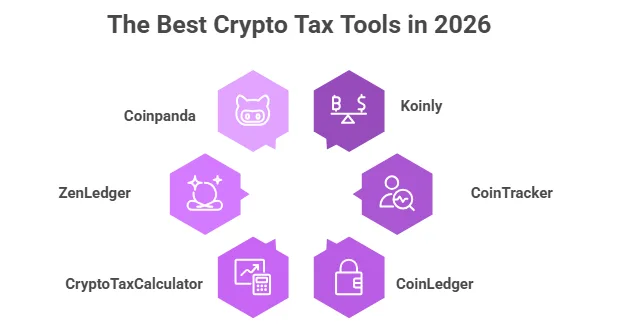
The 6 best crypto tax tools for 2026
The following are some of the best crypto tax tools that you can use for tax reporting across the world:
1. Koinly
Koinly is the most convenient crypto tax tool among international crypto users. The platform links to hundreds of exchanges, wallets, and blockchains, and automatically classifies transactions as trades, transfers, income, and expenses. This is important when you have to deal with assets distributed across various platforms.
The tool also supports DeFi and NFTs without disrupting your tax reports. It supports the import of complete crypto wallet histories, identifies transactions that are missing, and creates tax reports in more than 100 countries. In case you prefer to have a single tool that is applicable in nearly all situations, then Koinly can be a safe option.
Pros
- Great for international tax provisions.
- Wide integration and coverage.
- Manages tax reporting across DeFi, NFTs, and staking.
Cons
- It has high transaction volumes and a higher price.
- Requires manual fixes for complicated DeFi.
2. CoinTracker
CoinTracker is the most popular crypto tax tool that integrates portfolio tracking and crypto tax reporting. You are provided with real-time performance information and tax calculations. This assists you in managing the investments during the year, rather than at the time of tax filing.
This tool is particularly powerful for users who desire automation. It supports several exchanges and wallets. CoinTracker also auto-classifies numerous DeFi transactions. Its user-friendly interface enables data review and correction to be a lot easier compared to most competitors.
Pros
- Clean user experience
- Great automation and monitoring.
- Integrated portfolio insights.
Cons
- Has a U.S.-focused workflow.
- Higher tiers associated with higher charges.
3. CoinLedger
CoinLedger is a crypto tax reporting tool that concentrates on simplicity. This tool comes in handy when you need a quick and precise crypto tax reporting tool without the unwarranted complexity.
It links to big exchanges and wallets, and creates tax reports, ready to file with the IRS in a few minutes. This is perfect when you primarily deal with centralized platforms and would like to be able to export directly to filing software. CoinLedger also does not have a lot of features and is fast, which makes it perfect for tax season.
Pros
- Easy and quick installation.
- Easy report generation.
- Supports direct export to filing tools.
Cons
- Low-level sophisticated DeFi processing.
- Less detailed analytics.
4. CryptoTaxCalculator
CryptoTaxCalculator is designed to suit those users who are immersed in DeFi and NFTs. Most tools are not as precise as it is in managing complex types of transactions such as liquidity pools, yield farming, bridging, and NFT trading.
In case your trading is more than just basic trades, this software minimizes the chances of fragmented reports. It has the capability to handle high volumes of transactions as well as to calculate the correct basis of costs even in DeFi multi-step interactions.
Pros
- Great for DeFi and NFT tax reporting.
- Properly manages complicated transactions.
- Perfect for large crypto transaction volumes.
Cons
- Slight learning curve.
- Costs can increase when it is overused.
5. ZenLedger
ZenLedger is a more filing-based crypto tax software. It not only creates reports, but also assists those users who require professional assistance. You may upgrade to have CPA assistance that will be handy in case your tax scenario is complicated.
The platform also allows a vast number of crypto transactions, such as staking, DeFi, and NFTs. This tool is good for those interested in having software and optional human assistance on a single platform.
Pros
- CPA support available.
- Generates impressive crypto tax reports.
- Flexible service levels.
Cons
- The interface is outdated.
- It is more U.S.-centric.
6. Coinpanda
Coinpanda is intended to be used by international crypto users who have to work with various tax systems. It aids in reporting in most countries and localizes calculations to local tax regulations.
This renders it a good option when either you are residing overseas or when trading across jurisdictions. It is also capable of general crypto activity, but the depth of DeFi is a bit less than specialised tools.
Pros
- Strong international support.
- Multi-country reporting.
- Flexible pricing.
Cons
- Less developed DeFi tracking.
- The interface is not very smooth.
Features to consider when choosing crypto tax tools
To make the perfect choice of crypto tax reporting tools, you must consider these factors:
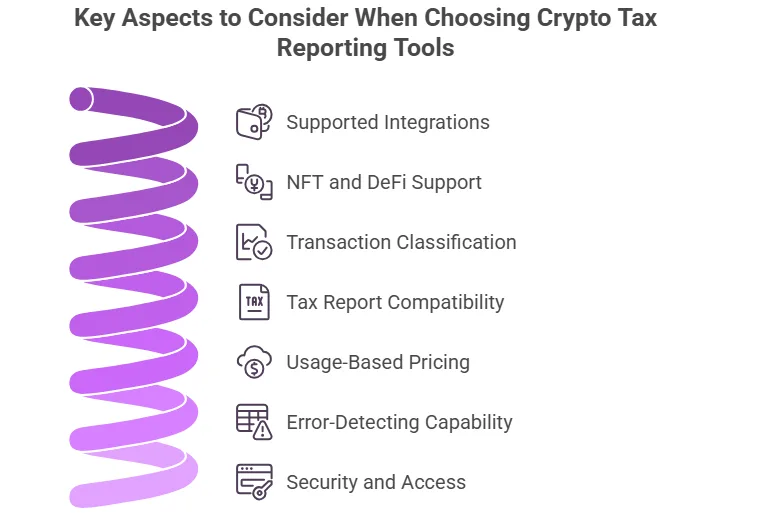
- Supported integrations (CSV and API): You require a crypto tax software that supports integration with all the exchanges, wallets, and dApps that you use. Lack of integrations creates a situation whereby you have to upload CSV files manually, thus creating more errors and wasting time.
- NFT and DeFi support: Some crypto tax tools do not handle smart contracts. When you are using liquidity pools, staking, or an NFT marketplace, you should select software that explicitly supports those activities.
- Accurate transaction classification: The crypto tax software should be able to appropriately label trades, transfers, income, and expenses. Misclassification translates to the wrong calculation of tax and potential compliance problems.
- Tax report compatibility: Ensure that the tool generates reports that are aligned with your filing process. Direct interconnection with filing software makes it easier to submit and eliminates errors.
- Usage-based pricing: The majority of the crypto tax reporting platforms are based on the number of transactions. Whether you stake or farm yield, you must go for a platform with scalable or unlimited plans to increase the volume of transactions quickly.
- Reconciling and error-detecting capability: The best crypto tax tool should indicate the absence of cost basis, recurring transactions, and transfers. This saves time by preventing the need for manual corrections.
- Security and access to data: You should go for crypto tax tools that are based on read-only API keys and strong authentication. Crypto tax software should not allow full control of your funds or external access.
Conclusion
Crypto tax reporting in 2026 does not have to be overwhelming or complicated. Instead, choosing the correct crypto tax tools can transform your disjointed transaction data into organized, compliant reports that you can rely on.
Whether you are going to consider Koinly, CoinTracker, CoinLedger, CryptoTaxCalculator, ZenLedger, or Coinpanda, make sure to pick one that fits your needs. But ultimately, most of these crypto tax tools will make your reporting seamless and effective.