


When someone loses crypto to a hack or a scam, it’s gone. There’s no customer support line to call and no government fund to fall back on. Banks have FDIC protection. Crypto doesn’t. That gap is exactly why crypto insurance platforms have become one of the most significant developments in digital asset security this year.
The good news is that real solutions now exist. Whether someone needs crypto wallet insurance, BitGo custodial insurance, or smart contract coverage, there are dedicated platforms built specifically to insure crypto assets. Here are five of the most established ones worth knowing.
Nexus Mutual DeFi insurance: Community-owned coverage for smart contracts
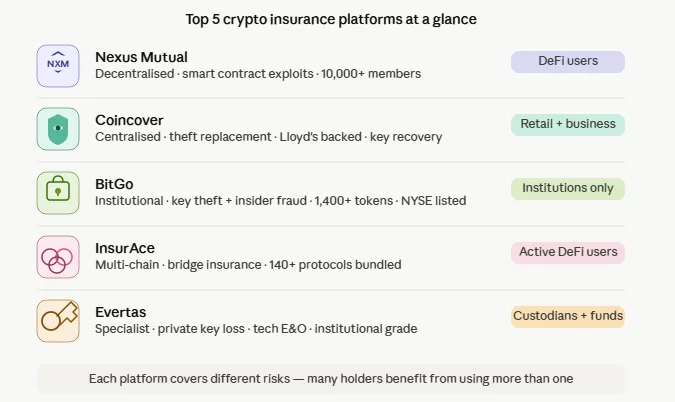
Nexus Mutual is the oldest and largest decentralized crypto insurance platform. It launched in 2019, operates on the Ethereum blockchain, and is structured as a mutual, meaning the members own it and vote on claims together. No corporate insurance company sits in the middle.
Members purchase NXM tokens to join the mutual, and those tokens represent their membership stake. Members then stake their NXM to underwrite risk across the protocol’s coverage pools. That pool backs Nexus Mutual DeFi coverage for smart contract exploits and protocol hacks. When someone files a claim, the community votes on whether it gets paid.
What separates it from traditional insurance is full transparency. Every dollar in the pool, every active policy, and every claim decision is visible on-chain. Anyone can verify it at any time.
Key details:
- Coverage starts under 1% annually for select lower-risk protocols, paid directly in crypto
- Over 10,000 members participate, from individual holders to institutional funds
- It’s protected over $6 billion in crypto assets
- It has paid out tens of millions in claims through events like the FTX collapse and Terra Luna crash
Nexus Mutual DeFi coverage doesn’t include phishing attacks or lost private keys. It’s built for cases where a protocol itself fails or gets exploited. For anyone using DeFi platforms like Uniswap or Compound, smart contract insurance through Nexus Mutual is one of the most battle-tested options available. Nexus Mutual DeFi remains the benchmark for decentralized coverage heading into 2026.
Coincover wallet protection: Real-time monitoring for your crypto
Coincover wallet protection works differently from Nexus Mutual. It’s a centralized service, meaning there’s an actual company managing the coverage rather than a decentralized community.
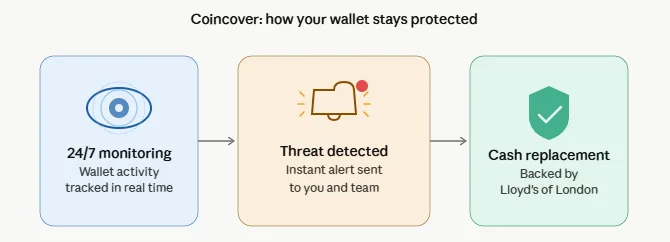
Coincover monitors wallets continuously and sends alerts at the first sign of suspicious activity. If theft occurs, it provides a cash replacement. If a user loses access to their wallet keys entirely, Coincover steps in to help recover them.
This crypto wallet insurance is backed by Lloyd’s of London through syndicates including Atrium, TMK, and Markel. That’s the same marketplace that insures satellites and offshore oil rigs, so it’s serious institutional backing applied to a crypto product.
What makes Coincover wallet protection practical:
- It covers most major cryptocurrencies, including Bitcoin, Ether, and all ERC-20 standard tokens
- It is trusted by over 600 organisations worldwide, from crypto institutions to government bodies
- It meets FIPS 140-2 Level 3 security standards for cold storage
- It works alongside BitGo’s institutional wallet infrastructure
If a crypto exchange or wallet app shows a “Protected by Coincover” badge, the user funds there are covered against security breaches. It’s a simple but meaningful thing to check before choosing where to store assets.
Coincover is also one of the few crypto wallet insurance solutions backed by regulated, institutional-grade underwriters, which separates it from purely on-chain alternatives.
BitGo custodial insurance: The institutional-grade safety net
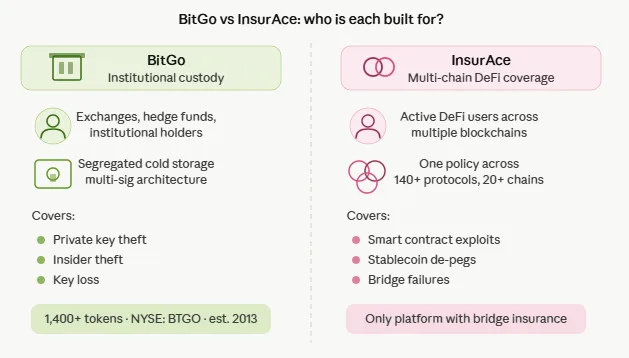
BitGo custodial insurance is built for a specific type of user: institutions, hedge funds, exchanges, and serious holders who prefer not to manage their own private keys.
BitGo has been operating since 2013, which makes it one of the longest-running names in crypto custody. It went public on the NYSE in January 2026 under the ticker BTGO. It supports over 1,400 tokens and handles a significant share of global Bitcoin transactions. Its flagship product, “Qualified Custody,” stores client assets in segregated cold storage accounts, completely offline, secured through BitGo’s battle-tested multi-signature architecture.
BitGo custodial insurance covers:
- Theft or copying of private keys
- Insider theft or dishonest acts by employees or executives
- Key loss
That coverage comes included for eligible custodial clients at no extra cost. For clients using hot wallets or self-custody setups, additional crypto theft coverage is available through Coincover wallet protection, a partnership that dates back to 2019.
BitGo isn’t designed for someone casually holding a small amount on a phone app. It’s the infrastructure backbone that major exchanges and crypto companies rely on to keep client funds safe.
Smart contract insurance through InsurAce: One policy across multiple chains
InsurAce is built for active DeFi users operating across multiple blockchains at once. Instead of buying separate smart contract insurance for every protocol they use, they can bundle it all into one policy.
The platform maintains coverage for over 140 protocols across more than 20 chains, including Ethereum, Binance Smart Chain, Avalanche, and Polygon.
It also offers something no other platform on this list provides: bridge insurance. When tokens transfer from one blockchain to another, there’s a brief window of vulnerability. InsurAce covers losses that happen during that process.
The Portfolio Cover product is the main draw:
- Coverage includes smart contract exploits, stablecoin de-pegs, custodian risks, and bridge failures
- Multiple protocols can be bundled into a single policy
- INSUR token holders vote on claims and earn rewards for participating
- It’s one of the few multi-chain crypto insurance platforms with bundled pricing
Smart contract insurance through InsurAce is ideal for anyone juggling yield farming on Ethereum, token swaps on Polygon, and staking on Avalanche, all under one plan. InsurAce takes a lot of the complexity out of insuring crypto assets spread across several platforms at once.
Crypto theft coverage with Evertas: Covering what others won’t
Many traditional insurance companies either skip crypto entirely or offer policies with significant gaps. Evertas was built specifically to fill those gaps.
It’s the first insurance company focused solely on blockchain and cryptocurrency users. Its coverage goes well beyond standard hack protection. Evertas insures for loss of private keys, something almost no other insurer will touch.
Losing a private key is like losing the only copy of a vault combination. Once it’s gone, the assets inside are locked away for good. That kind of crypto theft coverage is rare, and Evertas is one of the only places that offers it.
It also handles technology errors and omissions, including:
- Smart contract failures
- Exchange outages
- Hardware malfunctions
These are high-risk categories for crypto holders that standard policies skip entirely. Evertas works with custodians, crypto funds, exchanges, and financial institutions. For anyone evaluating where to store funds, knowing whether a platform carries Evertas crypto theft coverage is a meaningful signal about how seriously they take protection.
Wrapping up
Crypto theft coverage, smart contract exploits, lost wallet keys, and exchange hacks are all real risks that come with holding digital assets in 2026. The difference now is that crypto insurance platforms exist specifically to handle all of them.
Whether someone’s deep into DeFi protocols or just holding assets on an exchange, knowing how to insure crypto assets properly isn’t something to put off. It’s part of treating digital wealth with the same care as any other serious financial holding.