


Crypto theft hit a painful milestone in 2025. Over $3.4 billion was stolen across the industry in 2025, and the majority of it came from a single type of wallet. That number alone is reason enough to understand where digital assets actually live and how to protect them properly.
Choosing a secure cryptocurrency wallet isn’t just a technical decision. It’s a financial one. The difference between a secure setup and a vulnerable one can mean losing everything overnight, not because of bad luck, but because of where the keys were stored.
What is a secure crypto wallet?
A crypto wallet doesn’t hold coins the way a bank account holds dollars. Bitcoin and Ethereum only exist on the blockchain. What the wallet stores is a private key, which is the digital proof of ownership that allows someone to send or receive funds. Lose that key and the crypto is gone. Hand it to the wrong person and it’s gone too.
That key is the only thing standing between someone and their funds.
Wallets split into two types. With a custodial wallet, a third party like an exchange holds the keys, so the user is trusting someone else to keep them safe. With a self-custodial wallet, the user holds the keys directly. It’s a bit like the difference between letting a bank hold your valuables and keeping them locked at home yourself. More responsibility, but nobody else has access.
Cold storage wallet vs. hot wallet: What’s the difference?
This is the most important distinction in crypto security, and it comes down to one thing: internet connection.
A hot wallet stays online at all times. That includes mobile apps, browser extensions, and exchange accounts. They’re free, easy to use, and practical for small amounts or regular transactions. The downside is that anything online can be targeted.
A cold storage wallet keeps private keys completely offline. There’s no network connection to exploit, no way for malware or phishing attacks to reach the keys remotely. The only realistic way to steal from a cold storage wallet is physical access, and even then, PIN codes and tamper detection make it extremely difficult.
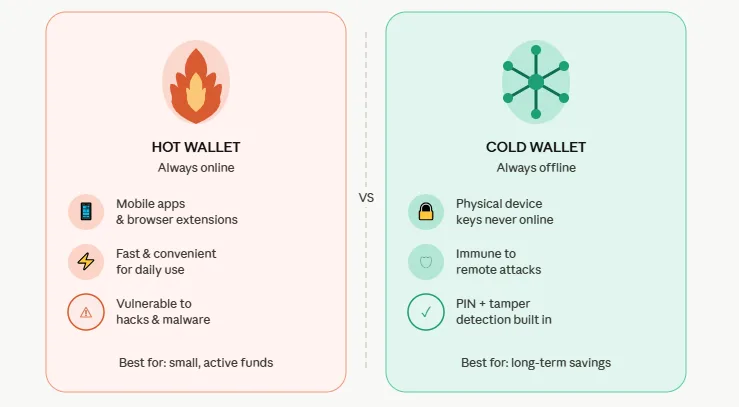
Wallet-related attacks accounted for the largest share of crypto theft by value in both 2025 and 2026. Cold storage incidents almost always came down to physical theft or user error, not remote hacking. The practical approach for anyone holding a meaningful amount of crypto is to use both: smaller, active funds in a hot wallet and long-term holdings in a cold storage wallet. It works the same way a checking account and a savings account do.
Hardware wallet security features to know
Hardware wallets are the most widely used form of cold storage. They’re physical devices, often the size of a small USB drive, that keep private keys offline and away from any network. Not all devices are built the same, though, and the hardware wallet security features across different products vary quite a bit.
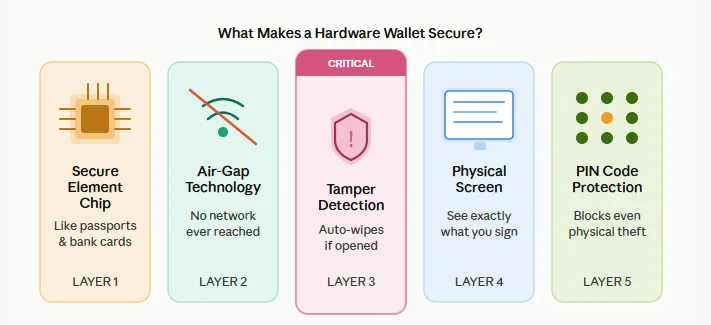
The foundation of any hardware wallet is the Secure Element chip, the same type found in passports and bank cards. It stores private keys in a tamper-resistant environment that resists physical probing and brute-force attacks.
On top of that, high-end wallets add air-gap technology, meaning they never connect to USB, Bluetooth, or Wi-Fi at all. Transactions are signed offline and communicated only through QR codes.
Tamper detection adds another layer. Sensors inside premium devices wipe the wallet completely if someone tries to open it, and even the packaging is designed to show any interference during shipping.
Better wallets also include a physical screen so users can see exactly what they’re signing before confirming. Earlier models suffered from “blind signing,” where full transaction details weren’t visible to the user, making it easy for attackers to manipulate what actually got approved.
Hardware wallet security certifications explained
Hardware wallet security is measured using a standard called Common Criteria EAL, which stands for Evaluation Assurance Level. Ratings run from EAL1 to EAL7, and the higher the number, the more rigorous the independent testing.
Ledger devices use EAL5+, which is roughly equivalent to the security level found in standard bank cards. Trezor Safe 3 reaches EAL6+, a step above that, with formal verification of the entire security architecture. EAL7 is the highest level achievable, military and government grade, requiring formal verification of both design and implementation.
Most consumer electronics never come close to EAL6, so hardware wallets operating at EAL5+ and above already offer protection that goes well beyond typical digital products.
EAL7 certified wallet: NGRAVE ZERO
Only one consumer crypto wallet has ever achieved EAL7 certification: the NGRAVE ZERO. As the only EAL7 certified wallet available to the public, it was designed entirely for people who won’t accept a compromise on security.
It’s completely air-gapped. No USB port, no Bluetooth, no NFC. The only way to communicate with it is through QR codes. The operating system was built from the ground up by NGRAVE’s own engineers, removing the vulnerabilities that come from using off-the-shelf software.
Key generation is also different from any other wallet on the market. The device combines the user’s fingerprint, a hardware random number generator, and input from a built-in light sensor to create what NGRAVE calls a “Perfect Key.” No two are ever the same, and the process can’t be duplicated remotely.
The backup system, called the GRAPHENE, uses two stainless steel plates that are fire-resistant and waterproof. Neither plate alone reveals anything useful. Both are needed together to recover the wallet, which means one stolen plate doesn’t compromise the funds.
Best crypto wallet in 2026: Top picks by type
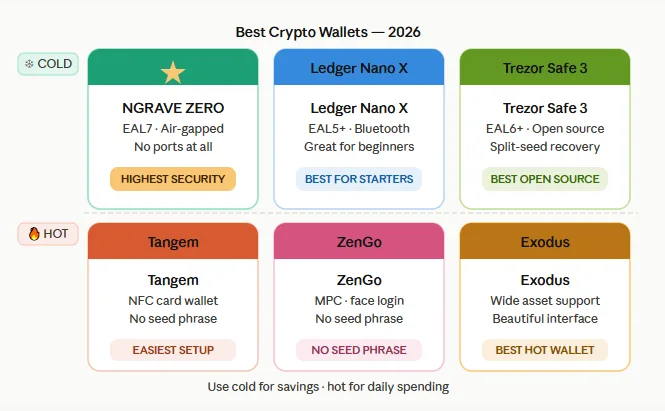
Not every wallet suits every person. The NGRAVE ZERO is built for those who want the absolute highest level of protection, with EAL7 certification and a fully air-gapped design that leaves no digital entry point. Ledger’s Nano X and Flex are the go-to starting points for anyone new to hardware wallets, with solid asset support and an app that doesn’t require a technical background to navigate. Trezor Safe 3 sits in a strong middle ground, open-source from top to bottom, EAL6+ certified, and with a split-seed recovery option that adds a useful extra layer.
Tangem takes a different approach entirely. It’s a wallet the size of a bank card, taps via NFC, and skips the seed phrase setup that trips up a lot of beginners. ZenGo solves the same problem on the software side, using Multi-Party Computation so there’s no seed phrase to lose or misplace, with facial recognition handling login. Exodus stays at the top of the hot wallet category heading into April 2026, largely because it’s one of the few that manages to look good, work well, and support a wide range of assets without friction.
How to approach crypto storage in 2026
Getting this right doesn’t take expertise. A hardware wallet at EAL5+ or above already puts someone well ahead of the majority of crypto holders in terms of protection, and setup is far less technical than it used to be. Most devices now walk users through the process from the first screen.
The most practical strategy is a hybrid one: a hot wallet for day-to-day spending and a cold storage wallet for anything worth protecting long-term. Hardware wallet security has improved to the point where even entry-level devices now offer protection that used to require institutional setups. Getting started is simpler than it’s ever been.