

Crypto used to be a game of who had the loudest hype. That’s changed. The projects that led the space in 2025 weren’t the ones with the most followers. They were the ones actually making money.
That shift matters because it separates real adoption from noise. And the best way to measure it is through crypto protocols revenue.
What crypto protocols revenue actually means
A crypto protocol is a blockchain-based financial service, whether fully decentralized code or a company operating primarily on-chain. These protocols earn money through fees, the same way any other business does.
When analysts refer to crypto protocols’ revenue, they mean what a protocol actually keeps after paying out its users and liquidity providers. It’s the on-chain version of a profit margin, and it’s distinct from total fees collected. All figures here use CoinGecko’s protocol revenue methodology unless stated otherwise. Revenue is what proves these things actually work.
The top 10 crypto protocols by revenue
Based on verified data from CoinGecko Research and DefiLlama, here’s who led and why.
1. Tether (USDT)
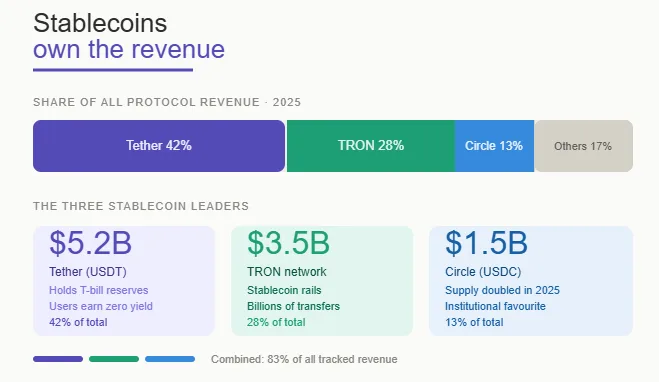
Tether is the most widely used dollar substitute in crypto. It generated approximately $5.2 billion in protocol revenue in 2025, capturing roughly 42 percent of total revenue across all tracked crypto protocols.
It works like a bank. Users park money in USDT, Tether holds the real dollars in reserve assets like Treasury bonds, and collects the interest. Because USDT holders receive no yield, nearly all of that interest counts as protocol revenue. No product launches needed. Just volume and interest rates.
2. TRON
TRON is the blockchain network that billions of USDT transactions travel through daily. Every transfer pays a small fee to the network, and with the sheer volume TRON handles, those fees add up to one of the largest revenue totals in the industry.
It’s not flashy, but it’s consistent. TRON generated approximately $3.5 billion in 2025, almost entirely driven by stablecoin activity running on its rails.
3. Circle (USDC)
Circle runs USDC, the second-largest stablecoin in crypto. It earns money the same way Tether does, through interest on the real-dollar reserves backing every USDC in circulation.
USDC supply more than doubled through 2025, which directly lifted Circle’s earnings past one and a half billion dollars. As regulatory clarity improves globally, USDC is increasingly the stablecoin institutions trust.
4. Hyperliquid
Hyperliquid is a fully on-chain trading platform where users can place leveraged bets on crypto prices without any middleman. No broker, no exchange account. Just a wallet and a trade.
It generated approximately $843 million in revenue in 2025, with total trading volume reaching nearly $3 trillion for the year, up from under $600 billion the year prior. DefiLlama’s annualized revenue figure for Hyperliquid sits at roughly $747 million, reflecting a point-in-time snapshot rather than the full-year total. Either way, it was the strongest purely decentralized revenue story in the top ten. That momentum has carried into 2026, with Hyperliquid recording over $490 billion in trading volume in Q1 2026 alone.
5. Pump.fun
Pump.fun is a token launchpad on Solana. Anyone can create and list a new crypto token in under a minute, and every token created and traded on the platform generates fees for the protocol. Pump.fun was a top earner in 2025. Its revenue has since declined sharply through Q1 2026.
It pulled in over $500 million in 2025 from retail activity alone, with no institutional backing, just regular users launching meme coins and trading them. However, that story changed sharply through the first quarter of 2026. Platform revenue fell roughly 75 percent year-over-year, dropping from daily peaks above $7 million in 2025 to around $1 to $1.5 million through Q1 2026, as the memecoin cycle cooled and competition on Solana intensified. Pump.fun remains a case study in how quickly retail-driven revenue can scale, and how quickly it can fade.
6. Ethena (USDe)
Unlike traditional stablecoins that just sit on dollar reserves, Ethena’s USDe uses delta hedging to generate yield. The mechanics are involved, but the user experience is simple: you hold it, and it pays you.
Revenue jumped over 200 percent in a single quarter last year, a pace few protocols matched. It has not slowed down much since, making Ethena one of the names serious DeFi watchers keep coming back to in 2026.
7. Sky (formerly MakerDAO)
DAI has no company behind it and no government backing it. Users mint it by locking up crypto as collateral, and Sky takes a cut on the loans. That makes it one of the rare entries on this list where the revenue model is genuinely decentralized.
The Endgame rebrand has been messy by most accounts, but the numbers have held up. Sky kept producing steady revenue through all of 2025 and still sits at the foundation of DeFi’s stablecoin infrastructure well into 2026.
8. PancakeSwap
PancakeSwap lets users trade one crypto token for another in seconds, no account needed and nothing to sign up for. The protocol takes a small cut on each trade.
It runs primarily on BNB Chain and has one of the largest active retail user bases in DeFi globally. PancakeSwap has also expanded into derivatives trading and cross-chain swaps, widening the ways it earns fees beyond basic token swaps.
9. Aave
Aave runs a two-sided market: some users deposit crypto and earn interest on it, while others put up collateral and borrow against it. No bank sits in the middle, just code.
Active loans on Aave peaked at approximately $29 billion in 2025, doubling from the year before. By year-end, it held more than 60 percent of all DeFi lending activity and had expanded across more than fifteen blockchain networks. Aave’s native stablecoin GHO has continued to grow as a revenue stream through the first months of 2026.
10. Phantom Wallet
Phantom started as a simple crypto wallet for Solana users. It has grown into a multi-chain wallet that earns revenue by taking small fees when users swap tokens directly inside the app.
It generated over $22 million in a single month in 2025. For a wallet, that’s a meaningful number. It reflects just how many people are actively using it for daily crypto activity, not just storage.
DeFi annualized revenue and why it’s the metric that matters
DeFi annualized revenue has become the standard way analysts judge whether a protocol is genuinely sustainable. It takes a protocol’s recent earnings and projects them across a full year, cutting through the noise of one-off spikes.
It’s also what separates the top ten from the thousands of protocols that technically exist but generate nothing. DeFi annualized revenue is proof of consistent usage, and through 2025 and into 2026, that’s what capital has followed.
Nexus Mutual, Coincover protection, and BitGo insurance: The safety layer
As protocol revenue grows, so does the money sitting at risk inside these platforms. That’s where protection infrastructure becomes essential.
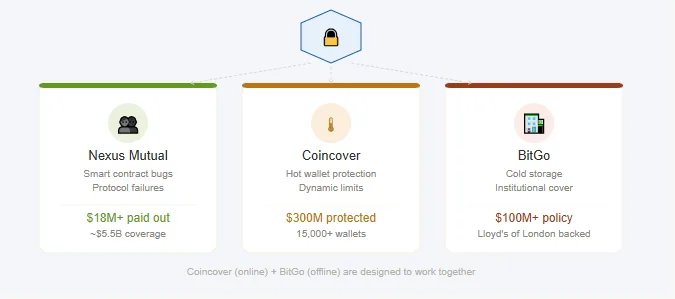
Nexus Mutual takes a different approach to insurance: instead of a company underwriting risk, members put their own capital on the line to back coverage for hacks, smart contract bugs, and protocol failures. So far, it has paid out over $18 million in claims, with cumulative coverage approaching $5.5 billion.
Coincover protection covers hot wallets with a dynamic model that adjusts limits as crypto prices move. Backed by Lloyd’s of London, it currently protects over $300 million across more than 15,000 wallets.
BitGo insurance handles the institutional side, with a Lloyd’s-backed cold storage policy starting at $100 million. The two work together by design: Coincover covers online wallet risks, BitGo covers offline storage.
What the top 10 tells us
Crypto protocol revenue isn’t just an analyst metric. It’s the clearest signal of which projects are genuinely being used, through every market cycle.
The top ten read like a cross-section of real financial services: stablecoins, trading, lending, wallets, and insurance. The protocols that held their revenue through the full year weren’t the most speculative. They were the ones tied to consistent economic activity.
Pump.fun’s 2026 decline illustrates the flipside: retail hype can generate impressive short-term numbers, but without repeat usage, it doesn’t last. That distinction is what separates durable businesses from one-cycle stories, and through the first months of 2026, it’s what capital has continued to follow.