


In an exclusive chat with AltCoinDesk, Leila Salieva, the co-founder and CEO of Sombrero Galaxy Agency, delved deep into her journey in the blockchain space. Starting her career in the industry back in 2017, she has juggled different roles, ranging from building a blockchain division inside a major fintech firm to actively contributing to DAOs like Horizen and ApeCoin and others.
In the following interview, Salieva shared her thoughts on what actually translated from Web2 to Web3 marketing, the role of AI-driven marketing, DAO governance, and building a brand that lasts in an industry infamous for its hype cycles. The interview follows below.
Interview with Leila Salieva
1. You’ve been in marketing for 15+ years and entered Web3 early in 2017 – what did you see then that most marketers completely missed?
In 2017, many traditional marketers overlooked a major opportunity. Cryptocurrency wasn’t just another investment avenue; it has essentially revolutionized how we perceive value. Coming from a background in Web2 or traditional tech, the focus had primarily been on customer acquisition costs and sales funnels, reducing users to mere numbers.
However, as I dabbled myself in Web3, I recognized a significant transformation – the transition from “users” to “owners.” While some marketers rejected tokens as just trends, I saw them as a powerful means to unite brands and communities.
In Web3, your community is not just at the base of a funnel – they are your partners, advocates, and essential players in the journey. Identifying this shift early on was a decisive turning point for me and has profoundly influenced the successful strategies we implement today at Sombrero Galaxy Agency. Collaboration is the name of the game now, and I’m proud to be at the forefront of this movement!
2. What actually translates from Web2 marketing into Web3 – and what completely breaks?
What translates: Human psychology, the need for strong storytelling, and, of course, clear brand positioning. People still want to know why you are building, what problem you are solving, and how it makes them feel. A confusing UI/UX or a weak narrative killed as many Web3 projects as Web2 products.
What completely breaks: The top-down broadcast model. In Web2, you pay platforms (like Google or Meta) to shout at consumers. In Web3, if you try to “shout” at a community without offering native value, transparency, or co-owning, you will be rejected immediately.
Furthermore, traditional data hoarding and cookie-based tracking are broken completely. Web3 marketing relies on on-chain analytics, wallet profiling, and community engagement metrics (like Discord sentiment and governance participation) rather than invasive third-party data. You don’t acquire a user; you recruit an active participant into your ecosystem.
3. Everyone is “adding AI” to their stack right now – what does real AI-driven marketing look like versus just surface-level automation?
Surface-level automation involves using AI as an advanced typewriter—producing generic blog posts or scheduling social media tweets. While it’s a productivity tool, it lacks transformative impact.
Real AI-driven marketing is about predictive intelligence and hyper-personalization at scale. At Sombrero Galaxy Agency, we look at AI as an engine for dynamic strategy.
For example, true AI marketing involves analyzing massive datasets of on-chain behavior, combined with off-chain sentiment, to predict market trends before they peak. It looks like dynamic audience segmentation, where messaging adapts in real time based on a user’s wallet history.
4. You’ve had a seat at the table in DAOs like Horizen and ApeCoin – how different is governance in practice versus the idealized vision?
The idealized vision of a DAO is a beautiful, frictionless utopia of pure decentralization where every voice carries equal weight and decisions happen organically. In practice, DAO governance is messy, highly political, and often suffers from immense friction.
Having actively participated in DAO governance, I can tell you that voter apathy and whale dominance are actually real challenges. The reality is that not everyone has the time or context to vote on every proposal.
We are seeing a necessary shift toward delegated voting and working groups (subDAOs) to execute tasks efficiently. The idealized vision held that we could eliminate human coordination problems with code; the practical reality has taught us that human coordination requires intensive community management, clear communication frameworks, and robust marketing to keep stakeholders engaged.
It’s a work in progress, but it remains the most exciting experiment in organizational structure today.
5. In a space driven by hype cycles, how do you build a brand that actually lasts beyond one market cycle?
Building a resilient Web3 brand requires a relentless focus on the underlying product and the core community. You do this by over-communicating during downturns, shipping consistently, and delivering tangible value that doesn’t depend on token price action. At our agency, we advise clients to build a “moat of trust.”
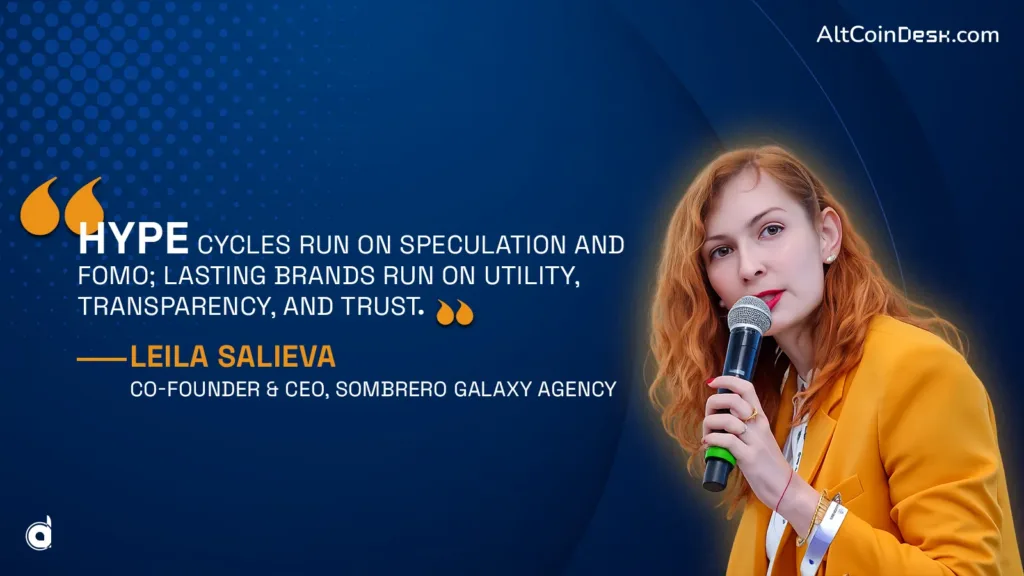
If your entire brand identity is tied to a bull run, you will collapse when the market cools. If your brand is tied to solving a genuine problem and fostering a deeply engaged, aligned community, you will not only survive the winter – you will dominate the next cycle.
6. What does a successful immersive brand experience actually look like in 2026?
In 2026, we are thankfully moving past the clunky, isolated “metaverse” gimmicks of the early 2020s. Today, a successful immersive brand experience is seamless, interoperable, and intensely “phygital” (blending physical and digital).
It looks like augmented reality (AR) is deeply integrated into our daily mobile and wearable devices, where digital assets overlay the real world. A brand experience today might involve purchasing a physical product that unlocks a dynamically evolving AI-generated digital twin or access to a token-gated community.
The key is spatial computing combined with blockchain verification. Users don’t want to log into a separate, empty digital room anymore. They want their digital identity, their NFTs, and their brand loyalty rewards to follow them seamlessly across platforms, ecosystems, and real-world activations.
7. What advice would you give to women trying to break into leadership roles in crypto today?
Don’t wait for permission or an invitation. The beautiful thing about Web3 is its open-source, permissionless ethos. If you see a problem, propose a solution. Join DAOs, participate in governance, write threads, and build your proof-of-work in public.
Technical fluency is a superpower, even if you aren’t a developer. You don’t need to write Solidity code to lead, but you must understand the mechanics of smart contracts, tokenomics, and consensus mechanisms to earn respect and make strategic decisions.
Final word for all the girls: It’s true that crypto can still feel like a boys’ club. However, you need to just find your tribe, amplify each other’s voices, and claim your seat at the table. Your unique perspective is exactly what this industry needs to reach mainstream adoption.