


So, governors are now crypto cops? America’s prediction market gold rush has finally gotten so out of hand that state governors are grabbing their legislative pens and signing executive orders like their careers depend on it. And honestly? Maybe they do.
The Illinois EO prediction markets saga kicked off on April 20, 2026, when Governor JB Pritzker quietly dropped Executive Order 2026-04, barring state employees, officers, appointees, and board members from using confidential government information to place bets on prediction platforms like Kalshi and Polymarket.
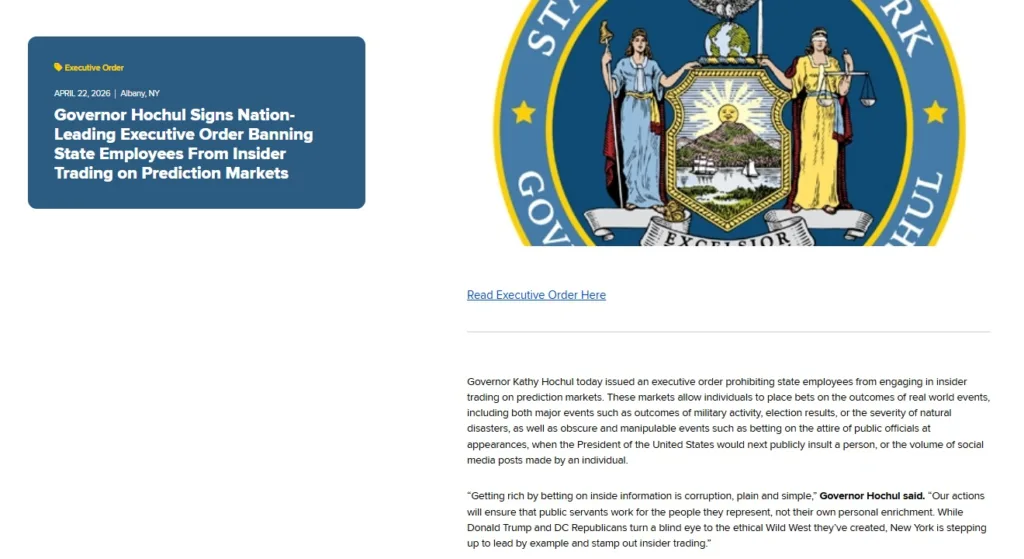
Two days later, on April 22, New York Governor Kathy Hochul went one louder, signing Executive Order 60 and declaring it the strongest such protection in the nation. Not to be left out of the history books, California’s Gavin Newsom had already set the tone back in March, banning gubernatorial appointees, their spouses, children, business partners, and what appears to be anyone who has ever shared a meal with a state official from profiting via inside information on prediction platforms.
Three governors. Three executive orders. One very uncomfortable question for the rest of us: what exactly has been going on in these prediction markets?
Wait, what even are these things?
If you have been living your best life away from financial Twitter and crypto Telegram groups, here is the short version. Prediction markets are platforms where users trade on the outcomes of real-world events. We are talking elections, military activity, natural disasters, sports results, and yes, apparently, what a public official will be wearing at their next press conference. Platforms like Kalshi and Polymarket have turned event-based speculation into a product, and the CFTC, the federal body that oversees commodities and derivatives, has given them the regulatory green light to operate nationally as legitimate event contracts.
By March 2026, these platforms were clocking a combined monthly trading volume of $23.6 billion. That is not a typo. Twenty-three point six billion dollars in a single month, wagered on everything from whether Nicolás Maduro would still be Venezuela’s president by Tuesday to the precise timing of a military strike in Iran.
Which, when you say it out loud, starts to sound less like a financial innovation and a lot more like someone left the casino door open inside the Pentagon.
The trades that made everyone nervous
Here is where the story gets genuinely uncomfortable. In January 2026, an anonymous trader pocketed more than $400,000 betting that Nicolás Maduro would soon be removed from power. Fine, maybe someone just had strong geopolitical instincts. But then reporting surfaced showing more than $1 billion in what observers described as perfectly timed bets around the war in Iran, including wagers tied to the location and timing of military strikes and the status of the Strait of Hormuz.
That is not stock market intuition. That is either the luckiest run of speculation in history, or something far more troubling is happening at the intersection of non-public government information and decentralized betting infrastructure.
Governor Hochul was not subtle about what she thinks. In her official announcement, she stated plainly:
Getting rich by betting on inside information is corruption, plain and simple. Our actions will ensure that public servants work for the people they represent, not their own personal enrichment. While Donald Trump and DC Republicans turn a blind eye to the ethical Wild West they’ve created, New York is stepping up to lead by example and stamp out insider trading.
The phrase “ethical Wild West” has since been doing a lot of heavy lifting in political conversations, and honestly, it earns its keep.
Illinois went first, quietly
Before New York grabbed the headlines, Illinois set the tone with Pritzker’s EO on April 20. The Illinois EO prediction markets ban is notably broad. It covers state employees, officers, board members, and appointees, and it explicitly prohibits not just placing insider bets but also sharing confidential information so that someone else can place those bets. No proxies, no middlemen, no helpful tips over dinner.
Pritzker’s reasoning echoed a familiar frustration. With federal oversight that he and other Democratic governors view as lax under the current administration, states feel they have no choice but to fill the gap themselves. The Illinois EO on prediction markets builds on existing state ethics law and signals that Illinois is not willing to wait for Washington to sort this out.
The Trump administration, for its part, has not been sitting still either, though its approach has been the opposite of restrictive. On April 2, 2026, the CFTC, operating under its current leadership, filed lawsuits against Arizona, Connecticut, and Illinois, challenging their cease-and-desist orders against Kalshi and Polymarket as unconstitutional overreach under federal jurisdiction.
Connecticut’s Attorney General called these lawsuits “recycled industry arguments” that courts had already rejected. The legal ping-pong match between federal preemption claims and state gambling authority continues, and nobody has a definitive answer on who wins this one.
Nevada did not need an executive order. It got a court
While governors were busy signing papers, Nevada went ahead and got a 5-0 ruling from its state court that halted Kalshi’s operations on sports, politics, and entertainment contracts within the state. This followed a complicated sequence involving a federal injunction that was initially granted, then reversed, then remanded back to the state court by a federal judge who determined the claims arose under Nevada gaming statutes rather than federal commodity law.
By March 21, 2026, a 14-day temporary restraining order was in place, and Kalshi was complying while appealing to the Ninth Circuit. Polymarket had already geo-blocked Nevada users before things got that far.
Nevada’s aggressive posture reflects a tension that runs through all of this. States that have built multibillion-dollar sports betting industries, with licensing requirements, tax revenues, and consumer protections, are watching prediction markets hoover up roughly $600 million in potential tax revenue without operating under the same rules. That is a financial grievance dressed up in a legal argument, and it is not going away.

Kalshi started policing its own users, sort of
On the same day Hochul signed her executive order, Kalshi announced it had suspended three congressional candidates for what it described as political insider trading, specifically placing bets on their own races. One of those candidates, Mark Moran, who is running in the Democratic primary for Virginia’s U.S. Senate seat, said publicly that he wanted to get caught. Whether that counts as integrity or a publicity strategy is left as an exercise for the reader.
This came after Kalshi disclosed in February 2026 that it had opened around 200 investigations and expelled or suspended several accounts for insider trading activity. Fines have included a $6,229 penalty paired with a five-year ban and a $539 fine with a similar suspension. A California gubernatorial candidate was also previously banned from the platform.
Kalshi policing its own users while simultaneously fighting state regulators in court is a genuinely strange position. It is the equivalent of a casino telling its own dealers they cannot count cards while arguing the state has no right to regulate the casino at all.
The angle nobody is talking about loudly enough
Here is something worth slowing down on. Prediction markets are not purely a Wall Street product. Polymarket, one of the two dominant players, runs on blockchain infrastructure. Its contracts are settled in USDC, a dollar-pegged stablecoin. When you place a bet on Polymarket, you are interacting with smart contracts on a decentralized network, not filing a form with a broker.
This matters for the regulatory conversation in ways that state-level executive orders do not fully address. An anonymous trader making $400,000 on a perfectly timed political bet and doing so through a crypto-native platform creates an evidentiary challenge that is qualitatively different from tracking a suspicious options trade at a traditional brokerage. Blockchain transactions are pseudonymous by design. Compliance tools exist, but the forensic infrastructure for identifying insider trading in crypto-settled prediction markets is still catching up to the scale of the problem.
The Illinois EO on prediction markets and similar state orders are right to target the supply side of insider information, meaning the government officials who hold it. But they do not solve the harder problem of what happens when the trading infrastructure itself is designed to resist the kind of surveillance that financial regulators rely on. That is a federal question, and it is one the CFTC has not meaningfully answered yet, at least not publicly.

11 states are writing new laws, and 3 governors are signing orders
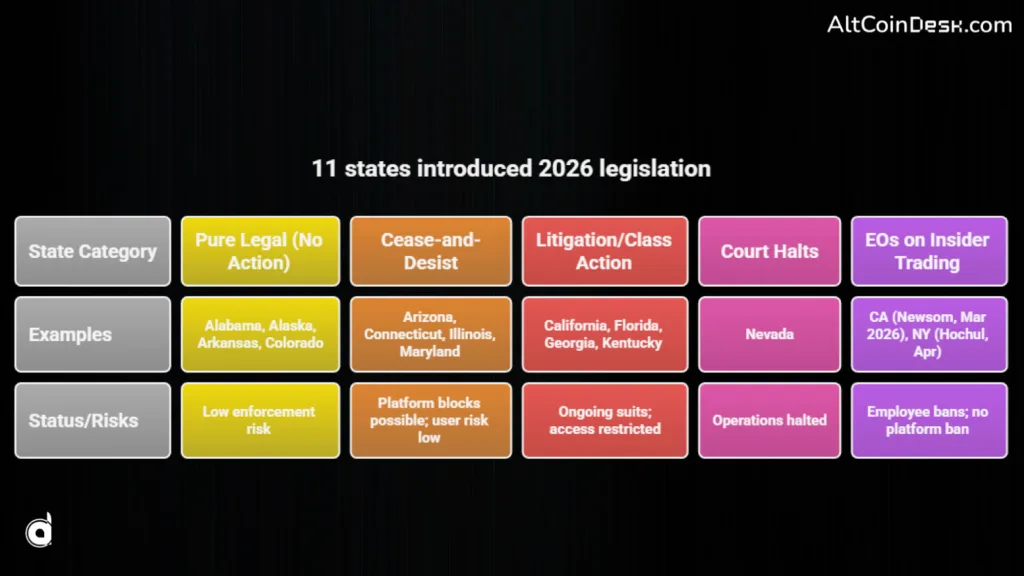
As of April 2026, eleven states have introduced legislation targeting prediction markets in some form. Hawaii and Kentucky are among those where bills are actively advancing. Some target outright bans; others look at taxation. The patchwork is expanding faster than any single regulatory framework can keep up with.
The states that have issued cease-and-desist orders read like a geography quiz: Arizona, Connecticut, Illinois, Maryland, Montana, New Jersey, New York, Ohio, and Tennessee. Massachusetts and several others are in active litigation. Nevada has its court order. California, New York, and Illinois have executive orders. Alabama, Alaska, Colorado, and roughly thirty other states have, so far, done nothing at all.
What this creates is a regulatory archipelago, where the legal status of prediction market trading depends almost entirely on which state you happen to be sitting in when you place a bet.
So, where does this leave regular people?
If you are a state government employee in New York, Illinois, or California, the answer is simple. Do not bet on things you know about because of your job. That was probably already obvious, but now it is also written into an executive order with dismissal and law enforcement referral as the consequences.
If you are an ordinary trader who has never worked in government, the legal landscape is genuinely murky depending on your location. Federal law says these platforms are legal. Your state might disagree. The courts are still arguing about who is right.
And if you are someone who placed a very well-timed bet on a military operation in Iran and made a lot of money doing it? You might want to speak to a lawyer. Several of them.
Key takeaway
The governors signing the Illinois EO prediction markets playbook and its state-level equivalents are not wrong to be concerned. The combination of billion-dollar trading volumes, politically sensitive event categories, crypto-native infrastructure, and a federal government that is currently more interested in defending these platforms than regulating them is a genuinely volatile mix. Whether executive orders are the right tool for the job or whether they are governors doing the only thing within their power while waiting for federal action that may not come is a fair debate to have.
What is not debatable is that someone made a billion dollars betting on a war, and nobody has fully explained how. That should bother all of us a little more than it currently does.