



You worked hard stacking sats, DCA-ing through every dip, and nodding wisely at dinner parties when someone mentions “self-custody.” Then one Tuesday morning, a stranger in a different city convinces your mobile carrier he is you, hijacks your phone number, resets your exchange password, and drains your portfolio while you are still deciding between oat milk and oat milk for your morning coffee.
Congratulations. You just became a statistic.
The Chainalysis 2026 Crypto Crime Report revealed a jaw-dropping 1,400% surge in impersonation scams and a 450% spike in AI-enabled fraud. Meanwhile, in just under 20 days in April 2026, digital asset platforms lost more than $605 million to cyberattacks across at least 12 separate incidents. The bad guys are not slowing down. They have gone industrial.
The good news? Crypto identity theft protection services exist precisely for this chaos, and in 2026, they have gotten significantly smarter. The bad news? Most people do not use them until after the damage is done. Let us fix that, shall we?
What is crypto identity theft?
Here is the thing people get wrong. Crypto identity theft is rarely about someone cracking your seed phrase like a Hollywood hacker. That is the movie version. Real life is far more boring and far more devastating.
What actually happens is this: a thief steals your email address, your phone number, your Social Security number, or some combination of the three. They use those boring, everyday identity details to take over your exchange account, bypass your two-factor authentication, or impersonate you through a KYC check. Your private keys were never touched. Your identity was.
Common attack routes include account takeover on exchanges through stolen login credentials, SIM-swap attacks that hijack your phone number and kill your 2FA, and deepfake or synthetic identity fraud used to pass verification on your behalf. So the protection you actually need is not a fancy wallet guard. It is protection for the human behind the wallet.

Why 2026 hits different
SpyCloud’s 2026 Identity Exposure Report found that a notable portion of malware infections occurred on endpoints that already had antivirus or EDR tools installed, proving that endpoint controls alone are no longer enough. The report also flagged that over 642.4 million credentials were harvested from 13.2 million infostealer malware infections in 2025 alone, with 80% of exposed corporate credentials containing plaintext passwords.
Read that again. Eighty percent. Plaintext. The digital equivalent of writing your house key number on your front door.
In a significant policy shift, the U.S. Treasury Department announced in April 2026 that it would extend its cybersecurity threat-sharing program to eligible crypto firms, a service previously reserved only for traditional financial institutions. That tells you everything about how seriously regulators are now treating this space.
And closer to home in the crypto community, Ice Open Network confirmed in April 2026 that four former partners tied to a third-party service provider leaked its user identity database, shaking user confidence at a platform level. The message is plain: the identity layer is the new battlefield.
Best digital bodyguards of 2026
Aura: The overachiever
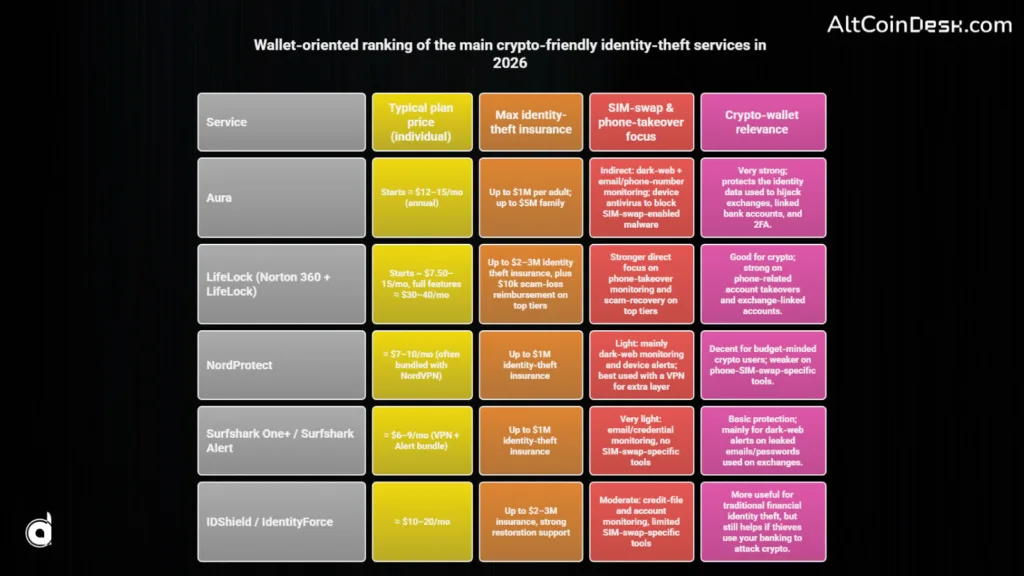
If crypto identity theft protection services were a school, Aura would be the student submitting the assignment three days early with a color-coded bibliography. It bundles three-bureau credit monitoring, dark-web scanning, automatic data-broker opt-outs, antivirus, VPN, and a password manager into one app. It also offers up to $1 million in identity theft insurance per adult, scaling to $5 million for families.
What makes it genuinely useful for crypto holders is speed. In independent side-by-side testing, Aura consistently finds more dark-web exposures than competitors and alerts users faster, sometimes within minutes of a breach being detected. When attackers are racing to use your leaked credentials before you notice, minutes matter enormously. Aura is widely rated the best all-around choice for 2026, especially if you use custodial exchanges where your email and phone number are the keys to the kingdom.
LifeLock with Norton 360
If your biggest nightmare is a SIM-swap attack, LifeLock’s top-tier plan bundled with Norton 360 is probably your match. It is heavier on phone-takeover monitoring and scam-recovery support than most competitors, and it pairs identity surveillance with full device security, including antivirus, a VPN, and phishing protection for the laptop or phone you use to trade.
The trade-off is cost. Full features land somewhere around $30 to $40 per month when bundled properly, and its dark-web detection is slightly slower and catches fewer exposures than Aura in head-to-head tests. Insurance coverage scales up to $2 to $3 million on top plans, plus a $10,000 scam-loss reimbursement layer that most competitors do not offer. If you are an active trader who lives on Binance or Coinbase from your phone, this is a serious contender.
NordProtect: Privacy-first
NordProtect is the identity protection arm of Nord Security, and it is aimed squarely at users who already trust NordVPN and want to extend that trust to their digital identity. It covers dark-web monitoring, credit-score tracking through one bureau, and up to $1 million in identity theft insurance. Higher-tier plans bundle in NordVPN, Threat Protection Pro malware defense, and data-removal services through Incogni.
It is not the most powerful standalone tool for SIM-swap defense, but for a privacy-conscious crypto user who already values a VPN as part of their stack, it is a smart and relatively affordable layer. Think of it as the sensible mid-range sedan of identity protection rather than the sports car.
Surfshark Alert: Budget basics
Surfshark Alert is the budget option in this conversation, bundled with Surfshark’s VPN and antivirus package. As of 2026, it offers dark-web monitoring, email and identity scans, and leak-detection alerts but does not include full credit report monitoring or restoration services in all regions. It will not hold your hand through a full identity recovery, but it will tap you on the shoulder when your email or password shows up somewhere it should not.
For a crypto-savvy user who already practices strong security hygiene and simply wants a cheap early-warning layer on top of their existing VPN, Surfshark Alert does the job without making a dent in your monthly budget.
IdentityForce and IDShield
Services like IdentityForce and IDShield are more oriented toward classic financial identity fraud, covering credit-report changes, Social Security number monitoring, and strong identity restoration support with insurance up to $2 to $3 million. They are slightly less tailored to crypto-specific threats like account takeovers, but still relevant if your fiat bank accounts are linked to your exchange for deposits and withdrawals. A thief with your banking identity can do indirect damage to your crypto holdings even without ever touching a wallet.
How to pick the right one
The honest answer depends on three things: your budget, how you hold your crypto, and what keeps you up at night.
- If you use custodial exchanges heavily and want maximum dark-web surveillance at a reasonable price, Aura is the default recommendation. If SIM-swap attacks are your specific phobia and you can stomach a higher monthly bill, LifeLock’s premium tier is the answer.
- If you want privacy tools and identity monitoring in one privacy-brand package, NordProtect delivers solid value. And if you simply want basic alerts without spending much, Surfshark Alert exists for exactly that.
- For anyone in a high-crypto-activity region like Dubai, where digital finance moves quickly and cross-border transactions are common, the combination of a strong dark-web monitoring service with biometric two-factor authentication on exchanges and a hardware wallet for self-custody is the 2026 gold standard.

Gaps these services skip
No digital identity protection for crypto works perfectly, and the fine print matters. Here is what the marketing brochures tend to quietly skip past.
None of these services protects your private keys. If malware is already on your device and you store a photo of your seed phrase in your camera roll (and yes, people do this), no identity service in the world can save you. These tools protect your identity layer, not your wallet layer.
Most also have limited direct SIM-swap intervention. They can alert you that your phone number appeared in a suspicious context, but actually stopping a SIM swap requires you to contact your carrier and place a SIM lock, something you have to do yourself.
They also do not watch your blockchain transactions in real time. If someone drains your on-chain wallet, these services will not flag it. That is what hardware wallets, multi-signature setups, and transaction review interfaces are for.
And finally, as crypto fraud experts have noted in 2026, traditional KYC is no longer enough to stop an AI-driven attacker with a “clean” synthetic identity, which means even the platforms you trust are working with imperfect tools. Identity protection services react and help you recover. They do not make you bulletproof.
Where is all of this heading?
The future of crypto identity protection looks less like a subscription service and more like an invisible operating system running underneath everything you do online.
Platforms are moving toward biometric and behavioral verification, where your typing rhythm, device posture, and location history quietly confirm that you are you during a withdrawal. AI-powered fraud engines are scoring every login and transaction in real time.
And long-term, the industry is drifting toward decentralized identity models where you control your own verifiable credentials and share them selectively rather than handing your entire identity to a centralized KYC database that becomes a single irresistible target for hackers.
Until that future arrives, the practical 2026 stack for any serious crypto holder is this: a non-custodial hardware wallet for significant holdings, biometric two-factor authentication instead of SMS-based 2FA on every exchange, a reputable identity protection service (Aura or LifeLock for most people), and a VPN plus antivirus combo on every device used for trading.
Key Takeaway
The criminals are industrialized. Your defenses should match the energy.
Protecting your crypto means protecting yourself first. The best digital identity safeguards for crypto are not optional extras anymore. They are the foundation on which everything else sits. Pick your service, set up your alerts, lock your SIM, and stop storing seed phrases where anyone (or anything) with camera access can find them. Your Tuesday morning self will thank you.