



So your crypto is just sitting there, doing absolutely nothing except giving you anxiety every time the market dips. You check the chart. You close the app. You check it again. Sound familiar?
Here is some news that might change your relationship with your portfolio: the best crypto lending platforms in 2026 will let your coins work a double shift while you sleep. No bank manager, no awkward small talk, no credit score drama. Just your assets, a smart contract or a regulated platform, and a surprisingly decent APY.
Crypto lending platforms are services that allow you to borrow money using your crypto as collateral or lend your crypto to earn interest.
Let us walk through the top seven players this year, including who is actually worth trusting with your precious tokens and who might quietly liquidate you while you are out getting coffee.
Aave: The DeFi elder statesman
Aave is now deployed across 18 blockchains with no KYC and no company holding your funds, making it the gold standard for decentralized lending in 2026. The protocol is non-custodial, meaning nobody is holding your assets hostage in a Cayman Islands server farm. As of early 2026, borrowing USDC on Aave sits at just over 4.5% APR, and supplying USDC gets you a return of roughly 3 to 4% depending on the pool and network.
It also invented flash loans, which sound like something a supervillain would use, and well, sometimes they do. For everyone else, though, Aave remains the most battle-tested decentralized option on the market. Just know going in: if your collateral value drops below the protocol’s hard limit, automatic liquidation will not send you a warm email first.
Compound: Boring is a feature, not a bug
The newest version of Compound, nicknamed “Comet,” simplified the whole protocol architecture. Each market is its own isolated unit, so if you have loans on multiple assets and one of them turns bad, it will only liquidate assets from that market rather than drain liquidity from others. That is the kind of sensible design that does not make headlines but absolutely saves portfolios.
Compound offers an average APY of around 4.54% and has been operational for many years without major exploits, undergoing multiple audits every year. Think of Compound as the reliable sedan of digital asset borrowing; nobody is putting it on a poster, but it gets you home.
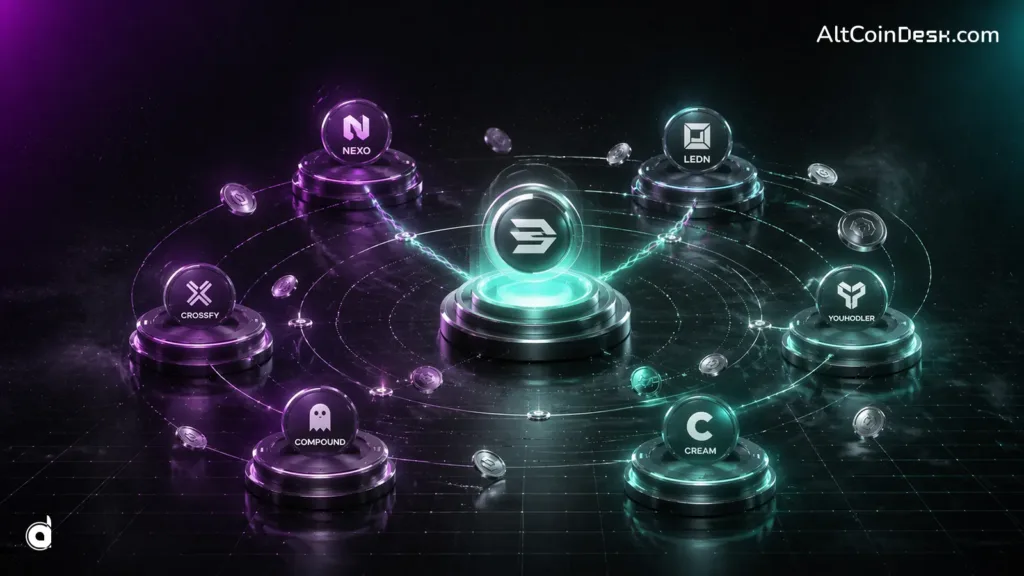
Nexo: The crypto lender that came back
Nexo had a dramatic few years. In 2023, Nexo settled with the U.S. SEC and multiple state regulators for 45 million dollars over unregistered securities allegations and subsequently exited the U.S. market. Plot twist: Nexo has since returned to the U.S. market as of 2026, offering variable APY, instant funding, no credit checks, and flexible borrowing limits, with perks like 0.9% APR for top loyalty tiers.
The platform accepts over 100 cryptocurrencies as collateral and uses real-time reserves attestation from Moore Johannesburg, with custody handled through Ledger Vault and Fireblocks, backed by substantial insurance coverage. It is the crypto equivalent of a comeback tour. Whether you trust it is entirely up to your personal risk appetite and your tolerance for dramatic backstories.
Binance Loans: The big exchange plays banker
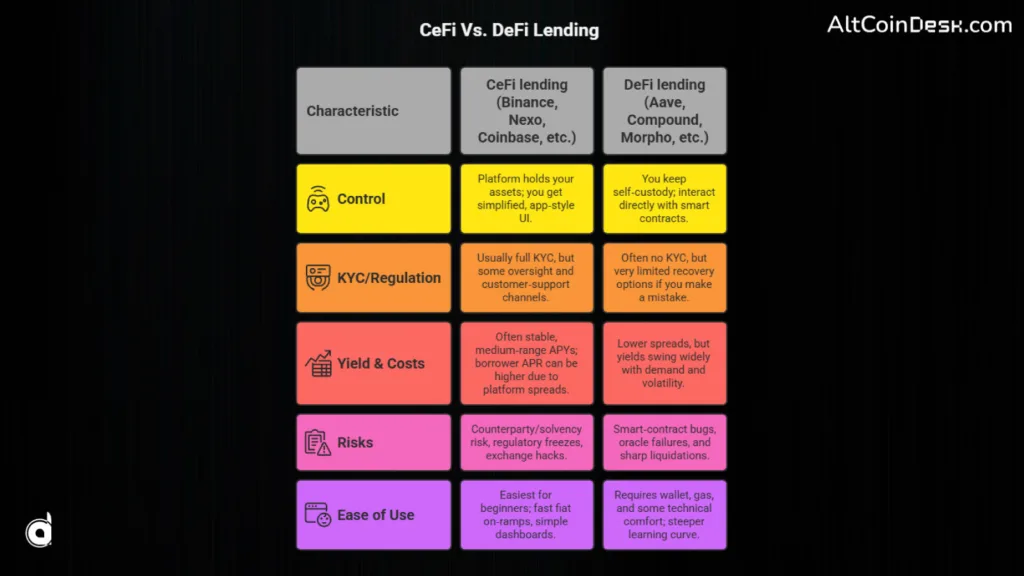
If you already live inside the Binance ecosystem, Binance Loans is the “why would you leave” option. Binance VIP Loans is a centralized lending solution tailored for high-volume traders and institutional VIP clients seeking large credit facilities directly within the Binance exchange ecosystem.
You pledge your crypto, you get USDT or fiat, and you keep trading. The catch, as always with centralized crypto loan services, is custodial risk. Your coins live on their platform, and whatever happens to that platform happens to your coins. The upside is deep liquidity and genuinely fast execution. For retail users outside the US who are already active on the exchange, this is a natural fit. For US users, however, the standard global Binance platform remains largely off the table.
Coinbase: The compliant option for the cautious
Coinbase has reintroduced its Bitcoin loan product in 2026, letting users borrow up to 100,000 dollars against their BTC holdings, with loans denominated in USDC. Under the hood, Coinbase is partnered with Morpho to power its crypto-backed loan product, and it is one of the easiest platforms to use without the complexities of other DeFi platforms.
If the phrase “self-custody wallet” makes you want to lie down, Coinbase is genuinely your most stress-free entry point into the world of digital asset borrowing. Rates start as low as 4%, there are no additional KYC hoops since you are already verified, and the interface will not make you feel like you need a computer science degree just to see your balance.

CoinRabbit: Speed over sophistication
CoinRabbit is the platform you call when you need liquidity in the next ten minutes and do not want to have a conversation about it. CoinRabbit stands out as a user-friendly, flexible option among the leading crypto lending platforms in 2026, particularly for quick loans against digital assets.
There are no credit checks, processing is often completed within minutes, and the whole experience is built for people who find traditional lending exhausting. The trade-off is that it is a centralized platform, so you hand over custody, and the rates may not win any awards when compared to DeFi alternatives. Still, for someone who needs fast liquidity without the on-chain gymnastics, CoinRabbit earns its spot on this list.
Ledn: The BTC purist’s paradise
Founded in 2018, Ledn has processed over 10.5 billion dollars in Bitcoin-backed loans without a single reported loss of client funds, a track record that survived the collapses of Celsius, BlockFi, and FTX. That sentence alone deserves a round of applause.
Its Custodied Loan product holds collateral in segregated on-chain addresses, ring-fenced from the platform’s other activities, meaning neither Ledn nor its funding partners can lend out your collateral for interest.
For long-term Bitcoin holders who want liquidity without selling their conviction, Ledn is the cleanest option on the market. The rates start at around 9.99% APR for larger amounts, which is not the cheapest, but you are paying for a genuinely conservative, transparent structure that held the line when others did not.
So which one should you actually use?
Here is the honest, no-fluff answer. If you are technically comfortable and want the lowest all-in borrowing costs, Aave and Compound are your best bets, as long as you actively watch your collateral ratios and do not sleep through a 20% market drop.
If you want a bank-style experience without the bank, Nexo and Coinbase cover that ground in 2026. If your entire stack is Bitcoin and you would rather do anything other than sell it, Ledn is the answer.
If you trade heavily on Binance already, their loan product is the path of least resistance. And if you need cash in the next ten minutes with zero friction, CoinRabbit exists for exactly that reason.
To sum up
The best crypto loan platform for you is the one that fits how you really act, not just the one with the highest APY on a comparison site. Keep your LTV low, read the liquidation terms before you need them, and remember that the platforms that seemed safest in 2021 may not be the ones that are still around in 2023. Make your choice in 2026.