


So there you are, bleary-eyed at 3 a.m., refreshing Uniswap as it owes you money, watching your liquidity position quietly bleed out while a bot somewhere on a server farm in an undisclosed location just made $4,200 in the same time it took you to find your reading glasses. Welcome to 2026, where the AI crypto trade revolution is not coming. It already clocked in, made coffee, and reorganized your desk without asking.
This is not a doom-and-gloom piece. This is an honest, slightly amused explanation of what is actually happening in decentralized finance right now, why robots are better at this than you (and me, and most humans), and what you should probably understand before the machines start charging rent.
Wait, is this even real?
Yes, embarrassingly so. A significant share of new DeFi protocols launched in early 2026 shipped with at least one autonomous AI agent baked directly into the workflow, handling trading, liquidity management, or risk monitoring from day one. This is not a feature they bolted on later. It is the actual product.
And on April 20, 2026, Coinbase officially unveiled Agentic Market, described as an app store where AI agents can discover services, check pricing, and start paying with stablecoins, all without a human manually setting up credentials. The platform already had over 167 million x402 transactions settled, with 85% of those on Base. That is not a pilot program. That is infrastructure.
Meanwhile, on-chain data from Base and Solana is already showing exponential growth in agent-generated trading volume. Not projections. Live numbers. The bots are here, they are trading, and they are surprisingly good at it.

So what exactly is an AI crypto trade agent?
Think of it less like a bot that executes orders and more like a tireless, emotionless intern who never sleeps, never panics, never revenge-trades after a loss, and never posts in a Telegram group at midnight asking if we are going to make it.
In practice, these agents scan prices, liquidity, funding rates, volatility signals, and even social sentiment simultaneously. They identify opportunities like arbitrage, yield optimization, or liquidity rebalancing, then submit transactions with predefined rules around slippage, position size, and risk limits. All of this happens continuously, across protocols, without you touching a thing.
EIP-7702 now enables safe agent trading without exposing private keys, and session keys allow AI agents to perform scoped, temporary actions while users retain full custody. So before you panic about handing a robot your wallet, know that the smarter implementations have thought about this. Your keys do not actually go anywhere.
The part where concentrated liquidity gets interesting
One of the places AI genuinely earns its keep is in Uniswap v3-style liquidity provisioning. If you have ever tried to manually manage a concentrated liquidity position, you already know it is approximately as relaxing as defusing a bomb while someone explains yield farming to you.
Reinforcement-learning approaches can adaptively rebalance liquidity ranges in real time, improving performance and reducing the downside of static LP strategies. This matters because concentrated liquidity is powerful but genuinely hard to manage at scale without automation. AI handles the repetitive, sequential decision-making that humans find exhausting after about 20 minutes.
DeFAI agents handle the execution layer autonomously, operating 24/7 and reacting to on-chain signals faster than any human can, meaning you no longer need to be glued to a dashboard to stay competitive. This is the practical promise underneath all the hype.
The bots everyone is actually using
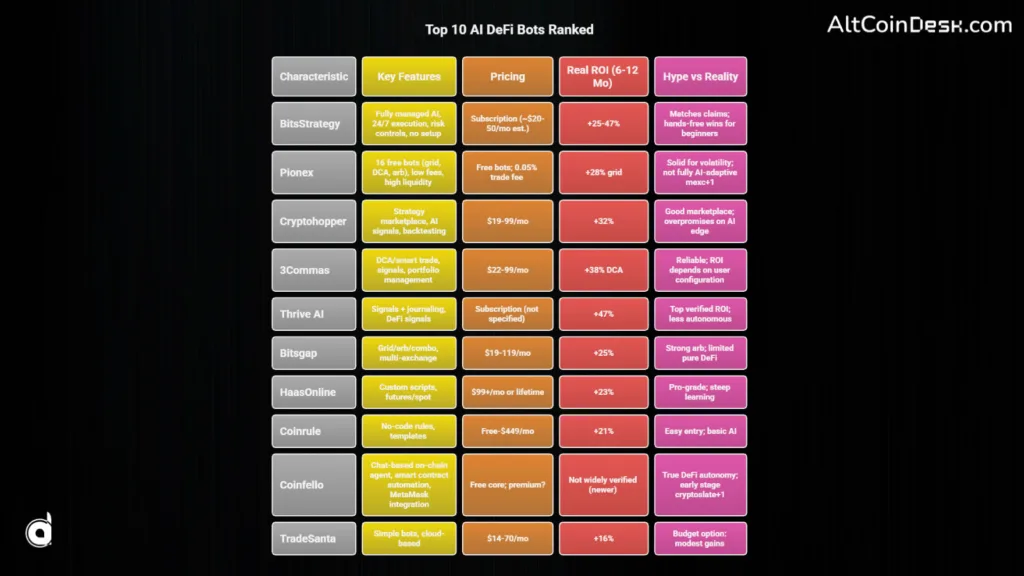
If you want names, here is the honest rundown. BitsStrategy is fully managed, requires no configuration, and targets beginners who want hands-off automation. Pionex offers 16 free built-in bots, including grid and DCA strategies, charges no subscription fee, and earns through a 0.05% trade fee.
Cryptohopper brings a strategy marketplace and AI signals. 3Commas focuses on DCA and smart trading with portfolio management. Thrive AI consistently posts the highest verified return figures among signal-based tools.
Coinfello is the newer, more adventurous option: a chat-based on-chain agent that integrates directly with MetaMask for Uniswap swaps and liquidity management. You literally type “swap 1 ETH for USDC on Uniswap,” and it previews the transaction for your approval. It is early, worth watching, and precisely the kind of product that shows where this category is heading.
Reality check on returns: expect 15 to 60% annual ROI in bull markets with drawdowns under 15% for well-configured systems. Anyone promising 100% monthly gains is either selling you something or confused about what a percentage is.
Coinbase built an app store for AI agents
This deserves its own moment. Coinbase’s Agentic. Market sits on top of the x402 micropayments protocol, which powers “agentic wallets” for autonomous crypto transactions, acting as a storefront and discovery layer for services that AI agents can pay for and use on their own.
Coinbase product lead Nick Prince described the goal as giving “humans and their agents access to thousands of services, with zero API keys required.” The company’s broader thesis is that agentic AI will become a major user of blockchains itself, opening wallets, deploying smart contracts, and negotiating for services with minimal human input. Machine-to-machine commerce, running on crypto rails, is no longer theoretical.

The part nobody wants to talk about: Real risks
Here is where the satire takes a brief intermission for some actual information you need.
AI agents amplify crypto risks the same way a megaphone amplifies sound. When many agents react identically to the same market signal, they create feedback loops. They sell together. They pull liquidity simultaneously.
They make a bad moment significantly worse. In March 2025, MEV bots drained $215,000 from a single Uniswap v3 position in seconds through a sandwich attack. Three similar attacks hit on the same day. This is the adversarial environment AI agents operate in, and the ones without protections are genuinely dangerous to their users.
There is also model risk, the polite term for “it was right most of the time until it catastrophically was not.” An AI system can perform beautifully on average and still blow up during a regime shift, a smart contract exploit, or an illiquid market event. This is why serious implementations now include kill switches, allowlists, canary transactions, limited permissions, and strong operational controls.
Developers now implement network-level kill switches to halt runaway agents, and systems use monitoring tools to enforce network policies without requiring human intervention. Controls exist. Use platforms that have them.
Regulators are paying attention now
In March 2026, the CFTC created an Innovation Task Force specifically to shape rules for crypto and AI markets. Europe’s MiCA framework continues pushing formal authorization requirements across the crypto stack. The European Union enforces MiCA regulation, requiring entities operating crypto assets to comply with strict disclosure and surveillance rules, with platforms implementing AI-driven monitoring tools to detect conflicts of interest and insider trading.
The likely outcome is not a ban on AI crypto trading. It is more compliance-friendly architectures, audit trails, permissioning layers, and identity controls. In other words, the bots stay. They just have to file paperwork like the rest of us.
What does this all mean for you?
The future of this space looks less like “retail traders using bots” and more like an autonomous financial layer where agents manage treasury operations, market making, yield strategies, hedging, and cross-chain execution on behalf of users and institutions. Some analysts in 2026 suggest crypto may become the payment and settlement layer for AI agents themselves, especially for machine-to-machine commerce and tokenized infrastructure.
Three things to watch: whether AI agents keep growing inside new DeFi launches rather than just as add-ons, whether major protocols standardize agent permissions and safety rails, and whether regulators finally clarify how autonomous financial systems should be supervised.