
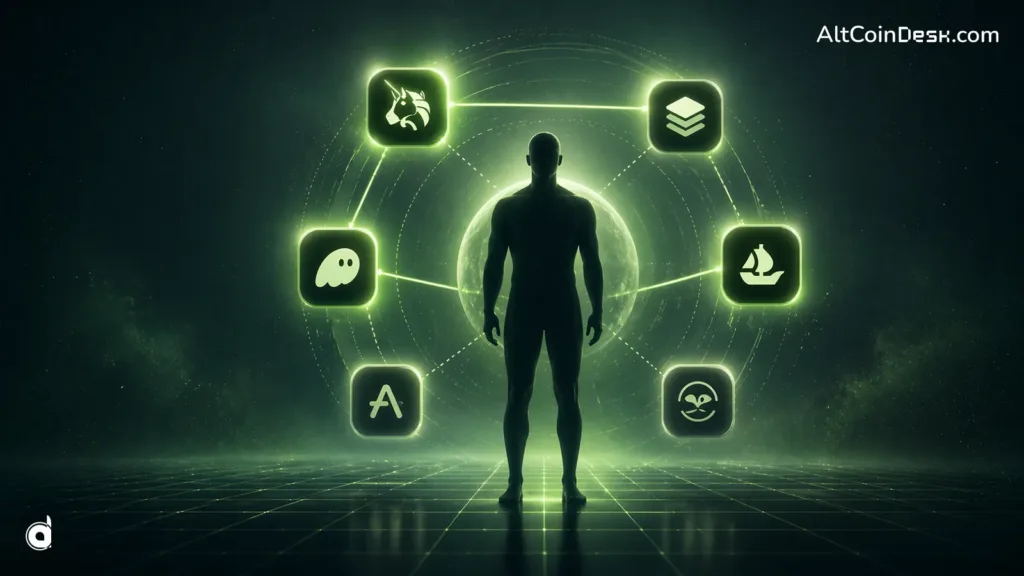

Web3 has grown beyond speculation, as most people now use decentralized applications (dApps) for their daily activities. Be it gaming, browsing, trading, staking, creating, or collecting NFTs, or even chatting with friends and family, blockchain-based applications can handle it all in 2026.
Recent data shared by eSparkBiz shows that the total market value of the Web3 market stands at approximately $10.2 billion in 2026. However, the market is not going to stop there, as demand is expected to continue rising with more adoption of web3 technologies.
This article will analyze the six Web3 apps experiencing strong adoption in 2026. We will focus on web3 apps that have exhibited long-term demand, functionality, and strong integration into daily activities.
What are web3 applications?
Web3 applications, also known as decentralized applications (dApps), are applications built on the blockchain architecture instead of centralized servers like web2 apps. These apps are executed on distributed networks with transactions being validated together, as opposed to having one entity to store data or manage operations.
Smart contracts are at the core of Web3 applications. These are self-executing programs that automate operations like payments, transfers of assets, or make decisions regarding governance. When deployed, smart contracts do not require intermediaries and reduce the dependence on banks, corporations, or centralized platforms.
Web3 apps are used by users via digital wallets where assets, identity credentials, and authorization are stored. This organization influences the control towards individuals and not platforms. Neither can assets be arbitrarily removed, nor can they be subject to centralized approval.
These mechanics, however, do not drive the demand for web3 applications in 2026. Rather, adoption is driven by user-friendliness, efficiency, security, and level of decentralization.
The 6 best web3 apps that individuals actually use every day in 2026
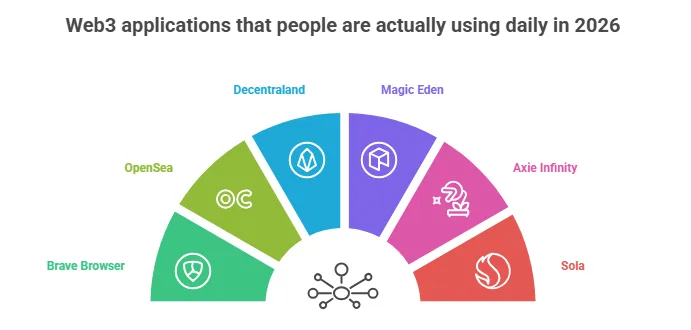
1. Brave browser
The Brave browser is one of the most evident examples of Web3 integration on a large scale. This browser serves as a typical web browser, with privacy and optional token rewards integrated into the experience.
By default, Brave is empowered to block advertisements, analytics, and tracking and improve its performance. Its attention-based model provides users with rewards for those who opt in, but it is second in importance. Performance and control are the most important values.
Since browsing is already a common behavior, Brave enhances the user experience without behavioral change. Such positioning enables it to keep a stable audience outside the Web3-native audience.
2. OpenSea
OpenSea remains a primary platform for the discovery of digital assets. Although the app’s trading volumes have remained stagnant, user activity has remained high, with most seeing it as the perfect app for the discovery of non-fungible tokens (NFTs).
The OpenSea interface is user-friendly. Users can explore collections, handle their assets, and participate in digital ownership without having to necessarily poke around the complex tools. This ease of use continues to make it current, even as far as some specialized platforms introduce themselves.
With its use as a discovery layer, OpenSea can facilitate all the activities in 2026 by enabling users to view, verify, and manage digital assets.
3. Decentraland
Decentraland has remained relevant over the years. This application offers a virtual arena where its users get to attend events, socialize, and move around digital locations.
The app has virtual land and assets, although they are not the main source of engagement. Users come back to socialize, create branded experiences, and community events that reflect real-world behavior.
The platform is strongly based on familiarity. It copies the already existing patterns, like going to events or discovering environments, and incorporates digital ownership as an extra layer, as opposed to the primary concern.
4. Magic Eden
Magic Eden has developed through prioritizing the user experience and access. It diversified into more blockchains early, enabling it to gain traction in the blockchains where the users were most engaged.
The platform is more focused on discovery than on more advanced trading. This is the design that will attract less advanced users who would rather avoid navigating a complicated interface and wish to have an easy system to navigate and gather digital objects.
Uniformity propels its usage on a daily basis. People come back since the experience is consistent and familiar to them, and not due to incentives or speculative patterns.
5. Axie Infinity
Axie Infinity has developed out of its original play-to-earn concept and changed into a more balanced game system. The emphasis has been put on the quality and sustained play.
Players come back to develop, compete, and play the game instead of receiving token rewards. This has brought in better retention as the platform is now in line with the standard gaming expectations.
Its further use is an indication of the general shift in Web3 gaming. This app makes winning titles not about using blockchain features to facilitate ownership and trading of titles, but rather results in entertainment that dominates titles.
6. Sola
Sola provides an alternative play of social interaction. User engagement drives content distribution and not centralized algorithms or advertising motivations.
Visibility is determined by the cultural approval of the community, and the content can be disseminated according to relevance and not due to advertising. This provides a more level playing field, and the little creators can be reached naturally.
Habit is incorporated in daily engagement. Users revisit to read and interact with the content, and receive tokens as well. This aligns the two with the main aim of any social site product: competitive, meaningful interactivity.
The benefits of using web3 apps in 2026
Individuals decide to use web3 applications in 2026 due to the following reasons:
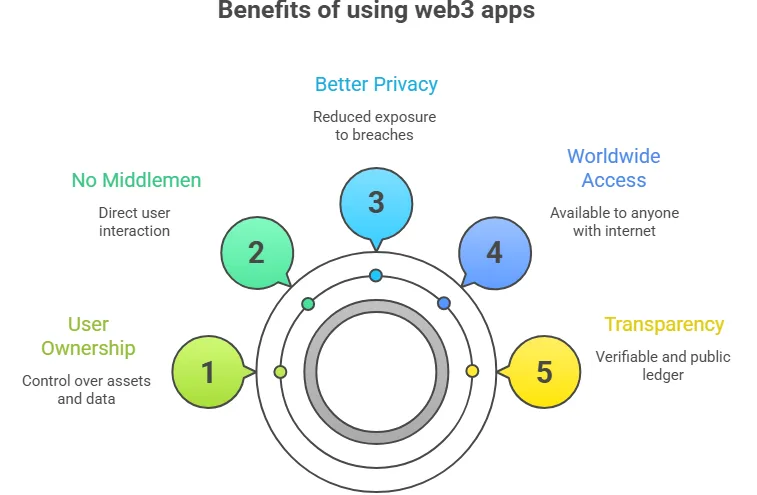
- User ownership: Wallets give the user ownership and control over their assets and data, and eliminate dependencies on a centralized platform.
- No middlemen: Direct interaction between the users saves money and gets rid of the third parties.
- Better privacy: The data used in a decentralized system can be more easily tracked, and exposure to centralized breaches is reduced.
- Worldwide access: They are available to any person who can access the internet, regardless of their geographical location.
- Transparency: part of these systems can be verified and hard to control, as it is recorded on a publicly available ledger.
- Interoperability: Web3 applications enable customers to unlock their assets and identities across platforms and do not use any platform to secure them.
Conclusion
Web3 adoption in 2026 is value-driven, rather than hype based. Users enjoy using applications that offer value, reliability, and convenience even without incentives.
Web3 applications like Axie Infinity and Decentraland have flourished due to convenient access to privacy and ownership of digital objects. OpenSea, Magic Eden, and Brave Browser, on the other hand, offer better user experiences. Finally, Sola supports participation, turning social trends into safe and fulfilling activities.