



Web3 was supposed to be the next big thing. A fresh version of the internet where folks own their data, their accounts, and their digital money without a giant company sitting in the middle. The promise was huge, and the funding was even bigger.
But walk up to any friend who isn’t already into crypto, ask them to try a Web3 app, and watch what happens. They’ll bounce within a couple of minutes. That reaction is the whole story behind why Web3 still hasn’t crossed into the mainstream.
What’s really behind the Web3 adoption problems
The core issue has less to do with the tech and more to do with who built it. The whole thing was put together by engineers for engineers, then handed to everyday folks who just want stuff that works like Venmo or Gmail.
Web3 adoption problems mostly come down to a handful of things that mainstream users simply refuse to tolerate:
- Signups that drag on way too long
- Having to write down secret words on paper
- Fees that show up out of nowhere
- Zero customer support when things go sideways
- No “forgot password” button, ever
When someone compares all of that to opening a Cash App account in thirty seconds, they just walk away. That gap between what folks expect and what Web3 actually delivers sits at the heart of the Web3 adoption problems the industry keeps talking about but hasn’t truly solved. Fixing those Web3 adoption problems has become the main focus inside crypto product teams in 2026.
Why Web3 app onboarding scares off beginners
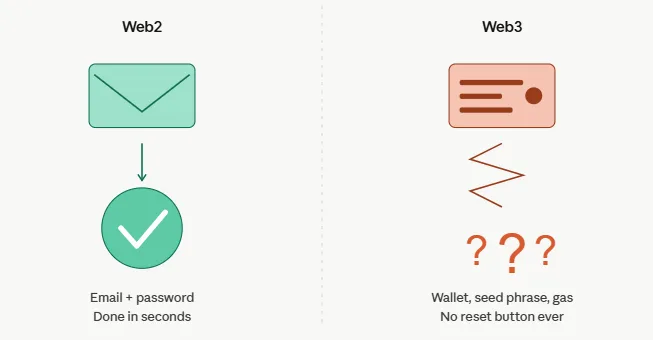
Opening a regular app usually means typing in an email, making a password, and tapping through a quick tour. Done. Web3 app onboarding is a whole different animal.
To use a basic Web3 app, a first-timer has to download a crypto wallet, copy down a long list of random recovery words, keep them somewhere safe forever, and then figure out how to connect that wallet to the app they actually wanted to use in the first place.
If anything goes wrong with those recovery words, the money tied to that wallet is gone. No bank to call. No support team to email. No chargeback. That single fact pushes a big chunk of first-timers to quit before they even finish setup.
Think about it this way. Someone hands a new Netflix user a notebook and says, “Write these twenty four words down. Don’t lose them. Don’t save them on your phone. If you forget them, your account vanishes forever.” Nobody would sign up for Netflix under those rules. Yet that’s what Web3 app onboarding has looked like for years.
Even careful folks slip up during setup, which is why Web3 app onboarding still feels so unforgiving. With no safety net, a single typo can cost real money. That kind of pressure feels closer to a trap door than a learning curve.
The biggest Web3 UX challenges new users face
Once someone actually gets past signup, the next wave hits. The Web3 UX challenges show up in how different every app feels.
In regular apps, folks know what a gear icon does, where the search bar usually sits, and what a save button looks like. Web3 hasn’t settled on those shared rules yet. Every dApp picks its own words, its own layout, and its own flow. Someone who just figured out one marketplace has to relearn everything the second they open a different one.
The vocabulary doesn’t help either. Terms like gas, staking, bridging, liquidity pools, slippage, and approvals get thrown around with no friendly explanation. A first-timer often has no clue whether they’re about to swap coins, lose coins, or lock them up for a month.
A few of the biggest Web3 UX challenges that keep tripping folks up:
- Wallet addresses that look like a cat walked across a keyboard
- Fees charged in one coin while the price is shown in another
- Error messages written in code rather than plain English
- Pop-ups asking for permission to do things nobody asked about
- Quiet network switches that break transactions without warning
Put together, those Web3 UX challenges turn simple tasks into a puzzle. Something as basic as buying a digital collectible can take far longer on a Web3 app than the same action on a regular website. That kind of friction kills momentum fast.
Web3 adoption barriers beyond just the design
The Web3 adoption barriers go deeper than clunky design. Trust is a massive part of the story too.
Scams have been a steady drumbeat for years, and they rank high among the Web3 adoption barriers nobody wants to talk about openly. Fake airdrops, phishing sites that look exactly like the real deal, wallet drainers hidden inside sketchy links, and pump-and-dump tokens have all trained the general public to link Web3 with getting ripped off. Once a person reads a couple of horror stories, it’s tough to get them to try anything in the space.
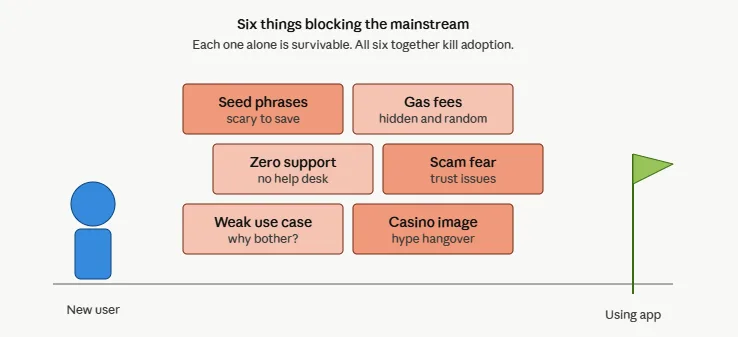
Another layer sits underneath all of that. A lot of Web3 apps, honestly, don’t solve a problem a normal user has in their daily life. Swapping from one token to another, joining a DAO, or managing an on-chain identity sound cool to builders, but they don’t mean much to someone whose main concern is splitting a dinner bill or snagging concert tickets.
The leftover damage from the last crypto hype cycle piles on even more. Token giveaways, meme coin launches, and million-dollar JPEG flips made the whole space feel like a casino. Serious builders working on real products now have to fight that casino reputation every single time they try to onboard a new user.
Add in unpredictable transaction fees, confusing network choices, and the fear of making one wrong click, and it’s easy to see why the Web3 adoption barriers have held the space back even as the underlying tech has gotten better.
How 2026 is starting to fix the mess
The good news is that the industry has finally admitted the user side was broken. A wave of tools and patterns rolling out in 2026 is quietly changing the story.
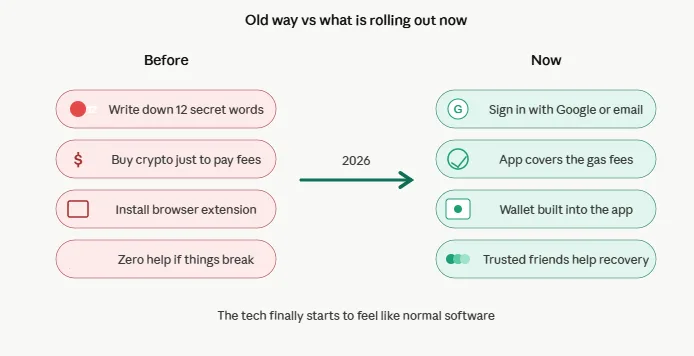
Account abstraction lets wallets behave more like normal app accounts. Folks can sign in with Google, Apple, or email, skip the seed phrase ceremony, and still keep ownership of their assets. Embedded wallets take it a step further by building the whole wallet right into the app, so a new user never even sees the word “wallet” during signup.
Gasless transactions are another big shift. Instead of forcing a brand-new user to buy crypto just to cover a fee, apps now pay those fees in the background, the same way a free trial covers server costs. Social recovery options also replace those scary recovery words with trusted contacts who can help someone get back in if they’re locked out.
AI-powered helpers are starting to sit between the user and the blockchain too, turning cryptic transactions into plain English before anyone taps confirm. All of that finally starts to feel like software regular folks could use without a tutorial.
Final thoughts
Web3 has a real shot at mainstream use once it stops asking its users to become part-time engineers. The tools showing up in 2026, smoother signups, friendlier wallets, sponsored fees, and clearer interfaces, are a clear sign the space is heading that way.
Until those upgrades become the default across every app, though, the gap between what Web3 promises and what everyday folks can actually use will keep holding things back. The tech is ready. The user experience is the part that finally has to catch up.