



Something quiet but enormous is happening in money right now. Big banks, payment networks, and fintech giants have started building on a new kind of financial plumbing, and it isn’t wire transfers or card rails. It’s stablecoins.
For anyone new to the topic, the shift can sound technical. At its heart, though, the story is about faster money, simpler settlement, and a group of digital tokens that are slowly becoming the foundation everyone else builds on top of.
What are stablecoins in finance?
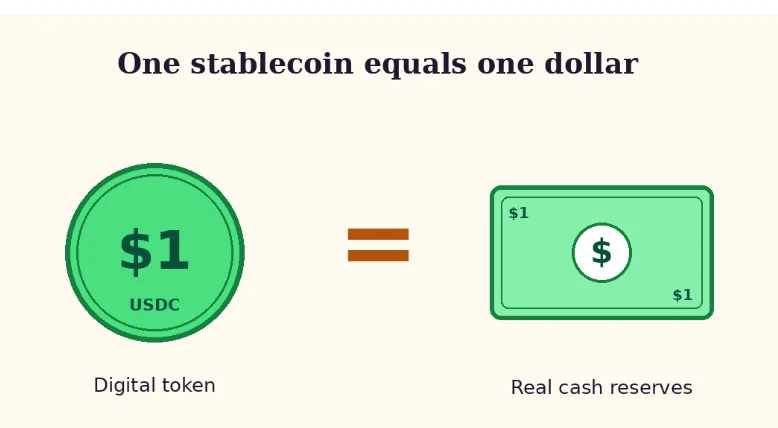
A stablecoin is a digital token designed to always be worth one dollar. Bitcoin can swing wildly in price, but each stablecoin is backed by real reserves, usually cash and short-term government bonds held by the issuer. One token in, one dollar out.
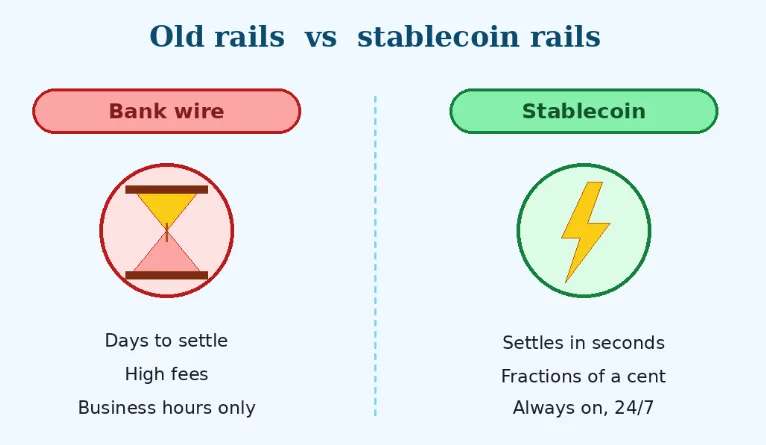
That tiny design choice unlocks something big. Because stablecoins live on a blockchain, they can move any time of day, across borders, in seconds, for pennies. No wire cutoff at 5 p.m. No waiting three days for a transfer to clear.
The role of stablecoins in finance has grown from a niche crypto tool into plumbing that real companies depend on. Payroll firms use them. Marketplaces use them. Treasury teams at global companies use them to shuffle funds between subsidiaries overnight. When people talk about stablecoins in finance today, they usually mean something that looks a lot closer to Visa’s rails than speculative crypto.
A good way to frame stablecoins in finance is as a new base layer, similar to how TCP/IP became the base layer of the internet. Nobody thinks about TCP/IP when they send an email. One day, nobody will think about stablecoins when they pay a freelancer across the world.
Why stablecoin market growth is exploding now
Two things kicked off the current surge. First, the GENIUS Act, signed in July 2025, gave stablecoins their first proper federal rulebook. It clarified that licensed issuers have to back every token with safe reserves and follow bank-style rules. That single piece of legislation pulled stablecoins out of the gray zone.
Second, traditional finance got interested. Once the rules were clear, card networks, banks, and fintechs stopped watching from the sidelines and started plugging in.
The result is stablecoin market growth that looks more like an S-curve than a bubble. Total stablecoin supply has reached new highs, and annual transaction volumes now run into the trillions of dollars. Some consulting firms expect stablecoins to account for a meaningful share of all dollar payments within the next few years.
What’s interesting about the current stablecoin market growth is who’s behind it. Payroll providers, remittance apps, corporate treasurers, and marketplaces are doing real work on real problems.
If stablecoin market growth keeps tracking its current pace, what used to be a side feature on crypto exchanges could become a standard option in everyday banking apps.
The rise of stablecoins infrastructure
Here’s where the “Layer 1” part of the story gets interesting. The biggest change over the past year is that major firms have started building dedicated blockchains for stablecoins.
Circle, which issues USDC, launched a blockchain called Arc, purpose-built for institutional stablecoin finance. Fees are paid in dollars, not volatile crypto, and launch partners include BlackRock, Goldman Sachs, BNY Mellon, Visa, and Mastercard. That’s Wall Street, not crypto Twitter.
Stripe is working on its own version with Tempo, a settlement blockchain paired with wallets, issuance tools, and a pending bank charter. Over on the Tether side, a separate Layer 1 called Stable has launched to handle USDT transactions cheaply at scale.
All of this is stablecoins infrastructure in the literal sense. Rails, ledgers, and tooling designed from scratch for dollar-pegged tokens. The goal is boring reliability. Payments that settle instantly, every time, at predictable cost.
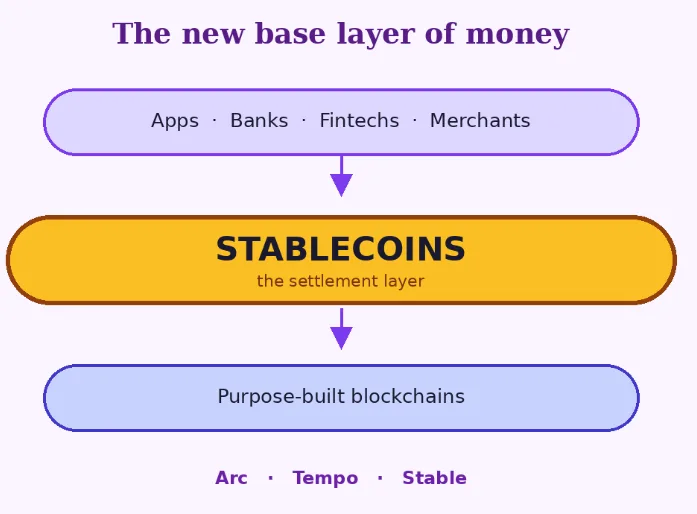
When a major asset manager and several global banks sign on as partners for a new blockchain, stablecoins infrastructure has quietly crossed from experiment into something closer to public utility. The layers now include issuers, purpose-built chains, bridges back to older banking rails, and compliance tools that handle anti-money-laundering checks.
Everyday stablecoin use cases
The easiest way to understand why any of this matters is to look at where stablecoin use cases already work in the wild.
- Cross-border payments: A traditional wire to the Philippines can take days and lose a chunk to fees and bad exchange rates. A stablecoin transfer settles in under a minute for almost nothing.
- B2B invoices: Companies pay overseas suppliers without routing through correspondent banks.
- Payroll for remote workers: Firms like Deel and Flywire let employers pay international contractors in stablecoins, which arrive the same day.
- Treasury operations: Corporate finance teams move cash between international subsidiaries overnight.
- Card spending: Visa and Mastercard now offer cards tied to stablecoin balances, so a coffee can be bought using USDC without the holder thinking about conversion.
A couple of concrete examples help. Scale AI pays its overseas contractors in stablecoins so their pay arrives on time and holds its value, even if their local currency is swinging. SpaceX uses stablecoins to collect Starlink payments from customers in countries where local banks are slow or unreliable.
These stablecoin use cases are solving real weekly pain for ordinary businesses. More advanced stablecoin use cases include tokenized bonds and real-estate funds, which need a digital cash asset to trade against.
The best stablecoins 2026 to know about
Talking about the best stablecoins 2026 really means talking about a short list of familiar names, each with a slightly different angle.
- USDT (Tether): Still the biggest by a long shot. Traders keep coming back to it because liquidity shows up almost everywhere, though its reserve reporting has raised eyebrows more than once.
- USDC (Circle): The one banks and big institutions usually reach for. Circle puts out reserve numbers every month and actively plays inside the rulebook.
- DAI and USDS (Sky): Neither relies on a company holding dollars in a vault somewhere. Crypto collateral backs them instead, so anyone leaning toward decentralization usually ends up here.
- PYUSD (PayPal): PayPal’s merchant base is already huge, and PYUSD slides right into it. Not many new tokens launch with that kind of built-in distribution on day one.
- Yield-bearing stablecoins: These are newer. Holders earn interest on top of the peg, and corporate treasury teams have started using them as a cash alternative when parking idle funds.
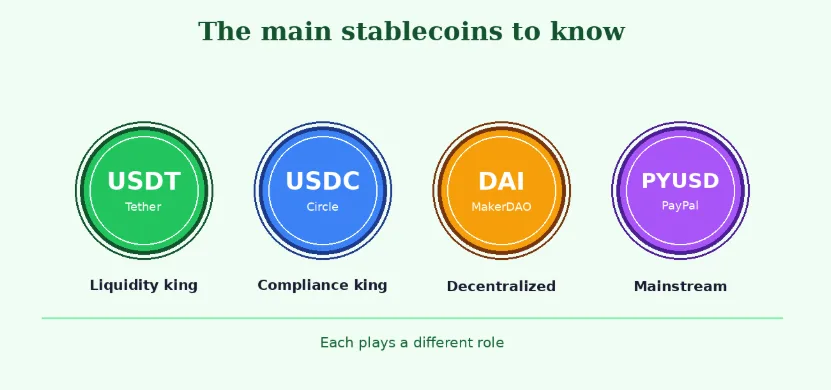
A simple shortcut helps when thinking through the best stablecoins 2026. USDT tends to win on liquidity. USDC wins on regulation. DAI leans decentralized. PYUSD comes with built-in reach.
The best stablecoins of 2026 all share one trait. Each is aiming to become trusted plumbing that businesses and everyday users can rely on.
What’s driving stablecoin adoption today
Stablecoin adoption is happening in waves across different industries at the same time.
Fintech platforms were first, plugging stablecoins into remittance and cross-border apps. Card networks followed. Visa has rolled out programs that let merchants settle international transactions in digital assets, and the company’s stablecoin settlement volume keeps climbing.
Banks are next. A consortium of European banks, reportedly including BBVA, BNP Paribas, and ING, is working on a euro-denominated stablecoin. Once banks that traditionally sit on top of payments start issuing their own tokens, stablecoin adoption has clearly crossed into the mainstream.
Even AI plays a part. Stablecoin adoption within machine-to-machine payments is quietly growing, since AI agents need a simple, borderless way to transact. What ties all of it together is usefulness. The tokens solve familiar problems like slow settlement, heavy fees, and limited hours, all at once.
The takeaway
Stablecoins started out as a tool for crypto traders who wanted somewhere stable to park value between trades. A decade later, they’re becoming the default way a growing number of businesses move dollars around the world.
The short version runs like this. Clear rules are in place. Big institutions are building on stablecoin-first blockchains. Ordinary companies are using them for real payments. If current trends hold, the quiet plumbing settling global payments a few years from now will look far closer to a stablecoin network than a traditional wire system.