



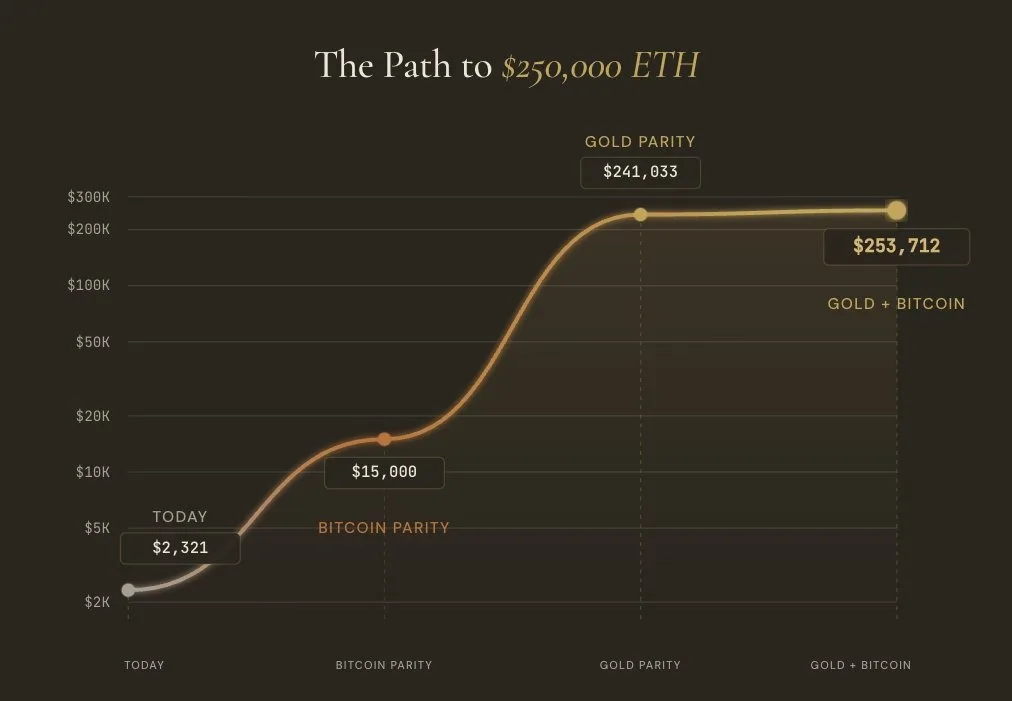
Citing Ethereum’s feature as a store of value, like Bitcoin and gold, as well as a productive asset that generates returns, Etherealize, the business development arm for the ecosystem, updated its long-term target for Ethereum. According to their thesis, Ethereum is capable of hitting $250,000, given that it captures the premiums of gold and bitcoin combined together.
ETH will hit $250K once if it captures gold and BTC premium
Priced at $2,300 with a circulating supply of 121 million ETH, the coin would need to hit $250,000 given that it captures the premium of $31 trillion in Bitcoin and gold combined together.
Explaining the logic behind Ethereum hitting $250,000 per coin, Etherealize mentioned that unlike gold and Bitcoin, Ethereum was not inert. Gold was valuable because it did nothing – it didn’t expire, it didn’t corrode, and its supply didn’t increase much, so the scarcity was there. In the same sense, Bitcoin: 21 million coins, no governance, no surprises. Just sit there and hold value.
Staking ETH earns rewards unlike holding Bitcoin and gold
Quoting Warren Buffet, CEO of Berkshire Hathaway, in the blog article, Etherealize states, “Gold, however, has two significant shortcomings, being neither of much use nor productive.
True, gold has some industrial and decorative utility, but the demand for these purposes is both limited and incapable of soaking up new production. Meanwhile, if you own one ounce of gold for an eternity, you will still own one ounce at its end.”
But the story shifts when it comes to owning Ethereum. ‘ETH dissolves this distinction.’ Unlike gold and Bitcoin, which hold their value, ETH generates a return simply from being held and staked.
For instance, when you stake one ETH today, it will be more than one ETH a year from now. That alone disqualifies it from Buffett’s criticism of gold.
However, the question that begs an answer is whether this property, combined with ETH’s other monetary attributes, is sufficient to capture the $31 trillion monetary premium currently held by gold and Bitcoin.
ETH supply maintenance makes it deflationary
According to Carl Menger – the founder of the Austrian school of economics and the author of the most influential theory of money’s origins ever – a good becomes money based on a combination of attributes, and the most important feature is resistance to supply dilution.
For instance, when the prie of gold rises, never can any miner dwarf the supply of gold with new supply and annual production.
Likewise, ETH’s issuance is capped at roughly 1.5% annually, and its burn mechanism actively destroys ETH in proportion to network usage, making the effective supply potentially deflationary.
Less risk is involved in staking ETH compared to holding gold
Buffett further argued, “Why would I hold any of them when they generate nothing?”
When it comes to money, it can be used to earn a return through lending, but that requires converting it into a credit instrument – a loan, a bond, a deposit – and accepting counterparty risk, bad debt, and so on.
A gold coin in a vault earns nothing. In addition, you usually have to pay someone to store it and keep it safe (e.g., vault fees, insurance, and transport). When it comes to earning yields on dollars, you have to give them up entirely. Giving them up means trusting the bank, the borrower, and the government.
However, ETH breaks this tradeoff. When staking ETH, it is not lending. There is no borrower, no bank, no counterpart. You lock ETH into the Ethereum protocol’s consensus mechanism and earn yield from the issuance rewards and transaction fees the network generates.
“The ETH remains yours. You can unstake and withdraw. The yield is not compensation for counterparty risk—it is compensation for providing security to the network and accepting protocol risk (validators who act maliciously are slashed and lose a portion of their stake).”
ETH crosses 50-day moving average
Meanwhile, Ethereum prices have crossed a major resistance level, the 50-day moving average, which is a short-term indicator. When price breaks above the 50-day EMA, it is generally considered a sign that short- to medium-term momentum is shifting in favor of buyers.
The 50-day EMA is frequently utilized as a trend indicator, as it represents the average price over the last few months, but with more significance attached to recent price behavior.
Once an asset crosses over from below this moving average line to above it, this implies that the selling momentum is waning, and the buyers are beginning to take control. In most instances, this crossover signals the start of an upward trend after the decline or consolidation period.
Post-breakout, the 50-day EMA will switch roles from being a resistance level to becoming a support level. Investors usually wait for a price to retest this line and bounce back above it.
While crossing this short-term indicator, ETH also formed a double bottom pattern, which has led to an upward breakout.
A breakout from double bottom pattern will see ETH hit $2.8K
A double bottom formation typically occurs after a downtrend and suggests that the downward momentum may start losing steam. It takes the shape of the letter “W” and develops when there is a fall in price to a specific low, after which there is a rise, followed by another drop to another low of similar magnitude, before finally rallying strongly.
The first fall marks the beginning of a zone of support, where buying pressure drives the price upward, but not enough to turn the trend around.
This causes the price to fall again, testing the support level, and failing yet again to fall further below it.
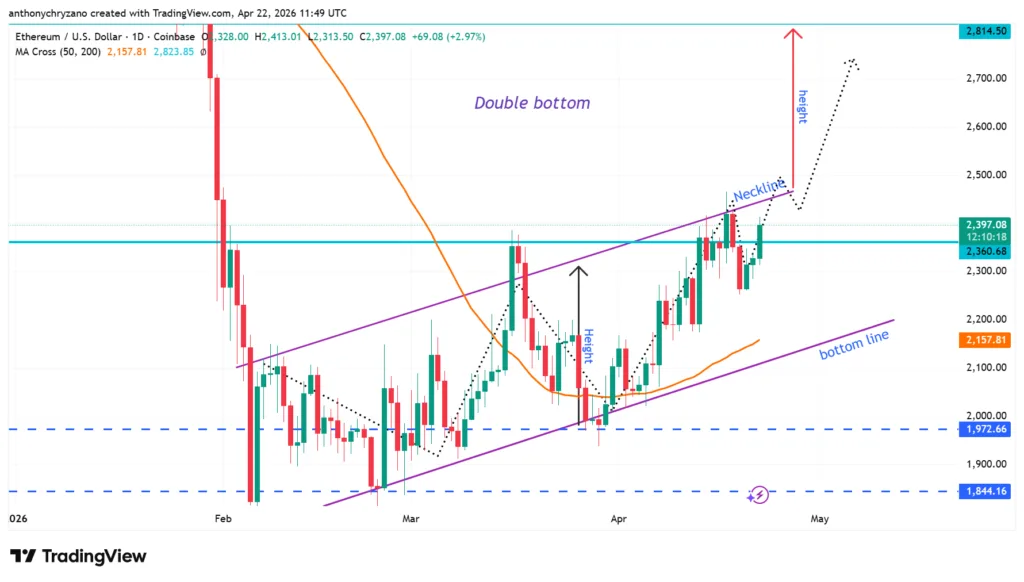
Unlike a conventional double, which has its lows at the same level, the second low is a bit higher. When a “double bottom” forms but the second low is slightly higher than the first, it usually reflects a subtle shift in market strength during the selling phase.
A conventional double bottom sees both bottoms at an equal level because sellers are constantly able to push prices down to exactly the same support level until they fail to do so.
In the case where there is a higher second low, it is indicative that sellers are losing steam in driving prices down, as they are unable to do so as they had done in the previous decline.
Once the prices break out from the double bottom pattern, as it has already done, there will be a major rise, which is equivalent to the difference between the bottom line and neckline. As such, ETH could rise and hit at least $2,800.