



Ethereum is once again testing the 200-week moving average after losing it in January. The coin is approaching this vital resistance level just when the ETH available on exchanges is drastically dropping below 15 million. Most coins moved from exchanges are staked on ETH, not transferred to cold wallets.
On the weekly chart, Ethereum is once again retesting the 200-day moving average after the dawn of 2026 drowned the coin below the $2,400 level. The 200-day Simple Moving Average (SMA) is widely regarded as one of the most important indicators in technical analysis because it reflects the long-term trend of an asset.
Pushing past this resistance level is seen as a potential shift from a bearish to a bullish phase, as it signals that price has regained strength after a prolonged period of weakness.
This level has significant importance, as retail and institutional traders closely monitor it, and systematic trading models frequently employ it as a trend confirmation tool. When the price moves above it, it can attract new buying interest, improve market sentiment, and sometimes trigger algorithmic inflows.
The 200-day SMA also acts as a dynamic support and resistance level—acting as resistance in downtrends and turning into support during uptrends. Reclaiming it can indicate a possible trend reversal or recovery phase. However, traders usually wait for confirmation, such as sustained closes above the level, rising volume, and the formation of higher lows, to avoid false breakouts.
Ethereum maintain long bullish trend despite huge crash
Ethereum has broken above this critical level (200-day SMA) after almost 3 months. Back in January 2026, the coin reached as high as $3,400 after the geopolitical conditions seeped into the market, dragging the prices below the psychological level at $3,000.
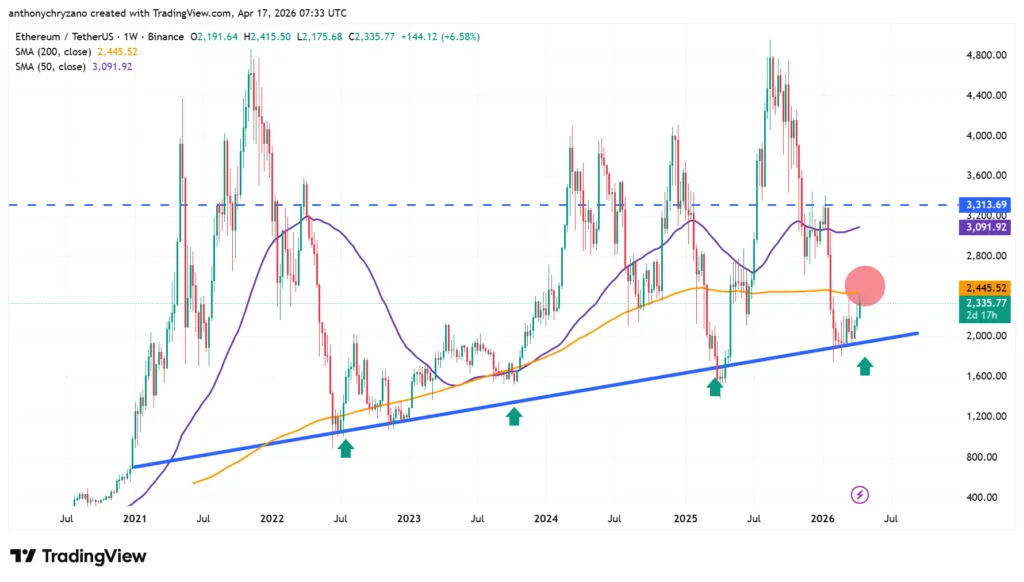
Despite this massive fall, Ethereum was still able to maintain its long-term uptrend. As shown in the chart above, Ethereum is still managing to hold on to its trend of making higher lows. This shows that the market is still respecting the long-term bullish structure.
Even during sell-offs, buyers are not allowing the price to fall below previous major support zones, which indicates accumulation rather than full distribution. This kind of price behavior often reflects a market that is correcting within an uptrend rather than entering a full bearish reversal.
ETH on exchange reserve tanks from 21 million to 15 million
Meanwhile, the exchange reserves have been tanking over the last quarter. From 21 million in September 2025, the reserve on the exchange tanked to as low as 15 million. When comparing the price behavior of the coin with the drop in exchange reserves, the reserves level was free-falling when ETH prices hit values above $4,000. And the decline in supply on exchanges continued, despite ETH losing value.
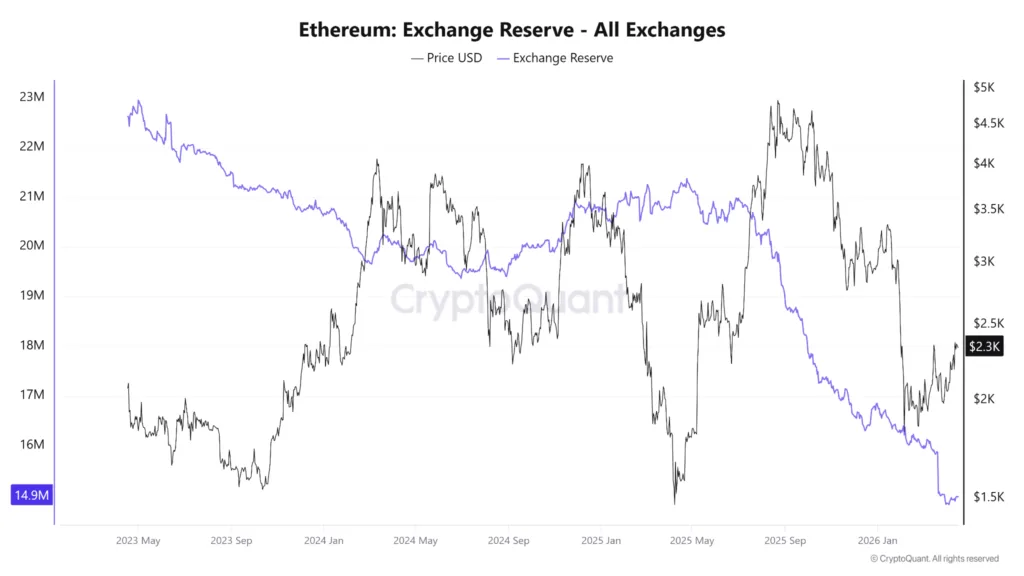
A drop in exchange reserves means that fewer coins of Ethereum are being held on centralized exchanges and more are being moved into private wallets, staking platforms, or DeFi protocols.
This is generally interpreted as a reduction in immediate selling pressure, since coins held off exchanges are less likely to be sold in the short term. Often, it also reflects accumulation behavior, where investors are choosing to hold their assets for longer periods in anticipation of future price appreciation.
Even though ETH was falling from above $4,000, the fact that exchange reserves were also steadily declining means that coins were being continuously withdrawn from exchanges instead of being deposited for selling. In other words, market participants were not sending ETH to exchanges to exit positions – even during the price decline.
Where is ETH ending up after being removed from exchanges?
Not all the ETH moved out of the exchange ends up in cold wallets. For instance, some ETH could be used for staking activity or participation in decentralized finance. When deployed in the above activity, ETH is locked into smart contracts to earn yield, and it reduces circulating liquidity.
Going by the charts, staking has consumed a significant portion of the supply exiting the exchange. The chart below shows that the total value staked on Ethereum had a drastic rise since the beginning of 2026. The total value stake has risen from 36 million in January to above 39 million as of today.
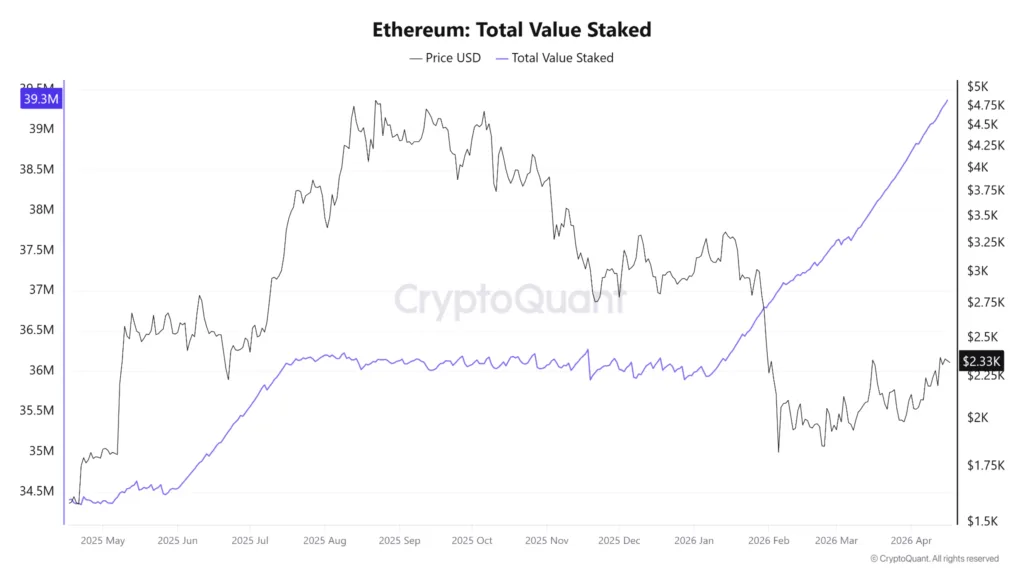
This rise indicates that a significant portion of ETH departing from exchanges is not for sale but rather forlong-term yield-generating position. This shows investors opt to earn staking rewards rather than keep assets liquid for trading. When ETH is moved out of the market, it reduces circulating supply and tightens liquidity in the market, and this can have a structural impact on price over time.
Participants appear to be positioning for long-term yield and network participation and are neglecting the short-term fluctuations.
Moreover, the ongoing rise in staking even when there are price fluctuations signifies that the traders have full faith in their decision-making process. Apart from indicating the trust of the trader in the Ethereum platform, it further shows how Ethereum is shaping itself to be a profitable investment option for the future.
On the other hand, this phenomenon adds to the general effect of supply constriction. With more and more ETH being used for staking, there will be fewer coins left for trading on exchanges, making the prices more volatile once the demand resumes.
With dwindling amounts of exchange inventory, the outcome will be a gradual constriction of liquidity from behind the scenes.
Ethereum staking provides an average return of 3% to 5% per year. However, the return on investment is not static and may vary based on network performance.
The returns on investment arise from the issuance of new Ethereum tokens, transaction fees, and other sources of income such as MEV (Maximal Extractable Value).
ETH validator entry wait time increases
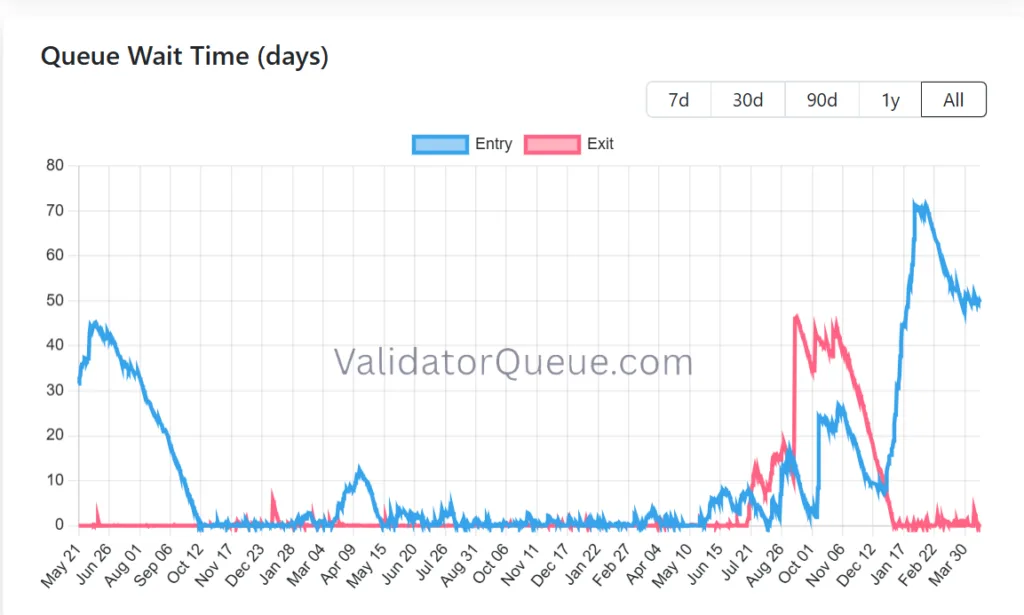
The queues at the entry and exit of the validators show great variations, as is seen in the graph above. The huge variation in the queue time of around 49 days in the case of Ethereum’s validator entry compared to 4 hours in the case of the validator exit is significant.
A wait time of 49 days implies that a new validator will be required to wait for such a significant period before entering the network.
Such delays in the process are likely to occur in cases where there are too many stakers who want to stake their ETHs. In other words, there are many people who are willing to stake their ETH and earn through this process; however, the network cannot meet the excessive demand.
However, an exit queue of four hours signifies how easy it is for validators to exit the network once they decide to unstake their shares.