


When the largest DeFi hack of 2026 unfolded in broad daylight, every second counted. Circle appeared to have a six-hour window where no action was taken. Now, a federal courthouse in Massachusetts is about to decide who really owns the kill switch on your stablecoin.
There is a moment in every great financial scandal when a single detail becomes impossible to unsee. In the case of what we are now calling the Circle Drift Protocol hack lawsuit, that detail is devastatingly simple: nine days before $230 million in stolen USDC flowed freely through Circle’s own bridge infrastructure and into the Ethereum ether.
Circle’s compliance team had found the time and the legal will to freeze 16 business wallets belonging to exchanges, casinos, and payment processors as part of a sealed civil case. Sixteen wallets. Legitimate businesses. Frozen.
Then came April 1, 2026. Over one hundred transactions. Six to eight hours. A nine-figure heist executed in plain sight across Circle’s Cross-Chain Transfer Protocol during U.S. business hours in U.S. market time zones. And not a single freeze.
ZachXBT, the on-chain investigator whose public posts have rattled trillion-dollar markets before, put it with characteristic bluntness, tagging Circle and CEO Jeremy Allaire directly: “Circle was asleep while many millions of USDC were swapped via CCTP from Solana to Ethereum for hours from the 9-figure Drift hack during US hours. Value was moved, and nothing was done yet again.”
He went further, calling the contrast with the March 23 business wallet freeze “potentially the single most incompetent” enforcement action he had witnessed in five years of on-chain investigation. Security researcher Specter added a chilling forensic footnote: the attacker had deliberately avoided converting stolen funds into Tether’s USDT during the bridging process, apparently confident that Circle was unlikely to intervene. That confidence, it turned out, was well-placed.
The hack that should not have been possible, until it was
Before we talk courtrooms and class certifications, let’s be precise about what actually happened, because the Drift Protocol exploit was not a sloppy grab-and-run. It was a six-month operation.
North Korea-linked hackers, likely the Lazarus Group, according to blockchain analytics firm Elliptic, spent roughly half a year infiltrating Drift Protocol, Solana’s largest decentralized perpetual futures exchange, by posing as a legitimate quantitative trading firm. They cultivated relationships with Security Council members and contributors.
Then, between March 23 and 26, they used a peculiarity of Solana called “durable nonces,” a feature designed for legitimate offline transaction signing, to pressure those insiders into blind-signing transactions that appeared routine but secretly contained delayed instructions to transfer full administrative control to attacker-controlled addresses.
On April 1, 2026, at approximately 16:05 UTC, the first pre-signed transaction fired. Administrative authority over Drift Protocol transferred to the attacker in one silent, valid, on-chain action. What followed was a masterclass in speed: the attacker whitelisted a fake token called CVT as collateral, then used the newly acquired admin powers to drain real assets from the protocol.
According to blockchain analytics firm Arkham, Drift’s main vault was emptied in roughly 12 minutes. The protocol’s total value locked crashed from approximately $550 million to under $250 million within an hour. The DRIFT token dropped more than 40%. At least 20 other Solana DeFi protocols reported indirect losses from exposure to Drift. The haul: $280 to $285 million, depending on which forensics firm you ask. What happened next is what brought Circle into a federal courtroom.
The bridge, the clock, and the six-hour window
After the initial drain, the attacker converted a substantial portion of stolen assets into USDC, the dollar-pegged stablecoin issued by Circle Internet Financial, and then used Circle’s own Cross-Chain Transfer Protocol (CCTP) to move approximately $232 million from Solana to Ethereum.
Not in one transaction. Not in a suspicious single blast that might trigger automated flags. In more than 100 separate transactions, spread across six to eight hours, during the American business day. This is where the Circle Drift Protocol hack lawsuit finds its most powerful plaintiff argument.
CCTP is not some third-party bridge that Circle built once and forgot about. It is Circle’s proprietary cross-chain infrastructure. Circle operates its message-passing layer. Circle maintains blacklist authority over USDC addresses under its own terms of service, which explicitly reserve the right to freeze assets tied to suspicious activity.
And here, in Circle’s own lane, approximately $232 million in suspected stolen funds were moving, not speeding, not obscured, just steadily, methodically moving from Solana to Ethereum across 100 transactions over the better part of a working day.
Circle issued a formal statement that reads precisely like a company that had its legal team in the room: “Circle is a regulated company that complies with sanctions, law enforcement orders, and court-mandated requirements. We freeze assets when legally required, consistent with the rule of law and with strong protections for user rights and privacy.”
Jeremy Allaire later elaborated: freezes happen when directed by courts or law enforcement, not by internal discretion, not in real time during hacks.
The Drift Protocol network posted on X, confirming the attack and suspending deposits and withdrawals, adding, in a statement that landed with dark irony, “This is not an April Fools’ joke.”
McCollum v. Circle: What the lawsuit actually says
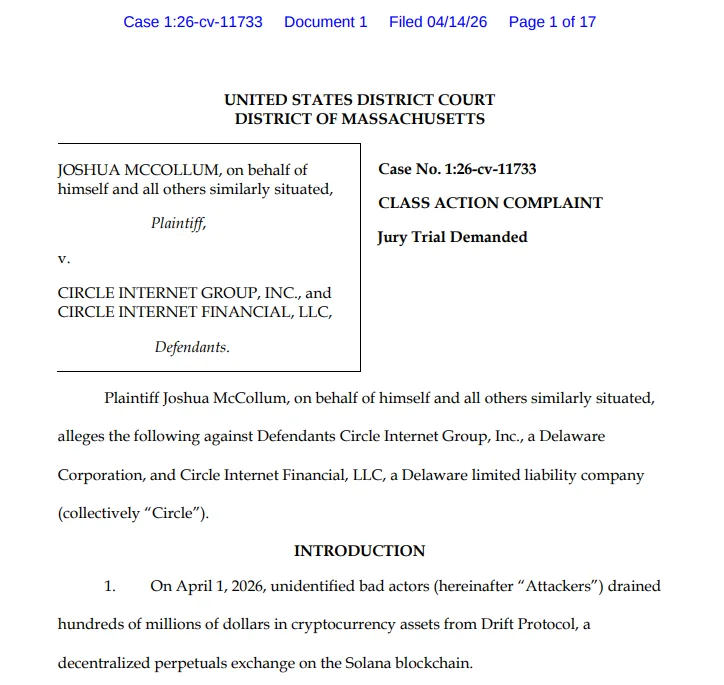
On approximately April 14 to 16, 2026, Drift Protocol investor Joshua McCollum filed a class action in the U.S. District Court for the District of Massachusetts on behalf of more than 100 class members. The law firm Gibbs Mura, A Law Group, Oakland-based financial fraud specialists who have recovered more than a billion dollars in prior cases, led the filing. A second, related investigation was simultaneously opened by affiliated attorneys at Silver Law Group.
The complaint’s legal architecture rests on two pillars.
- First, negligence: that Circle may have owed a duty of care to users whose funds transited its infrastructure and breached that duty by failing to act during a known, ongoing exploit and that this inaction directly caused or substantially magnified investor losses.
- Second, aiding and abetting conversion: by knowingly permitting the real-time movement of stolen USDC through its bridge without intervention, Circle may have facilitated the movement of allegedly stolen property.
The “nine days” contrast is not just rhetorical. It is the legal linchpin. Plaintiffs need to establish that Circle had both the technical capability and the behavioral precedent to freeze. The March 23 wallet freeze, 16 legitimate business accounts frozen under a sealed civil case, provides exactly that. If you can freeze a forex broker’s hot wallet for a civil proceeding, plaintiffs argue, you can freeze a hundred transactions carrying the proceeds of the largest DeFi hack in two years.
The lawsuit also details a broader pattern. On-chain analysts, including ZachXBT’s publicly released “Circle Files,” allege that Circle has allowed over $420 million in illicit USDC flows to go unfrozen across multiple significant hacks since 2022. These are not judicial findings, but they will form the factual record plaintiffs seek to present. In that framing, the Drift non-freeze is not an isolated lapse; it may suggest a repeated institutional posture.
Damages will be determined at trial. With over $230 million in documented stolen USDC and at least 20 DeFi protocols caught in the blast radius, the exposure number is very large.
ARK, rule of law, and the uncomfortable counter-argument
To be fair, genuinely fair, Circle and its defenders are not without a coherent position. ARK Invest’s director of digital assets research, Lorenzo Valente, made the case clearly: if Circle freezes the Drift hacker’s funds without a court order, then every future freeze becomes a judgment call.
Every non-freeze becomes a political statement. Who decides which nine-figure exploit crosses the threshold? Who arbitrates between the hack that gets frozen and the “sketchy wallet” that doesn’t?
Valente framed it starkly: “Every future freeze is now a judgment call. Every non-freeze is a political statement. Why freeze the Drift hacker but not that sketchy Nigerian fraud wallet? Why this protester but not that one?”
This is not a strawman. Bluechip founder and CEO Ben Levit put the tension even more precisely: “USDC can’t be positioned as neutral infrastructure while also allowing discretionary intervention without clear rules. Markets can handle strict policies or no intervention, but ambiguity is much harder to price.”
Ambiguity, it turns out, is exactly what both the Drift victims and the broader DeFi ecosystem are now paying for, in dollars, in legal fees, and in confidence.
The market already gave its verdict
Before any judge does. Circle Internet Group stock (CRCL) closed down 9.9% to $85.10 on April 9-10, 2026, following a simultaneous Compass Point downgrade from “neutral” to “sell” with a $77 price target, implying further downside.
The shares were already down approximately 24% over the prior month and 43% over the prior six months, a brutal stretch for a company that had one of the most hyped public market debuts of 2025, pricing its IPO at $31 per share before rocketing past $250.
The downgrade cited revenue concentration risk; Circle’s dependence on USDC transaction fee income makes it disproportionately sensitive to market share loss. And market share loss is now a genuine, structural risk, not just a theoretical one.
On April 16, 2026, less than three weeks after the hack, Tether announced a proposed rescue package of up to $127.5 million (with an additional $20 million from partners) to back Drift Protocol’s recovery and relaunch. The structure is revenue-linked, designed to repay an estimated $295 million in total user losses over time. The relaunch will be built on USDT, Tether’s stablecoin. Not USDC.
Drift, one of Solana’s flagship DeFi venues with over 175,000 users and roughly $150 billion in cumulative trading volume, is switching settlement layers entirely. That is not a temporary workaround. It is a competitive loss for Circle with long-term network effects; DeFi protocols that shift their plumbing rarely shift it back.
Key takeaway on the Circle Drift Protocol hack
A North Korean intelligence operation spent six months building a trap. It took 12 minutes to spring it. It took six hours of transiting Circle’s own infrastructure to launder the proceeds. And now it will likely take years of federal litigation to determine who bears responsibility for the losses.
Here is what we know. The Circle Drift Protocol hack lawsuit is not about whether USDC is a good stablecoin. It is not about whether Circle’s compliance team is populated by bad actors. It is about a single, foundational question that the growth of stablecoin infrastructure has made unavoidable: when a centralized issuer holds significant practical influence over a decentralized network, do they also carry practical responsibility?
ZachXBT’s tweet was blunt. The lawsuit is precise. The market has already moved. The judge gets the final say.