

The way money moves online is changing fast. Blockchain payments used to mean slow confirmations and fees that made small transactions completely pointless. That’s not the case anymore.
Layer 2 networks have made it possible to send fractions of a dollar across borders in seconds, at almost no cost. And sitting right at the center of it all is a newer framework called PayFi, which is quickly becoming the backbone of how digital payments work in 2026.
Before getting into Layer 2, it helps to know what Layer 1 is. Layer 1 is the main blockchain itself. Bitcoin and Ethereum are the two biggest examples. They’re secure and reliable, but slow and expensive when a lot of people use them at once. Layer 2 networks are built on top of Layer 1 to handle the speed and cost problem, while still using the main chain for security.
What is PayFi?
If you’ve ever paid $15 to send $50 to a relative abroad, or waited three business days for a payment to clear, that’s the exact problem PayFi is built to solve.
PayFi stands for Payment Finance. At its core, it’s what you get when traditional payments meet decentralized finance. The goal is simple: move money faster, cheaper, and without geographic limits.
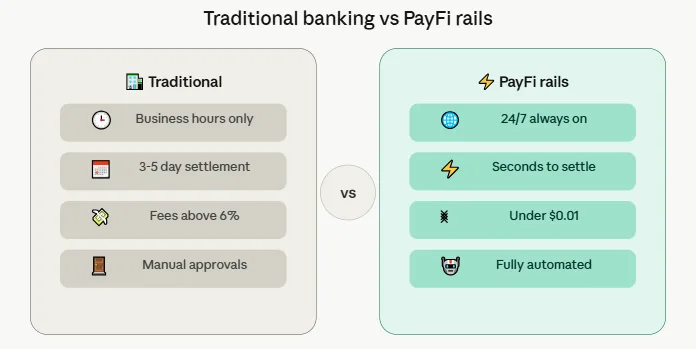
Unlike a bank wire that only works during business hours or a credit card payment that settles over several days, PayFi operates around the clock. There’s no waiting window nor any batch processing at the end of the day.
Think of it like the difference between mailing a check and sending a text. One travels on someone else’s schedule. The other arrives the moment you hit send.
PayFi rails and real-time settlement
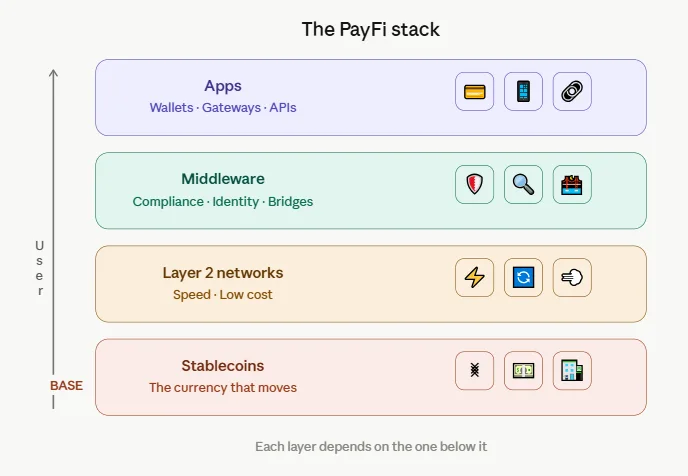
PayFi rails are the underlying infrastructure that move money within a PayFi system. The stack has four main parts:
- Stablecoins at the base, which act as the actual currency being moved
- Layer 2 networks that keep things fast and affordable
- Middleware that handles compliance, identity, and bridging crypto to traditional finance
- Apps and tools that real users actually touch, like wallets, payment gateways, and APIs
Traditional banking has closing times. Stablecoins don’t. That’s really what makes PayFi rails work. Because the currency never goes offline, payments can settle any time, any day, with no one needing to manually push them through.
Why low-cost transactions matter
Bitcoin’s base layer handles a handful of transactions per second. Ethereum handles a few more. Traditional card networks handle tens of thousands per second. That gap is why Layer 2 networks became necessary in the first place.
Low-cost transactions weren’t just a nice feature. They were the thing that made micropayments viable. If processing a payment costs more than the payment itself, the whole model falls apart. Layer 2 solved that problem.
On networks like Polygon, fees are a fraction of a cent per transaction. On Base, the average fee is well under a cent. On the Lightning Network, fees are so small they’re barely measurable.
That shift opened up things like:
- Paying per view instead of a monthly subscription
- Per-minute billing for services
- Machine-to-machine payments for AI and API usage
- Near-zero-cost cross-border remittances
Low-cost transactions are what turned micropayments from an idea into something that actually works.
High-throughput blockchain and why speed matters
A high-throughput blockchain can handle a large number of transactions per second without slowing down or getting expensive.
The Lightning Network can theoretically handle millions of transactions per second. Base handles thousands per second under real load. That kind of capacity is what makes a high-throughput blockchain useful for real payment infrastructure, not just crypto trading.
Speed matters for a simple reason: payments can’t feel like waiting. Whether it’s someone buying a coffee or an AI agent paying for API access, the transaction has to go through instantly. A high-throughput blockchain makes that possible without the congestion problems of a main-chain network.
Layer 2 micropayments in 2026
Choosing the best Layer 2 for payments means understanding what each network is actually built to do. Layer 2 micropayments work differently depending on the network, and each one has a specific use case it’s best suited for.
Lightning Network
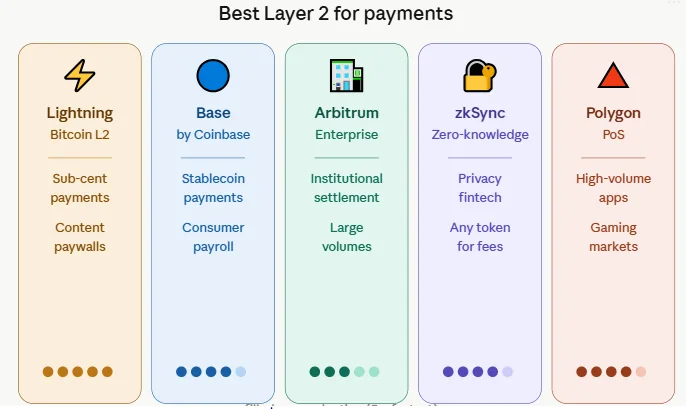
Lightning Network is Bitcoin’s Layer 2 and the strongest option for sub-cent micropayments. It opens payment channels between parties and lets them send funds back and forth instantly with near-zero fees. It’s built for content paywalls, API metering, and streaming payments.
Base
Base, built by Coinbase on Ethereum, is aggressively focused on stablecoin payments and consumer adoption. Its 2026 roadmap includes privacy features, stablecoin fee options, and expanded liquidity for USDC. Global payroll platforms have already rolled out stablecoin payout options on Base.
Arbitrum
Arbitrum is where institutional money moves. It holds billions in stablecoin supply and processes enormous stablecoin transfer volumes every month. PayPal expanded its PYUSD stablecoin onto Arbitrum specifically, citing micropayment viability and sub-cent transaction costs as core reasons.
zkSync Era
zkSync Era uses zero-knowledge proofs to verify transactions before they’re confirmed. It’s fast, cheap, and lets users pay fees in any token rather than just ETH, which removes a major friction point for everyday payment apps.
Polygon PoS
Polygon PoS offers some of the lowest fees in the ecosystem and is widely used for high-volume apps, gaming platforms, and emerging market payment products where consistent, cheap throughput is the priority.
Layer 2 micropayments across these networks cover everything from tiny content tips to cross-border business settlements.
Stablecoin payments as the backbone
Stablecoin payments are the fuel that makes PayFi work. If the currency itself is swinging 10% in value daily, pricing anything in it becomes a headache. Stablecoins remove that problem.
Stablecoin market cap has crossed $310 billion as of 2026. Governments in major economies are working on clear rules around them. On the corporate side, large retailers are seriously looking at paying vendors in stablecoins, mostly because waiting three days for a bank settlement when you could settle in seconds is hard to justify.
What makes stablecoin payments useful is that they run on their own. You set the conditions, and the payment handles the rest. No one needs to be at a desk approving each transaction.
PayFi infrastructure 2026: Where things actually stand
PayFi infrastructure in 2026 isn’t theoretical. It’s running in live systems. At the Web3 Hub Davos in January 2026 – a side event held during the World Economic Forum – leaders from Arf, LuLu Financial Holdings, and the Stellar Development Foundation confirmed that programmable liquidity is now active in institutional payment corridors. The conversation shifted from whether to adopt PayFi infrastructure to how quickly.
Sending money across borders through stablecoin rails now takes seconds and costs less than a dollar. Compare that to traditional wire transfers that regularly charge above 6% in fees. Payroll platforms have started offering crypto payouts over Layer 2. And AI agents are quietly starting to use the same rails to handle automated payments between systems.
The gap between legacy payment systems and Layer 2 stablecoin rails isn’t narrowing. It’s getting wider.
The best Layer 2 for payments: A quick breakdown
The best Layer 2 for payments depends on what’s being paid for.
- For sub-cent Bitcoin payments and content monetization: Lightning Network
- For stablecoin consumer payments and payroll: Base
- For enterprise settlement and large stablecoin volumes: Arbitrum
- For privacy-first fintech apps: zkSync Era
- For high-volume apps needing reliable, cheap throughput: Polygon PoS
There’s no universal winner. The best Layer 2 for payments is the one that fits the transaction type, user base, and compliance needs of the product being built.
The shift toward Layer 2 micropayments and PayFi infrastructure didn’t happen overnight, but in 2026, it’s hard to ignore.
Low-cost transactions, real-time settlement, and high-throughput blockchain networks have collectively closed the gap between what crypto promised and what it can actually deliver.
If you want to see this firsthand, the easiest starting point is downloading a Coinbase Wallet and sending a small USDC payment on Base. Fees will be under a cent and it settles in seconds. That one experience will make everything in this piece click.