


Blockchain was supposed to transform finance, healthcare, and logistics. For years, though, enterprise pilots kept stalling. Not because the technology didn’t work, but because everything on a public blockchain is visible to everyone. For a bank or a hospital network, that’s not an inconvenience. It’s a hard stop.
Zero-knowledge proofs changed that. There’s now a growing category of privacy-first ZK chains built specifically for companies that need enterprise privacy alongside real regulatory compliance. These are the seven that matter in 2026.
Why enterprise blockchain kept hitting a wall
A public blockchain works like a shared spreadsheet that thousands of computers all keep a copy of. Every transaction, every balance, every counterparty relationship is permanently recorded and readable by anyone who checks.
That’s a serious problem for businesses. A company can’t put employee payroll, trade settlements, or sensitive client data on a ledger that competitors and regulators can read freely. It’s the core reason enterprise blockchain pilots from 2018 to 2024 rarely got past proof-of-concept stage.
Private data protection isn’t optional for enterprises. Under regulations like GDPR and CCPA, it’s a legal baseline. Any chain that can’t guarantee it won’t clear procurement, let alone production deployment.
How zero-knowledge proof infrastructure actually works
Zero-knowledge proofs are a cryptographic method where one party proves something is true to another without sharing any of the data behind it.
The clearest example: entering a bar that checks age normally means showing a full ID, which reveals a name, home address, and exact birthdate. A zero-knowledge proof lets someone prove they’re over 21 without sharing anything else. The bouncer gets the one fact they need and nothing more.
Applied to enterprise blockchain, a company can prove it processed a transaction correctly and met its compliance requirements without broadcasting sensitive financial details across the network. That’s the core of zero-knowledge proof infrastructure, and it’s why regulated industries are paying close attention to these chains right now.
The 7 privacy-first ZK chains for enterprise use
Each chain approaches enterprise privacy differently. Some were designed specifically for banks. Others work as privacy layers that plug into networks enterprises already use.
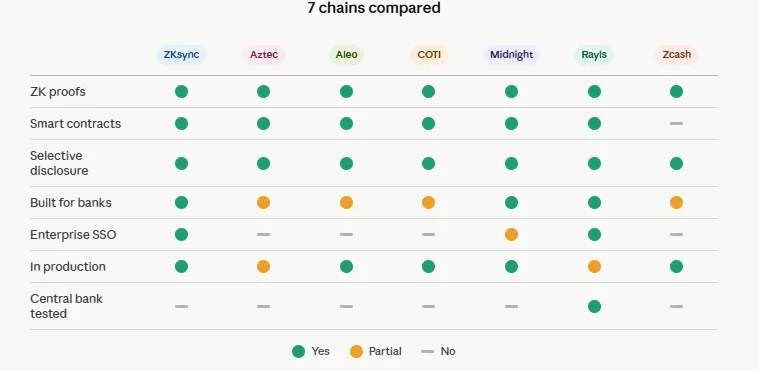
Here’s what sets each one apart.
1. ZKsync and the Prividium roadmap
ZKsync’s 2026 strategy centers on Prividium, a private execution environment built for institutional deployments. Each organization runs its own independent chain where transaction data, balances, and internal logic stay completely hidden from outside observers. Security is inherited from Ethereum, which verifies correctness in the background, without any of the transparency that comes with it.
The ZKsync Prividium roadmap includes support for enterprise identity tools like Okta and Azure, native cross-chain connectivity without external bridges, and performance built for institutional-scale financial workflows. Real-world asset tokenisation and confidential financial operations are already being piloted on it. Production deployments are expected to reach tens of millions of users later in 2026.
2. Aztec Network
Aztec rebuilt the entire stack from scratch with privacy as the default rather than adding it on top. Developers can mark individual functions in smart contracts as private or public, giving them fine-grained control over what stays confidential and what doesn’t.
The Ignition Chain went live in November 2025 as the first fully decentralized Layer 2 on Ethereum, with the Alpha Network adding full private smart contract execution on March 31, 2026. However, a critical security vulnerability in the proving system was discovered on March 17, 2026, and a fix is scheduled for the v5 release in July 2026. Enterprises evaluating it should factor in that it’s still in early-stage deployment, though the architecture itself is purpose-built for privacy from the ground up.
3. Aleo
Aleo is a zero-knowledge native Layer 1, meaning privacy isn’t layered on top of anything. It’s built into every transaction by default. Its compliance mechanism, “view keys,” lets companies grant auditors or regulators selective access to specific transactions without opening everything else.
In early 2026, two major stablecoin issuers launched private dollar-pegged tokens on Aleo, targeting enterprise payroll and treasury management. It’s one of the most concrete working examples of how confidential transactions and programmable compliance can coexist at the protocol level.
4. COTI
COTI works as an Ethereum L2 with Nightfall extending its reach to other Ethereum-compatible chains. Rather than requiring a migration to a new chain, it brings enterprise privacy to wherever a business already operates.
Its 2026 roadmap includes Nightfall, a ZK-based system for confidential transactions on Ethereum and compatible chains with built-in KYC-gating for regulated environments. EY’s Global Blockchain team publicly endorsed the deployment, adding notable institutional credibility to the project. COTI’s stated goal is making privacy available on-demand, without forcing organizations to start over from scratch.
5. Midnight by IOG
Midnight launched mainnet on March 31, 2026, backed by some of the most credible enterprise validator names in the space: Google Cloud, Vodafone, and eToro. Built by Input Output Global, the team behind Cardano, it uses zero-knowledge proofs to give developers precise control over what data is disclosed and to whom – a model the project calls “rational privacy.”
The architecture separates public and private state at the contract level, so developers can define exactly which parts of an application remain confidential without rebuilding around privacy as an afterthought. A Bank of England-regulated institution has already committed to a phased commercial deployment on the network. The current federated validator model is designed to transition to full decentralization in Q3 2026. For enterprises that need recognizable institutional infrastructure on day one, the validator roster alone sets Midnight apart from most chains at a comparable stage.
6. Rayls by Parfin
Rayls was built from the start specifically for banks and financial institutions, which separates it from nearly every other chain on this list. Each institution can run its own private subnet, a walled-off blockchain environment, while still connecting to the broader network when needed.
It’s already been tested by Brazil’s Central Bank for its digital currency program and was highlighted in JPMorgan’s institutional blockchain privacy research. Rayls’ Enygma protocol combines zero-knowledge proofs with homomorphic encryption for end-to-end private data protection. Mainnet V1 is scheduled to launch April 30, 2026, with privacy node updates planned through Q2 and Q3.
7. Zcash
Zcash has been running since 2016 and laid the groundwork for ZK cryptography in production, but it belongs in a different category from the chains above. It was among the first blockchains to show that ZK cryptography works in production at scale, and that history matters to enterprises in regulated industries.
Its view key system lets auditors check specific shielded transactions without accessing a full account history. It doesn’t have the smart contract programmability of Aztec or Aleo, but for enterprises focused primarily on confidential transactions and a clean audit trail, the network’s maturity carries genuine weight.
What a compliance-ready blockchain needs to deliver
Enterprise privacy isn’t just about hiding data. It’s about doing that in a way regulators can still verify when they need to.
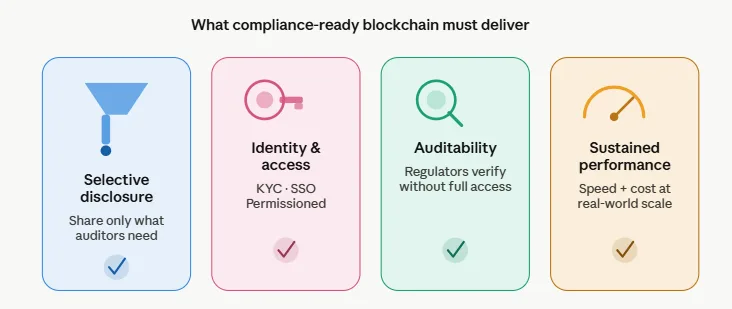
The chains worth serious consideration share a few common features:
- Selective disclosure: specific data can be shared with auditors without exposing everything else
- Identity and access controls: built-in KYC, permissioned access, or enterprise SSO integration
- Auditability: regulators can verify compliance without needing full transaction visibility
- Sustained performance: private data protection can’t come with prohibitive speed or cost tradeoffs at real-world scale
A compliance-ready blockchain has to solve both sides: strong confidentiality for the enterprise, and verifiable accountability for the regulator. Several of the chains above are already running in production environments that prove both are possible.
The gap between blockchain’s potential and enterprise adoption has always been a privacy problem more than a technology problem. Zero-knowledge proof infrastructure isn’t just a technical upgrade. It’s the reason enterprises in regulated industries are finally taking the infrastructure seriously.
Each chain here tackles the problem differently, and the right fit depends on the use case, regulatory environment, and the level of technical maturity a company needs on day one. What’s clear is that compliance-ready blockchain has moved past theory. Central banks are testing it, financial institutions are building on it, and the shift is well underway.