



Getting into blockchain usually starts with Bitcoin and Ethereum, maybe a little Solana after watching one too many YouTube videos at midnight. Somewhere along the way, someone mentions consensus algorithms, and the conversation either gets really interesting, or the other person suddenly remembers they have somewhere urgent to be.
Consensus algorithms are the most important part of how any blockchain works, and they’re just rarely explained in a way that makes sense to someone who isn’t already fluent in developer jargon. So let’s actually break that down the right way.
What is a consensus algorithm?
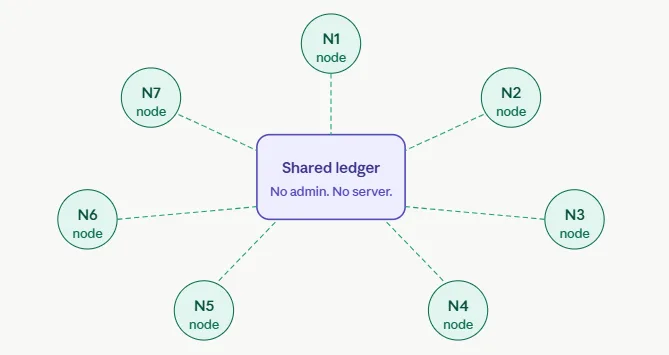
A blockchain is a shared notebook that thousands of strangers are all trying to write in simultaneously, with no editor, no admin, and no central server with a god complex calling the shots.
A consensus algorithm is the set of rules the network uses to decide which transactions are valid and who gets to add the next block. Without one, the whole decentralized dream collapses pretty quickly.
Proof of Work (PoW): Where it all started
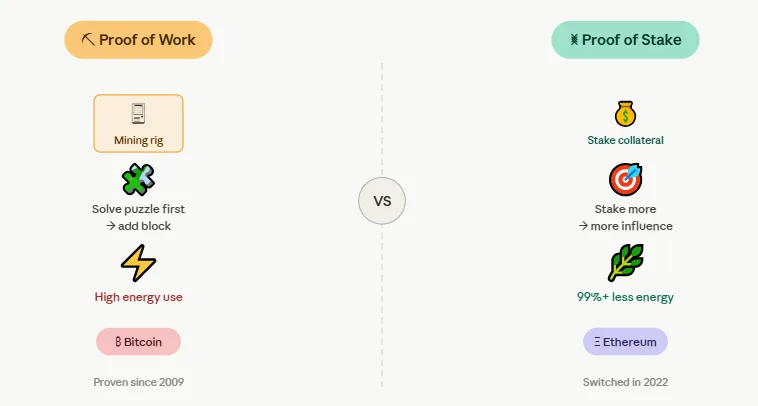
Proof of Work is the original, and Bitcoin has been running on it since the very beginning. Miners compete to solve computational puzzles, and whoever cracks it first earns the right to add the next block, which sounds reasonable until someone shows the electricity bill.
It’s proven and has survived well over a decade of attacks. But Proof of Work is energy-hungry and slow by modern standards, and those two problems together pushed developers to start thinking about better options.
Proof of Stake (PoS): The energy-friendly upgrade
Proof of Stake swapped the puzzle-solving grind for something more practical. Validators put up cryptocurrency as collateral, and the network selects them based on how much they’ve staked, which is basically the blockchain’s version of putting your money where your mouth is.
Ethereum made the full switch in 2022, and the numbers were honestly hard to believe: over 99% less electricity consumed practically overnight. That said, it’s not a perfect system. Validators who stake more carry more weight in the network, and that kind of imbalance can slowly tilt things toward centralization if nobody’s keeping an eye on it.
Proof of History (PoH): Solana’s cryptographic clock
Proof of History is where things get genuinely clever, and also where conference room whiteboard explanations tend to lose half the audience. It was developed by Anatoly Yakovenko, co-founder of Solana Labs, and it tackles consensus from a completely different angle.
Most blockchains spend a lot of time arguing about the order of transactions, which is a bit like a courtroom where everyone disagrees about what happened first, and nobody brought a watch. Proof of History skips that debate by building a cryptographic clock directly into the chain. Every event gets a timestamp using a sequential hashing chain that functions similarly to a Verifiable Delay Function, with each hash built on top of the previous one, creating an unbreakable sequence.
PoH doesn’t operate alone. On Solana, it works alongside Proof of Stake, where PoH handles timing and sequencing while PoS covers validation and security. Running a Solana validator is expensive and resource-heavy, which keeps the decentralization debate very much alive.
Delegated Proof of Stake (DPoS): The democratic approach
DPoS layers a voting system on top of PoS, which sounds like it would complicate things, but actually makes the network faster. Token holders vote for a smaller group of trusted delegates who validate on their behalf, like electing representatives except the ones who slack off actually get removed.
EOS and BitShares are the most well-known examples, with delegate pools kept deliberately small, usually between 21 and 101 nodes:
- Token holders vote for delegates who produce and validate blocks for the community
- Underperforming delegates can be voted out relatively quickly
- Block production follows a scheduled rotation with no chaotic scramble for the next slot
- The smaller validator set delivers high throughput without burning through energy
The real concern is when voter turnout drops, because power can end up concentrated in a handful of spots, and the whole thing starts feeling less like a decentralized network and more like a very exclusive club.
Proof of Authority (PoA): Reputation over collateral
Proof of Authority ditches token staking entirely. Validators are pre-approved, verified identities who put their actual reputation on the line, which is either reassuring or slightly terrifying, depending on how much someone trusts institutions.
PoA is a natural fit for private or consortium blockchains where participants already know each other. Enterprise supply chains use it, and carbon credit trading platforms have adopted it for private deployments. It trades open participation for speed and a design that regulators can actually work with.
PBFT: Built for distributed trust
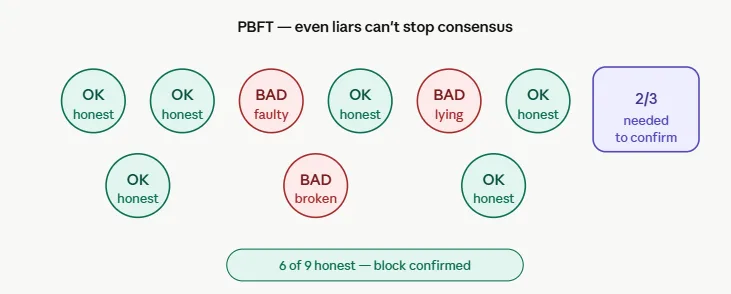
Practical Byzantine Fault Tolerance, mercifully shortened to PBFT, comes from academic research in distributed computing. The question it answers is simple: what happens when some nodes are broken, compromised, or actively lying to everyone?
Even if some nodes are lying or completely broken, PBFT keeps things moving by making sure a two-thirds majority has to agree before anything gets confirmed. Hyperledger Fabric, a widely used enterprise blockchain framework, leans on this same BFT approach in its ordering service for exactly that reason.
Research published in 2025 found it holds up well in Industrial IoT settings, where devices are limited and response time actually matters. The catch is scale: the more nodes you add, the more these nodes have to talk to each other, and that back-and-forth gets expensive fast, so PBFT really works best when the network stays small and permissioned.
Proof of Liquidity (PoL): Berachain’s DeFi-native model
Proof of Liquidity arrived with Berachain’s mainnet launch in February 2025, alongside one of the more creatively named token ecosystems in recent memory. In standard PoS, staked tokens sit locked up doing nothing productive. PoL flips that entirely by making liquidity provision the thing that actually secures the network:
- Validators stake BERA, the gas token, to secure the chain
- As they propose blocks, they earn BGT, a non-transferable governance token
- BGT flows to users actively providing liquidity to protocols on the network
- Applications can incentivize validators to direct rewards toward their own liquidity pools
Berachain keeps it running through three tokens: BERA handles gas, BGT sits at the governance layer, and HONEY is the native stablecoin. What makes it different is that rewards don’t just pile up at the validator level, they flow out to users and apps actively participating in the ecosystem.
Wrapping it up
Every consensus algorithm here exists because developers kept hitting problems the previous model couldn’t solve. Proof of Work built the foundation, Proof of Stake cleaned it up, and mechanisms like PoH, DPoS, PoA, PBFT, and Proof of Liquidity each carved out their own space by addressing limitations the earlier models left behind.
The underlying challenge is the Blockchain Trilemma: security, decentralization, and scalability can’t all be maximized at once, and every consensus algorithm makes deliberate trade-offs as a result. The best mechanism will always be the one that fits what a specific network actually needs, which is precisely why so many of them keep showing up.