


The way crypto traders bet on price moves has shifted in a big way. More money’s flowing through platforms with no company in the middle, and a handful of names are running the show.
The rise of DEX perps platforms ranks among the most interesting stories. They let traders use leverage, go long or short, and keep their funds in a personal wallet the whole time.
How DEX perps platforms work
A perpetual contract is basically a bet on where an asset’s price is going. Unlike a regular futures contract, there’s no expiry date. A trader can hold the position for as long as they keep enough collateral to back it.
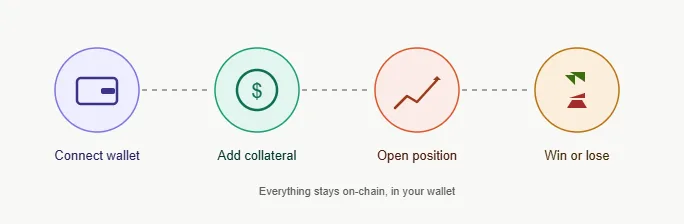
DEX perps platforms run entirely on smart contracts. No sign-up form, no ID check, no company holding deposits. A trader connects a wallet, puts up some collateral, and opens a position. Wins land back in the wallet. If a position drops too far, it closes automatically. That’s called liquidation.
1. Hyperliquid: The depth and liquidity king
Hyperliquid sits at the top of the table. It runs on its own custom blockchain built specifically for fast trading, with gasless orders and a feel close to a centralized exchange.
The platform leads on liquidity and open interest, holding more than 70% of total OI across the sector and roughly 44% of weekly perp DEX volume by Q1 2026. Its HIP-3 framework, which went live on mainnet in October 2025, lets anyone staking 500,000 HYPE launch their own perpetual markets, opening the door to commodities, tokenized equities, FX pairs, and almost anything else with a reliable price feed.
For traders who want the deepest book and the smoothest execution, Hyperliquid’s the usual first stop.
2. Aster: Multi-chain perps powerhouse
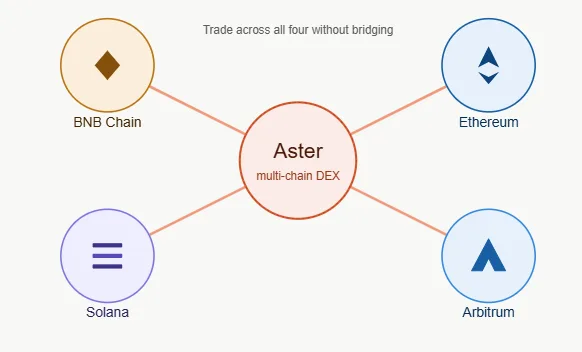
Aster takes a multi-chain approach. Traders can use it across BNB Chain, Ethereum, Solana, and Arbitrum without juggling bridges. Backed by some heavy hitters in the industry, it’s scaled up fast.
Standout features include:
- Up to 1001x leverage on majors like Bitcoin and Ethereum in Simple Mode
- “Hidden orders” that stay invisible on the public order book
- Tokenized stocks and metals alongside crypto pairs
- Yield-bearing collateral, so margin can earn passive returns while a trade’s open
Aster’s own privacy-focused Layer 1, Aster Chain, went live in March 2026, opening the door for more developers to build on top of it and bringing zero-knowledge encryption and stealth address features into the mix.
3. Lighter: Zero-fee zk-rollup contender
Lighter’s calling card is simple: zero trading fees for everyday users. It’s built as a zero-knowledge rollup tied to Ethereum, where every match and liquidation gets cryptographically proven on the base chain.
That matters for serious traders. If anything goes wrong with the sequencer, users can pull funds back to Ethereum on their own through the Escape Hatch.
For high-frequency strategies, paying nothing in fees changes the math entirely. The platform’s native LIT token launched in December 2025, with staking rewards going live at the end of January 2026.
4. edgeX: Institutional-grade mobile-first venue
edgeX runs on StarkEx and targets both retail and institutional traders. A big slice of its volume actually comes from phones, which is rare for derivatives venues.
A few highlights:
- Strong order throughput with low latency, with the engine targeting 200,000 orders per second
- Spot trading and perpetuals live today, with stock perps and prediction markets rolling out through the V2 upgrade
- Solid uptime through stressful market events
- Easy deposits from many different chains
When the broader market got hit by a brutal flash crash on October 10-11, 2025, edgeX held up cleanly. That kind of reliability earns serious trust from bigger players.
5. Paradex: Privacy-first Starknet appchain
Paradex runs as an appchain on Starknet and leans hard into privacy. Positions, entry prices, and liquidation levels all stay encrypted, so nobody can snoop around hunting for soft targets.
It also offers zero-fee retail trading and a wide product spread, including perpetual options. A unified margin setup lets one pool of collateral support several positions across different markets. The platform’s DIME token launched around early 2026, anchoring the next phase of its ecosystem.
For privacy-focused traders, there’s nothing quite like it among today’s DEX perps platforms.
6. dYdX: The original perps veteran
dYdX is one of the original names in decentralized derivatives. Version 4 lives on its own Cosmos-based chain, and the protocol’s been running through bull and bear cycles since well before most newer venues existed.
Volume’s much smaller than the headline names these days, sitting under 3% of total perp DEX market share after dominating the sector in earlier years. But trust runs deep. Governance feels mature, validators stay active, and token holders genuinely steer the protocol’s direction through ongoing upgrades, RWA perp launches, and DYDX buyback programs.
For traders who care about track record and a serious community, dYdX still earns its place.
7. GMX: Shared pool liquidity model
GMX takes a totally different approach. Instead of matching buyers with sellers, traders trade against shared pools of assets. Anyone can deposit into the pools and earn a slice of every fee.
A quick way to think about it:
- Tight pricing on swaps with low price impact, while perp positions use a dynamic price impact fee in V2 to keep markets balanced
- Liquidity providers earn real yield from actual trading
- The protocol now runs across eight major chains, including Arbitrum, Avalanche, Solana (as GMTrade), Ethereum, Base, BNB Chain, Botanix, and MegaETH
- Markets cover crypto, plus newer additions like gold and silver
The “real yield” model has held up through cycles, which is why so many providers keep their capital parked there.
8. Drift Protocol: Solana’s hybrid trading hub
Drift’s the leading perp venue on Solana. It blends an orderbook, an automated market maker, and just-in-time liquidity into one system, so a trade pulls from whichever source offers the best price at that moment.
What sets it apart:
- Cross-margin across perps, spot, lending, and borrowing in one account
- Up to 101x leverage on majors like BTC, ETH, and SOL, with lower caps on smaller pairs
- Sub-second execution thanks to Solana’s speed
- Strong support for native Solana assets as collateral
- A clean mobile experience for traders on the go
Volume’s modest compared to the headliners. Still, for anyone already inside the Solana ecosystem, Drift’s the natural home for derivatives.
Picking the right DEX perps platform for you
Every name on the list pulls in a different kind of trader, and the real question isn’t which one is “best” but which one fits how someone actually trades.
Anyone running serious size on majors usually lands on Hyperliquid for the depth and on edgeX when reliability through volatile sessions matters more than headline volume. Multi-chain users who don’t want to bridge between ecosystems gravitate to Aster, while traders who care about every basis point of fees tend to settle into Lighter or Paradex, with the latter pulling in the privacy-focused crowd that doesn’t want positions visible on a public ledger.
Solana natives almost always default to Drift because the cross-margin setup and ecosystem fit make everything else feel like extra steps. Liquidity providers chasing real yield instead of points programs lean toward GMX, where pool deposits earn a cut of actual trading fees. And anyone who values a long track record, mature governance, and a community that actually shows up for votes still finds a home on dYdX, even if the volume isn’t where it used to be.
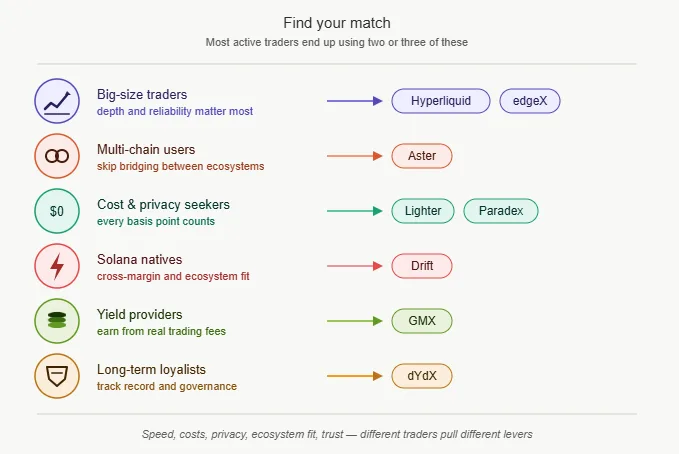
The short version: speed, costs, privacy, ecosystem fit, and trust each pull a different lever, and most active traders end up using two or three of these venues rather than picking just one.
Final thoughts
The way crypto futures get traded keeps shifting toward platforms where no company holds the bag. That’s a quiet but massive change, and the names above are the ones driving it.
Anyone stepping into this space should keep in mind that leverage cuts both ways. The same tools that can multiply gains can drain an account in minutes. Going slow, starting small, and learning a platform inside out before sizing up is the real edge.