



While ETH has fallen sharply from its October 2025 high near $4,700 – now trading closer to the $2,300 area—exchange data is telling a very different story underneath. On Binance, one of the most closely watched signals – the Taker Buy/Sell Ratio – is flashing its strongest bullish reading in years.
Ethereum buyers are stepping in aggressively
The 14-day simple moving average of Ethereum’s Taker Buy/Sell Ratio has climbed to 1.036, its highest level since April 2021. In simple terms, anything above 1 means buyers are more aggressive than sellers in the market.
Taker orders are the ones that “hit” the order book immediately. It means that this isn’t passive interest—it reflects real buying pressure.
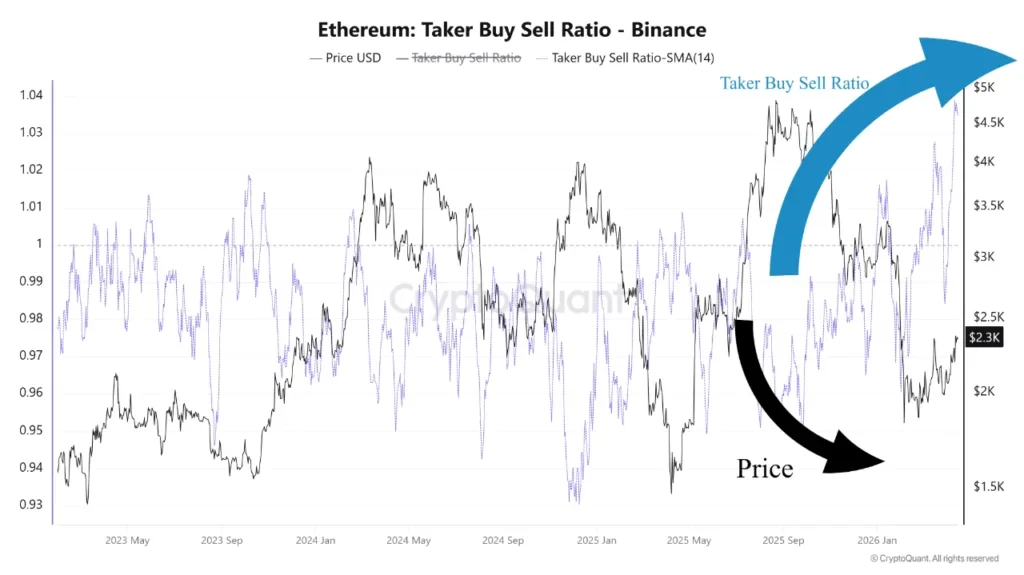
What makes this reading stand out is the context. It’s not happening during a rally or breakout. It’s happening during a steep drawdown. Price has been drifting lower for months, yet buy-side aggression is increasing rather than fading.
That kind of divergence is not something you usually see in a weak market.
Price down, but the demand is up
Normally, when the price declines, you expect participation to cool off and buyers to step back. Instead, Ethereum is showing the opposite dynamic. As ETH has fallen from its highs, taker buy volume has steadily overtaken taker sell volume on Binance.
This creates a clear split between price action and underlying order flow. On one side, the chart looks heavy and corrective. On the other hand, actual execution data suggests participants are actively accumulating into that weakness rather than exiting it.
It’s this mismatch that traders tend to pay attention to. When price is falling but aggressive buying is rising, it often signals that sellers are being absorbed rather than chased.
A potential absorption phase
This kind of behavior is often associated with what market participants call an “absorption phase.” In these periods, large buyers step in quietly while the broader market remains bearish. Instead of pushing price up immediately, they absorb supply that’s being sold into the market.
If that process continues long enough, it can eventually exhaust sellers. Once that happens, even a modest shift in demand can lead to sharper upside moves, simply because there isn’t much remaining supply at lower levels.
That is exactly why this divergence matters. While it doesn’t completely assure a reversal, it does hint that the structure of the market is changing beneath the surface.
What’s next for the market?
For now, Ethereum remains in a corrective phase on price charts. But the internal flow data is starting to look increasingly constructive. With taker buy pressure at multi-year highs while price sits near the lower end of its recent range, the market is showing signs of accumulation rather than distribution.
If this imbalance continues, Ethereum may be moving closer to a point where downside pressure begins to fade—and the next meaningful move starts to build from a very different foundation than the one visible on the chart alone.