



Ethereum hasn’t been making much noise lately, but beneath the surface, something interesting is happening. The amount of ETH sitting on exchanges – often seen as “ready-to-sell” supply – has been steadily declining, and it’s now at levels that look very different from previous cycles.
Ethereum exchange supply has dropped sharply
Data shows that Ethereum reserves on exchanges have fallen from roughly 35 million ETH to about 14.9 million ETH. That’s a drop of nearly 57%, which is significant by any standard.
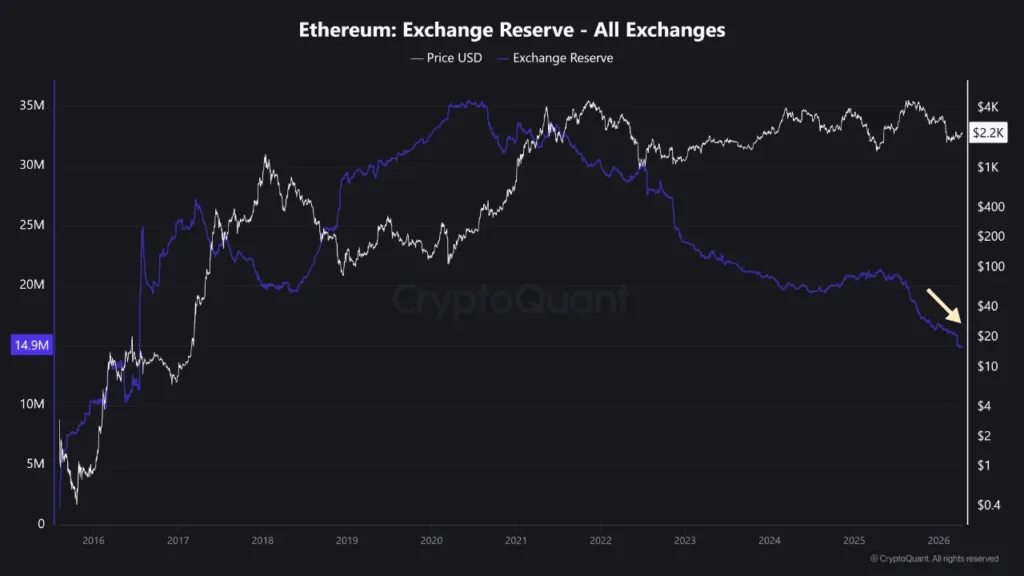
Such a fall typically hints toward a major change in behavior. Rather than keeping ETH on exchanges where it can be easily sold, more holders are moving it out of platforms – either into cold storage or using it for staking.
In simple terms, there’s less ETH sitting around waiting to be dumped on the market.
Compared to the 2020–2021 period, the difference is stark. Back then, exchange balances were much higher, and large amounts of ETH were readily available for trading. Today, that accessible supply looks much tighter.
Inflows are rising, but not like before
At the same time, there has been a recent uptick in ETH flowing back onto exchanges. Normally, that could be interpreted as a sign of potential selling pressure, since deposits often precede trades.
In some of the prior cycles – especially close to the 2021–2022 peaks – exchange inflows had increased a lot, sometimes climbing to the 10 to 20 million ETH range.
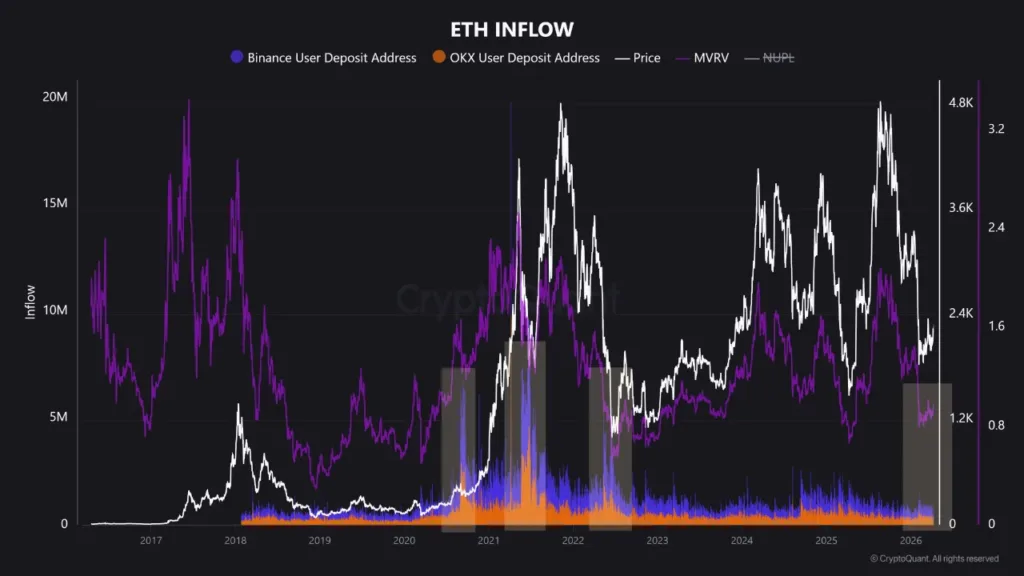
Those were the periods of heavy distribution, where large amounts of supply were actively being moved to exchanges, often ahead of major sell-offs.
What we’re seeing now is different. While inflows have picked up, they’re still well below those historical extremes. The recent clusters are relatively small in comparison, suggesting that whatever selling is happening isn’t happening at scale.
A tighter supply picture
Put those two trends together, and a clearer picture starts to form. On one hand, exchange reserves have dropped sharply, meaning there’s less ETH immediately available for selling.
On the other, inflows haven’t returned to the kind of levels typically associated with panic or large-scale distribution.
That combination points to a relatively tight supply structure on exchanges.
It doesn’t mean price can’t go lower – crypto rarely moves in straight lines – but it does suggest that the kind of heavy selling pressure seen at previous cycle tops isn’t present right now.
Quiet conditions, different setup
What makes this setup interesting is where price currently sits. Ethereum is still trading near the lower end of its recent correction range, not in a euphoric or overheated zone.
Historically, tighter exchange supply paired with muted inflows has sometimes shown up during periods where markets are stabilizing rather than breaking down further. It’s not a loud signal, but it’s a constructive one.
For now, the takeaway is subtle but important: Ethereum’s supply on exchanges is thinner than it has been in years, and the usual signs of aggressive selling just aren’t there.