

Crypto has always operated in a grey area, with no single authority, unclear rules, and plenty of risk for everyday users. Europe decided to change that and built one of the most comprehensive crypto regulatory frameworks in the world. That framework is called MiCAR, and it’s reshaping which stablecoins are even allowed inside the EU.
Not every stablecoin passed the test. Some of the biggest names got quietly delisted from European exchanges. Here’s a clear look at the top MiCAR-compliant stablecoins that cleared every requirement, why they matter, and what separates them from the ones that didn’t survive the cut.
What EU crypto regulation MiCAR means and why it matters
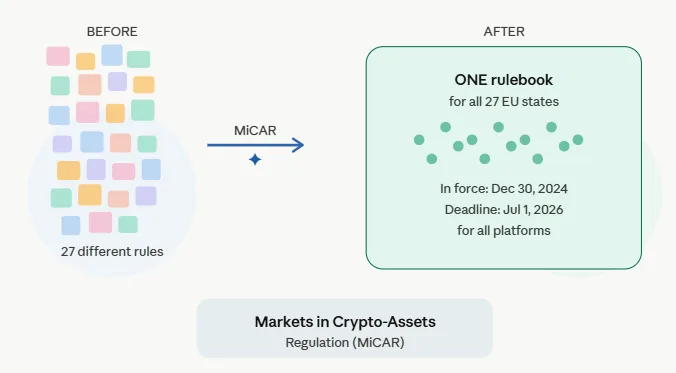
MiCAR stands for Markets in Crypto-Assets Regulation. It’s the European Union’s official rulebook for crypto assets, applied uniformly across all 27 member states. Before MiCAR, every country handled crypto differently. Some were strict, some were barely paying attention, and the whole thing was a mess. MiCAR replaced that patchwork with one unified standard.
Stablecoin-specific rules started applying from June 2024. MiCAR came fully into force on December 30, 2024. However, platforms that were already operating legally under national rules before that date were granted a transitional period to get properly authorized, and that window closes on July 1, 2026.
After that date, any platform still operating without MiCAR authorization will be banned from serving EU clients.
What it takes to get on the MiCAR stablecoin list
A stablecoin is a cryptocurrency pegged to a stable asset, usually a currency like the dollar or euro. Unlike Bitcoin, which can lose a third of its value before you finish your morning coffee, a dollar-pegged stablecoin is designed to hold steady at one dollar.
Under MiCAR, there are two types of compliant stablecoins:
- E-money tokens (EMTs): Pegged 1:1 to a single official currency. Most MiCAR-compliant stablecoins fall into this category.
- Asset-referenced tokens (ARTs): Backed by a basket of currencies or other assets, with even stricter requirements attached.
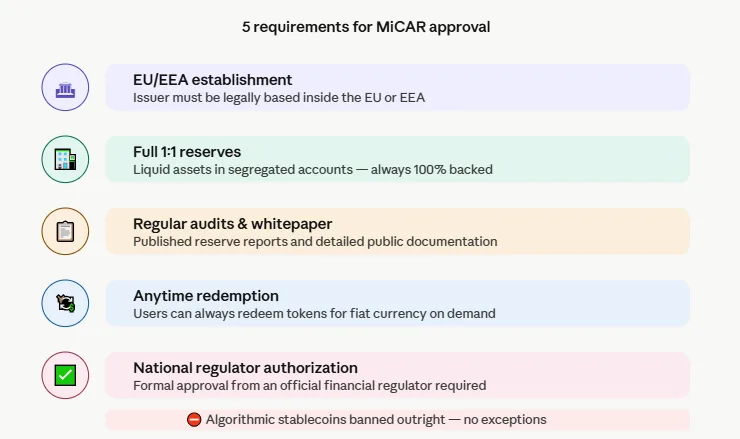
To earn MiCAR approval, an issuer has to meet every one of these conditions:
- Be legally established within the EU or EEA
- Hold full 1:1 reserves in liquid assets, kept in segregated accounts
- Publish regular audit reports and a detailed whitepaper
- Allow users to redeem tokens for fiat currency at any time
- Receive formal authorization from a national financial regulator
Algorithmic stablecoins, the kind that rely on code and market mechanics instead of real cash reserves to hold their peg, are banned outright under MiCAR. There are no carve-outs for algorithmic models, regardless of how they are structured.
Why the world’s biggest stablecoin got delisted across Europe
Tether (USDT) is the largest stablecoin in the world by market cap, and it didn’t make the MiCAR cut. Because it doesn’t meet the EU’s regulatory requirements, major exchanges including Binance, Coinbase, Kraken, and Crypto.com have already delisted USDT for European users. Anyone relying on USDT for EU-based trading or transfers had to find an alternative fast. The coins below are exactly what replaced it.
Top 10 MiCAR-compliant stablecoins: The full breakdown
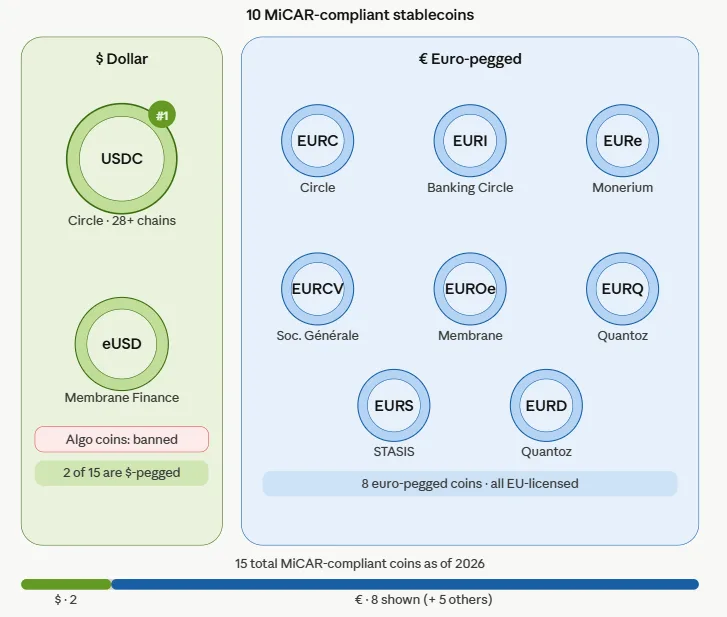
As of 2026, there are fifteen stablecoins with full MiCAR compliance. These are the top ten, covering both dollar and euro-pegged options across different use cases.
1. USDC (Circle)
Of the top ten stablecoins by global market cap, USDC is the only one with full MiCAR compliance. It’s pegged to the US dollar, runs on over 28 blockchain networks, and publishes regular third-party reserve attestations. It’s widely used for cross-border payments, DeFi, and business treasury management.
2. EURC (Circle)
When it comes to euro stablecoins, EURC sits at the top of the market by size. Every token is backed by actual euros sitting in licensed European banks, and it runs across Ethereum, Solana, Avalanche, and a handful of other chains, giving it solid coverage for both DeFi and traditional payment flows.
3. EURI (Banking Circle)
Banking Circle isn’t your typical stablecoin issuer. It holds a full EU banking licence, which gives EURI a regulatory foundation that most euro tokens simply don’t have. The coin was made for payments moving across borders, not for traders chasing yields.
It settles on Ethereum and BNB Smart Chain, and the reserves are held in accounts that are legally separate from Banking Circle’s own balance sheet, so customer funds stay intact no matter what happens to the company.
4. EURe (Monerium)
Monerium got its electronic money licence from the Central Bank of Iceland back in 2019, making it one of the earliest regulated issuers in this space. EURe is now live on Ethereum, Polygon, Gnosis, Arbitrum, Linea, and Cosmos through the Noble blockchain.
What makes it stand out is how tightly it connects to the regular euro banking system, something most crypto-native stablecoins still struggle to do.
5. EURCV (Société Générale-Forge)
Société Générale became the first major traditional bank to list a MiCA-compliant stablecoin on a public exchange when EURCV landed on Bitstamp in December 2023. Early on, it was locked down to whitelisted institutional wallets, but a July 2024 update lifted those restrictions and brought it in line with MiCAR’s open transferability rules.
Since then, it has moved fast. EURCV expanded from Ethereum to the XRP Ledger, with Ripple providing institutional custody, and in January 2026, it was used in a live tokenized bond settlement trial with Swift. That puts it in rare company among stablecoins that have actually been tested inside real financial infrastructure rather than just announced.
6. EUROe (Membrane Finance)
Issued by Finnish electronic money institution Membrane Finance, EUROe is available on Solana, Arbitrum, Avalanche, and Ethereum. It’s designed for low-cost digital commerce and cross-border payments within Europe’s regulated framework.
7. eUSD (Membrane Finance)
Also from Membrane Finance, eUSD is a dollar-pegged stablecoin with genuinely European regulatory roots. It was built from within the EU’s regulatory framework rather than seeking EU approval after the fact, which sets it apart from most dollar stablecoins.
8. EURQ (Quantoz Payments)
Quantoz Payments is a Netherlands-based firm operating under EU payment regulations, and EURQ is its flagship settlement token. Unlike many enterprise stablecoins, it processes transactions at any hour without delays, making it a practical fit for businesses handling cross-border payroll, supply chain obligations, and collateral positions.
9. EURS (STASIS)
EURS has been around long enough to predate most of its competition, and it still holds the second spot by market share in the euro stablecoin space. STASIS, which operates out of Malta, has kept a consistent focus on audits and regulatory transparency over the years. It works for both large institutions and regular users.
EURS has operated longer than most of its competitors, though as with any stablecoin, it’s worth reviewing its latest reserve attestations before committing large amounts.
10. EURD (Quantoz Payments)
Also from Quantoz Payments, EURD runs on the Algorand blockchain. Quantoz is recognized as an electronic money institution in the Netherlands, and EURD is built for fast, low-cost on-chain euro transactions.
Banks are now building their own regulated e-money tokens
The list of MiCAR-compliant stablecoins is only going to grow. In April 2026, ClearBank Europe, the Netherlands-based subsidiary of UK clearing bank ClearBank, became the first Dutch credit institution to complete the MiCAR notification process, immediately moving to offer EURC and USDC to institutional clients through Circle’s platform. That’s a traditional clearing bank connecting directly to the regulated digital asset ecosystem, which would have seemed unlikely just a few years ago.
On top of that, twelve major European banks, including ING, UniCredit, CaixaBank, BBVA, and Danske Bank, operating under the Qivalis alliance, have announced plans to jointly launch their own euro stablecoin in the second half of 2026, supervised by the Dutch Central Bank. When institutions of that size start issuing their own MiCAR-compliant stablecoins, it signals that the regulation isn’t slowing down adoption. It’s pulling the financial industry further in.
The final takeaway
MiCAR has drawn a clear line between stablecoins built for the long term and those that weren’t designed with genuine regulatory accountability. Every coin on this list has been vetted, authorized, and audited by national financial regulators, and that level of consumer protection simply didn’t exist in crypto before this regulation came into force.
For anyone using stablecoins in the EU, whether for payments, savings, or DeFi, knowing which ones are MiCAR-compliant isn’t just background knowledge worth having. It’s the difference between a stablecoin that still works after July 2026 and one that’s already been delisted.