

In traditional finance, a board of directors makes the decisions. In crypto, the community is supposed to. That’s the whole idea behind governance in blockchain projects, and some projects take it far more seriously than others.
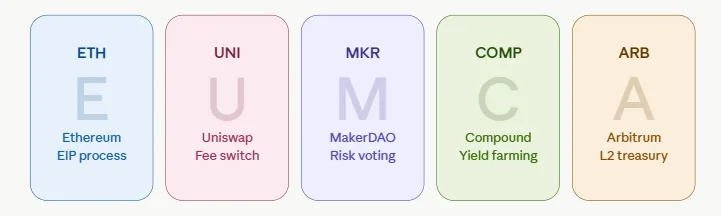
These five cryptocurrencies with the strongest community governance prove that token holder power can be real, not just a talking point. Some systems work better than others, but all five are worth understanding if you want to see where power truly sits in Web3.
What is decentralized governance crypto?
Decentralized governance crypto refers to blockchain projects where rules, upgrades, and treasury decisions are made by the community, not a central authority.
Instead of a CEO approving changes, token holders vote. Votes are recorded on-chain, executed automatically by smart contracts, and anyone can see the results. It’s transparent by design.
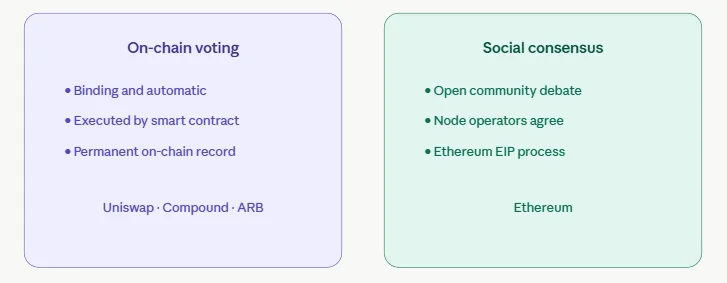
There are two main ways this works:
- On-chain voting: Votes are cast and executed directly on the blockchain. It’s binding and automatic.
- Social consensus: The community debates and agrees informally, which is how Ethereum operates through its improvement proposal process.
Both approaches have real trade-offs, which is why the projects below use different models.
How to spot strong crypto community governance
Not all governance is created equal. Here’s what separates serious projects from those that treat it as a marketing checkbox:
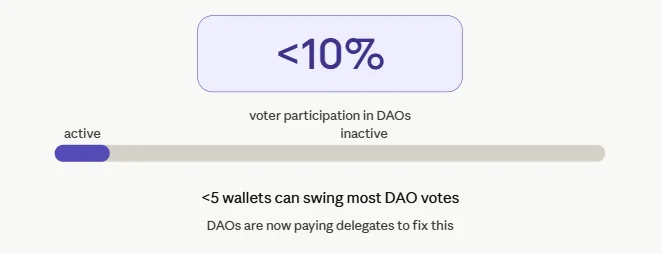
- Voter participation rate: What percentage of token holders actually vote? Across most DAOs, this number sits below 10%.
- Developer activity on GitHub: Are real engineers pushing code consistently?
- Forum activity: Are real debates happening before votes, or just formalities?
- Treasury size: How much does the community actually control?
- Proposal quality: Are proposals meaningful, or are they trivial housekeeping?
Keep these in mind as we go through each project.
Ethereum (ETH): Governance without a voting button
Ethereum doesn’t use a governance token to vote on protocol changes. Instead, changes go through a process called Ethereum Improvement Proposals, or EIPs. Developers write a proposal, the community debates it publicly, and if node operators and stakers broadly agree, it gets implemented.
It’s closer to how open-source software like Linux works than a corporate board vote.
What makes it stand out is the sheer scale of developer participation. Thousands of monthly active developers contribute to Ethereum-related projects. The network successfully executed one of the most complex blockchain upgrades ever, the shift from proof-of-work to proof-of-stake, without any central authority forcing the change.
All proposals are publicly debated, primarily through the Ethereum/EIPs repository on GitHub and the Ethereum research forum at ethresear.ch. Anyone can read, comment, or propose alternatives. Big decisions can take years, but on a network holding hundreds of billions in value, moving carefully has its advantages.
Uniswap (UNI): DAO governance tokens with real consequence
Uniswap is the largest decentralized exchange in crypto. No sign-ups, no brokers. You connect a wallet and swap tokens directly.
UNI is one of the clearest examples of DAO governance tokens working at a real scale. Holders vote on fee structures, treasury spending, protocol upgrades, and grants to developers.
The most significant vote in Uniswap’s history just happened. In December 2025, the community passed the “UNIfication” proposal with over 125 million votes in favor and just 742 against. That’s 99.9% support. The proposal activated the long-debated fee switch, redirected trading fees to burn UNI tokens, and triggered a one-time burn of 100 million UNI from the treasury.
Uniswap founder Hayden Adams wrote after the vote: “I believe Uniswap protocol can be the primary place tokens are traded. This proposal sets the stage for the next decade of its growth.”
Not everyone cheered. Some experienced liquidity providers raised concerns that activating protocol fees could compress their returns, potentially pushing them to exit. That tension between token holders and liquidity providers is exactly the kind of debate that makes Uniswap’s crypto community governance worth following closely.
MakerDAO / Sky (MKR/SKY): Where a bad vote has real consequences
MakerDAO runs DAI, now transitioning to USDS under the Sky rebrand. A stablecoin that holds its dollar value without being backed by actual dollars in a bank. MKR and SKY holders vote on collateral types, interest rates, and the risk parameters that keep it stable. Get a vote wrong, and the peg can break. That makes participation here serious, not ceremonial.
The protocol has rebranded to Sky, though the community still calls it Maker. Recent governance activity from March 2026 includes Solana chain integration, an Avalanche cross-chain bridge, and capital allocation updates – decisions that shape how billions in collateral are managed.
A governance delegate known as park_eth described MakerDAO to Blockworks as probably the most complicated governance in DeFi, adding that “Maker has built a very good culture of encouraging different opinions and actually having rigorous debate on the issues.”
The forum reflects that. Debates are long, detailed, and genuinely contested.
Compound (COMP): Where decentralized governance crypto got its blueprint
Compound is a lending protocol. You deposit crypto, others borrow it, and you earn interest. It’s one of the oldest DeFi protocols still running.
When Compound distributed COMP tokens to users in 2020, it pioneered the liquidity mining model, rewarding users with governance tokens just for using the protocol. That mechanic was widely copied and effectively kicked off DeFi Summer.
COMP holders vote on interest rates, collateral requirements, emergency security measures, and treasury decisions. Their Governor Bravo system allows faster decisions and batch proposal edits.
One honest observation: research examining on-chain voting data from Compound found that the number of addresses needed to decide most votes is very small. A handful of large wallets, including VC firms, can often determine outcomes. This tension between decentralization in theory and concentration in practice exists across nearly all DeFi governance systems, not just Compound.
Arbitrum (ARB): The fastest-growing governance DAO
Arbitrum is a Layer 2 blockchain sitting on top of Ethereum, making transactions faster and cheaper. It’s consistently among the highest transaction volumes of any Ethereum Layer 2, and the ARB DAO controls a substantial treasury deployed through developer grants, liquidity programs, and protocol upgrades.
The debates here get heated. In 2025, the Arbitrum Foundation proposed giving itself and four other entities soft veto power over proposals. The pushback was sharp. Pseudonymous contributor PaperImperium wrote publicly: “At some point we should stop calling these things governance tokens. Just call them Limited Partner tokens, because they trend towards zero control.”
Offchain Labs CEO Steven Goldfeder countered that ultimate control still rests with token holders, adding: “The fact that the power stems from the DAO doesn’t mean that the DAO should directly vote on what brand of toilet paper is used at Arbitrum events.”
As of April 2026, the community is voting on audit improvements and quorum structures, and recently approved a budget to reward delegates who vote consistently.
The real problem nobody wants to talk about: Voter apathy
Research examining on-chain voting data across major DAOs found that in most governance votes, the number of addresses that could swing the outcome is very small. Power concentrates around VCs and large wallets.
Some DAOs are starting to address this directly. Arbitrum now pays active delegates. Uniswap has over 200 registered delegates managing significant portions of voting power. It’s a structural issue, but projects are at least trying to fix it.
The final thoughts
Strong crypto community governance isn’t about having the right tools. Ethereum, Uniswap, MakerDAO, Compound, and Arbitrum all prove that participation, debate, and real stakes are what make governance meaningful.
If you want to understand how decentralized governance crypto works beyond theory, following the forums and voting dashboards of these five projects is the best starting point. The debates are public, the votes are real, and the money on the line is not small.