


Aave’s (AAVE) price crashed below the psychological $100 level after the Kelp DAO exploit. Investors started to pull out their money from the protocol, which crashed the value by $8 billion.
Aave loses $100 psychological level
Aave crashed below its psychological level of $100, and it is priced at just above $91 after Kelp, a liquid restaking protocol, was exploited.
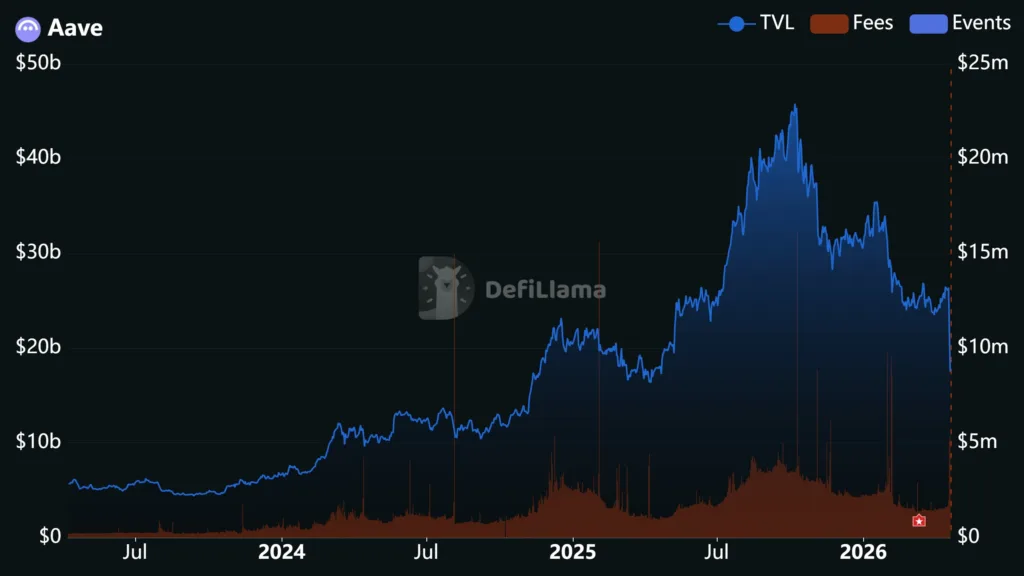
Investors pulled out of Aave after the Kelp DAO exploit because it triggered a sudden loss of confidence in the safety of lending pools and raised concerns about potential bad debt in the system. As such, more than $8 billion was removed from its TVL.
Although the platform Aave did not get directly compromised, the hack brought assets that were highly risky or under-collateralized into the system, leading to the fear that the loans would not be completely secured. With the news spreading, bigger depositors started pulling out their funds to minimize risks, which led to the quick drying up of liquidity in the pools.
Fear made investors withdraw tokens, not losses
In DeFi lending markets, this type of withdrawal is a classic display of the loss of trustworthiness, where deposits are pooled and lent out, meaning confidence plays a crucial role in stability.
When users sense the involvement of risk or the emergence of uncertain situations, they often rush to withdraw before liquidity becomes constrained, creating a bank-run-like effect. In addition, whale withdrawals also accelerate panic, further draining liquidity and reinforcing the fear among smaller users.
The actual loss was not the catalyst behind the withdrawals; rather, the Aave withdrawal was driven more by fear of contagion, liquidity risk, and uncertainty about the safety of collateral within interconnected DeFi markets.
Nearly $300 million drained out of the protocol
An on-chain analyst reported that the breach had been flagged in real-time, draining approximately $293.7M from the protocol’s RSETH Adapter. In addition ~$250M has already been swapped to $ETH and is currently being held across two chains.
The “rsETH adaptor” is a core smart contract module inside Kelp DAO’s liquid restaking system responsible for users depositing assets and receiving rsETH (restaked ETH). You can call it “conversion and routing layer” between deposited ETH/Liquid Staking Tokens and the rsETH token.
Aave loses its position as largest DeFi protocol
With this exploit, Aave lost its position as the largest DeFi protocol, as DeFiLlama shows that the TVL fell from about $26.4 billion to $18.6 billion by Sunday. The TVL nearly crashed by 30%.
When investors pull out money from the protocol, it shows that users are not willing to lock their money into a protocol. From a DeFi system’s perspective, that locked capital is the fuel that powers everything – lending, borrowing, trading, staking, and yield generation.
With this mass pullout, the stablecoins USDT and USDC are in full utilization, and $5.1 billion worth of stablecoins cannot be withdrawn until new liquidity comes into the protocol.
When Aave v3 lending pools for USDT and USDC reach maximum (100%) utilization, it means that almost all deposited stablecoins in those pools have already been borrowed out, leaving no idle liquidity available.
In practical terms, more than $5.1 billion worth of stablecoins are actively lent to borrowers, which prevents liquidity providers from withdrawing their funds until borrowers repay their loans or new deposits enter the system.
This situation reflects extremely high borrowing demand within the protocol, often driven by leveraged trading, yield strategies, or arbitrage activity across DeFi markets.
At the same time, it highlights a form of liquidity stress, since the pool is fully deployed and has little buffer to absorb new withdrawal requests.
Aave loses steam after the exploit
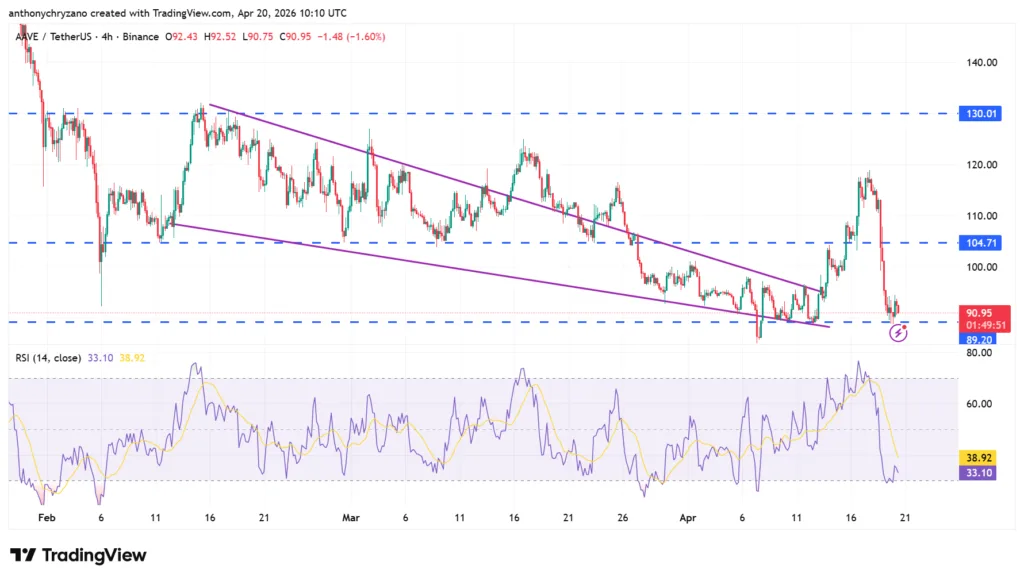
As shown in the chart above, Aave lost its major psychological level, $100, after investors lost confidence in the protocol, as it was vulnerable to hacks. From trading somewhere close to $116, Aave prices crashed to $91, losing more than 21%. This dismantled the new bullish momentum that Aave was building.
For instance, if you look at the chart above, it shows that Aave was trading inside a bullish falling wedge before breaking out upwards. A falling wedge is a pattern where the price’s net movement is downward, and while gradually decreasing, both highs and lows are making lower levels.
However, the main feature is that the downward movement slows and the range of motion tightens. The two trendlines slope downward and converge, showing that selling pressure is gradually weakening over time.
Once the apex of the falling wedge is complete, the breakout happens and the token appreciates, usually by the height of the wedge at its widest point. AAVE did everything, but the exploit spoiled the whole bullish scenario for the token.
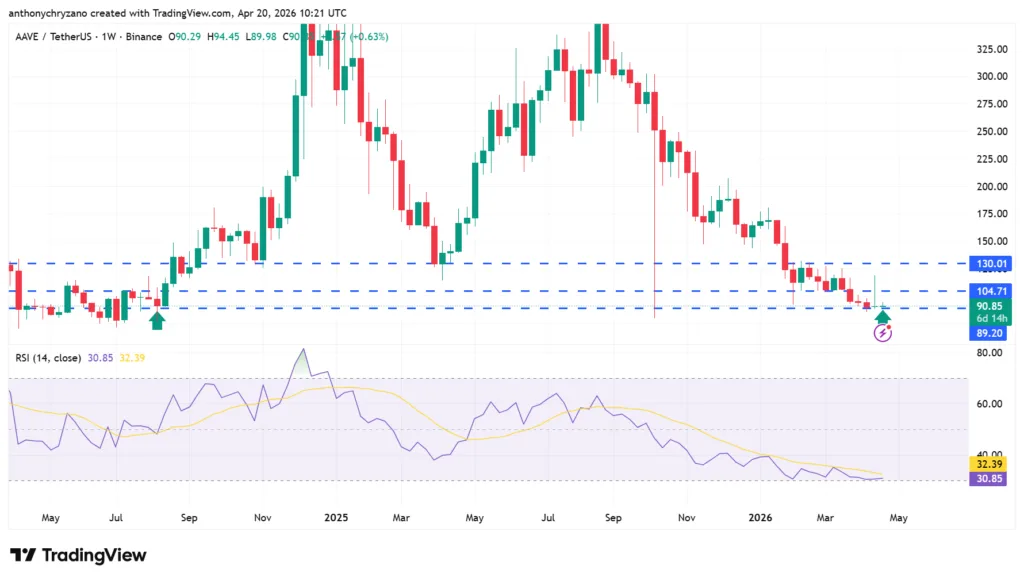
Zooming out from the scenario and looking at it from a broader perspective on a weekly chart indicates that AAVE is currently struggling at the August 2024 levels. Although the chart may look very gloomy and bearish, the silver lining is the relative strength index (RSI).
The RSI line is very close to the oversold territory, and this is a zone that traders look for before accumulating the tokens.
As such, traders might see this as an opportunity to grab the tokens at a discounted price. Given that this happens, then demand for the token could rise and the price could follow.