
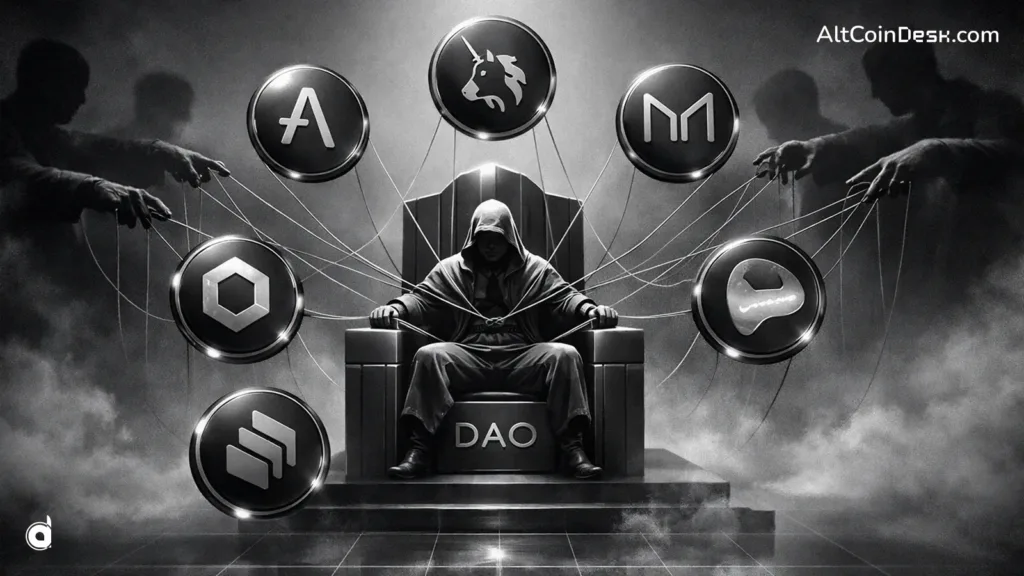

Let’s get one thing straight before we dive in: decentralized governance sounds like the most egalitarian idea crypto has ever produced. One token, one vote. Everyone at the table. Power to the people, right? Well, sort of. The reality of governance tokens with voting power is a little more like your office’s “open door” policy, where technically anyone can walk in, but only three people ever actually do.
This is the story of who really runs the protocols you trust with your money, which tokens give you genuine influence, and why the whales are almost always winning the vote before you even wake up.
So what is a governance token, really?
Think of a governance token as a share in a company that also doubles as a ballot paper in every company election ever held. When you hold MKR, UNI, AAVE, CRV, SUSHI, COMP, or DYDX, you are not just speculating on price. You are, in theory, a co-owner who decides whether the protocol raises fees, adds new collateral types, opens new markets, or redirects millions from the treasury.
Smart contracts tally the votes and enforce results without third-party intervention, so once a proposal passes, it executes automatically. No board of directors, no appeals process, no “let me get my manager.” Just code doing exactly what the majority told it to do. That is genuinely powerful. It is also genuinely exploitable, which we will get to shortly.
The six tokens actually worth your attention
Not all governance tokens with voting power are created equal. Some are glorified marketing gimmicks with a Discord server. The six below have real mechanisms, real stakes, and real drama.
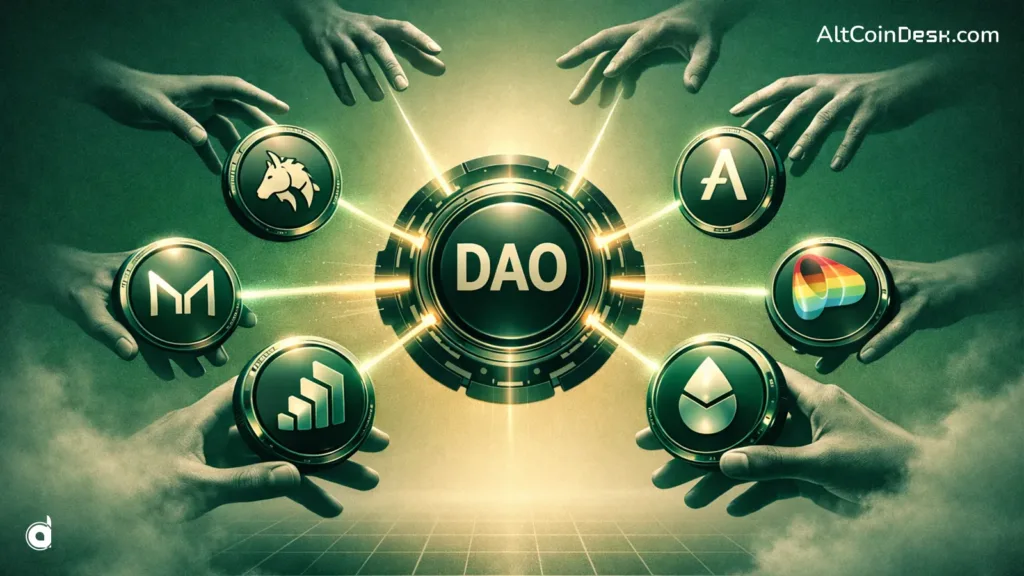
- MKR is the godfather of this whole experiment. MakerDAO, the protocol behind the DAI stablecoin, has been running community-led governance longer than most of its competitors have existed. MKR holders vote on collateral types, stability fees, and risk parameters. The tokenomics have a genuinely clever trick: when the protocol collects fees, MKR gets burned, which reduces supply over time and slowly concentrates voting power among those who stuck around long enough to still hold it. It is not glamorous, but it works.
- UNI governs Uniswap, the largest Ethereum-native decentralized exchange. A governance vote proposed in early 2026 would expand the protocol fee switch to all Uniswap v3 pools on Ethereum mainnet and eight other chains, directing those fees to an on-chain mechanism that automatically burns UNI tokens. That is the kind of vote that directly ties your token to the protocol’s actual usage, not just its hype cycle. Uniswap’s initial distribution also leaned heavily toward users and liquidity providers rather than insiders, which at least gave it a fighting chance at broad participation.
- AAVE has been having a particularly eventful year. The Aave DAO passed AIP 469 with 74.89% approval in April 2026, granting Aave Labs 25 million dollars in stablecoins and 75,000 AAVE tokens vesting over four years, marking the first binding action under the “Aave Will Win” framework, which mandates 100% of product revenue flows to the DAO treasury. They also launched Aave V4 on the Ethereum mainnet in March 2026 with a new hub-and-spoke architecture designed to reduce liquidity fragmentation. The governance dispute in late 2025 over frontend fees, which critics labeled “stealth privatization,” is a reminder that even protocols with good tokenomics can have messy politics.
- CRV and the veCRV model deserve their own paragraph because they are the most unapologetically honest designs in this entire industry. Curve Finance looked at the problem of short-term voters gaming governance and basically said, “Fine, you want power? Lock your tokens for four years.” The vote-escrow model gives more weight dramatically to long-term, committed holders. It is arguably the purest answer to the sustainability question, and predictably, it is also the most dominated by sophisticated actors who can afford to lock large positions for years.
- SUSHI and COMP round out the list in different ways. SushiSwap has experimented with emission models and staking structures that try to reward sustained holders over mercenary capital. Compound, meanwhile, leans on delegation, spreading voting rights to liquidity providers and letting smaller holders assign their votes to active delegates who actually read the proposals.
Delegation: Democracy’s middleman problem
Here is where it gets satirical. The entire delegation system, which sounds so reasonable on paper, basically recreates the representative democracy problem that decentralized finance was supposedly escaping. You give your votes to someone you trust. They accumulate votes from thousands of other people who also cannot be bothered. Suddenly, three people are making decisions for a protocol with a billion dollars in it, and they were elected by a combination of Twitter clout and the fact that everyone else had a job to go to.
Holders of UNI, COMP, MKR, and AAVE can either vote directly or delegate their voting power to others, with delegation described as a crucial efficiency mechanism that channels influence to active contributors. That framing is generous. In practice, delegation creates “professional delegates” who may or may not align with the average holder’s interests, and once a small group of delegates becomes the default choice, it takes a coordinated and expensive re-delegation campaign to dislodge them.
Synthetix has this problem acutely. Its staking-based delegation layer means governance looks participatory from the outside but operates more like a committee from the inside, with a small group setting direction while the broader community effectively watches from the lobby.
The flash loan heist that actually happened
Now for the part of governance token history that reads like a crime thriller where nobody quite went to jail. In October 2020, BProtocol executed a multi-step transaction that began with a synthetic Ether borrowing, which was then used as collateral to borrow approximately seven million dollars worth of MKR tokens, which were used to pass a governance vote and then returned to the markets, all within a single block. The team was not trying to steal anything. They just wanted Oracle access and got impatient. But the incident proved something alarming: you do not have to own governance tokens with voting power to control a vote. You just have to rent them for one block.
MakerDAO subsequently voted on a proposal that extended the delay between a proposal passing and its implementation from 12 hours to 72 hours, giving the community enough time to review and veto a potentially unfair vote.
That fix addressed the specific vulnerability, but the broader lesson remains: any protocol where voting power is tied directly to token balance at a given block and where those tokens can be borrowed cheaply is a protocol that can theoretically be hijacked by someone with enough capital and no long-term stake in the outcome whatsoever.
DYDX and the burn on veto trick
dYdX takes a slightly different angle on the sustainability problem. Its newer chain-era governance introduced a burn-on-veto mechanism where, if a proposal crosses a veto threshold, funds tied to that proposal get burned. That is not just a disincentive for bad actors. It is a financial punishment for even attempting an abusive proposal, which changes the calculus entirely.
A governance-approved experiment on dYdX redirects 100% of the protocol’s net transaction fees to buy back DYDX tokens from the open market, estimated at five to ten million dollars worth, with staker and validator rewards temporarily funded from the over one hundred million dollar Community Treasury. That buyback pressure, combined with a delegation-enabled voting model, tries to give long-term holders more skin in the game than short-term speculators.
The 2026 roadmap for dYdX also includes launching spot markets, expanding Telegram-based trading, simplifying retail logins, and introducing real-world asset perpetuals, starting with synthetic equities. Whether these additions strengthen or dilute governance participation is the open question.
Whales, oligarchs, and the illusion of decentralization
The most uncomfortable truth about governance tokens with voting power is that distribution and decentralization are not the same thing. You can airdrop tokens to a million wallets and still end up with three whales running the protocol, because those three whales will be the only ones showing up to vote every week. Voter apathy is not a bug unique to DAOs. It is a feature of every democratic system in human history. The difference is that in a DAO, apathy has a price denominated in USD.
YFI launched as a “fair launch” with no pre-mint and no venture capital allocation, which made it a darling of decentralization advocates. Over time, however, whale accumulation through exchange-based buying and liquidity pool concentration created a situation where large holders can swing proposals. KERNEL, launched in 2025 with an explicit community-centric allocation of roughly 55% going to airdrops and rewards, has a structurally broader distribution, though its whales tend to be institutional-style restaking protocols rather than pure speculators.
There is more than just a philosophical risk to centralizing governance. A whale-controlled DAO can move money from the treasury, change the way fees work, change the amount of collateral needed, or worse, push through proposals that are good for insiders but bad for users who aren’t paying attention. Malicious actors can work together to push bad ideas and take advantage of protocols, and big investors can buy up a lot of governance tokens, which leads to centralized decision-making.
What does sustainable governance actually look like?
The truth is that no protocol has completely fixed it. The closest competitors use a mix of long lock periods that reward patience over speculation, delegation with transparency and recall mechanisms, burn-on-veto penalties that punish bad proposals economically, and broad initial distributions that don’t give insiders a supermajority from the start.
As DeFi matures, new governance models, including quadratic or delegated voting, may help solve issues like low participation and voter inequality, aiming to ensure that decision-making better reflects the broader community. Quadratic voting, where your ten-thousandth token gives you dramatically less additional power than your first, is particularly interesting because it structurally limits whale dominance without requiring them to give up their tokens.
The next time someone tells you a protocol is “community-governed,” ask them what percentage of the last five proposals were decided by the top ten wallets. That number will tell you everything. Governance tokens with voting power are one of crypto’s genuinely interesting inventions, but calling them democratic without checking the voter turnout is like calling a town hall meeting “the will of the people” when only the mayor’s friends showed up.
The tokens are real. The votes are real. Whether the governance is actually decentralized is, as always, a matter of who shows up and who already owns the room.