



For a long time, every blockchain tried to handle everything in one place. Processing transactions, storing data, reaching agreement, confirming finality, all of it on the same chain, competing for the same space. That’s fine until real demand hits, and then the whole thing starts showing cracks.
The modular blockchain approach flips that. Instead of one chain doing every job, the work gets divided across layers that each specialize in one thing. The whole system ends up faster, cheaper, and far easier to build on top of. By 2026, this is no longer a design experiment. It’s the foundation that a significant chunk of crypto actually runs on.
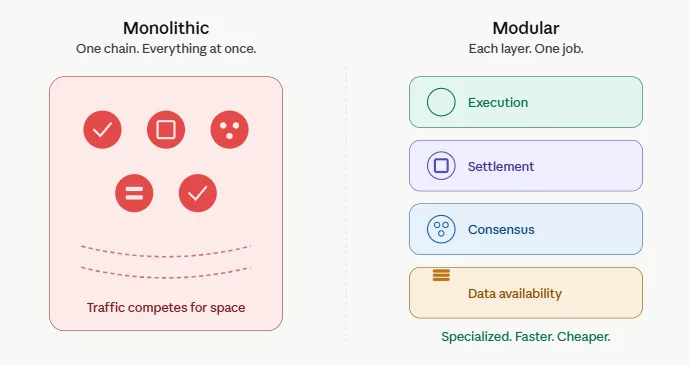
Breaking down the four layers (because the rest won’t make sense without it)
Every blockchain, whether modular or not, has to handle four core functions:
- Execution: Running transactions and smart contracts
- Settlement: Making transactions final and irreversible
- Consensus: Validators agreeing on what happened and in what order
- Data availability: Keeping transaction records accessible so anyone can verify them
Traditional chains pile all four onto one layer and everything competes for the same limited space. Modular chains separate them so each layer can specialize without getting in the other’s way.
Think of it like a court system. Lower courts handle the day-to-day cases. The Supreme Court doesn’t deal with every parking ticket, it only steps in when something needs a final, binding verdict. That’s exactly the role the settlement layer plays in a modular stack.
How modular blockchains became impossible to ignore in 2026
The numbers make it hard to argue otherwise. Layer 2 networks now handle a vast majority of Ethereum ecosystem transactions, with daily transaction counts regularly crossing two million. Total value locked across major rollups has exceeded $39 billion.
Transaction costs have dropped by as much as 90% in certain setups compared to posting everything directly on Ethereum. That’s the kind of difference that moves real products from “too expensive to build” to “actually viable.”
The best modular blockchains aren’t replacing Ethereum. They build on top of it, each handling the slice of work they’re built for, while Ethereum holds the security foundation underneath.
The 7 modular blockchain projects leading right now
1. Celestia
Celestia’s only job is data availability. It doesn’t run transactions or confirm settlements. It stores and orders transaction data so anyone can verify a chain’s state without having to re-run the entire transaction history themselves.
It holds roughly 50% of the data availability market and supports over 100 rollups. Every major rollup framework, including Arbitrum Orbit, OP Stack, and Polygon CDK, now lists Celestia as a supported data availability option. Its Matcha upgrade, which went live in late 2025, doubled block sizes to 128MB and reduced node storage requirements by 77%.
2. Arbitrum
Arbitrum is the dominant execution layer on Ethereum. It uses optimistic rollups – processing transactions off-chain, assuming they’re valid by default, and only running a check if someone submits a fraud challenge. That assumption of validity is what keeps it fast and affordable.
It holds roughly 31% of Layer 2 DeFi total value locked. Robinhood integrated Arbitrum for brokerage settlement infrastructure, and Franklin Templeton has deployed tokenized assets on the network. Those aren’t small signals. Traditional finance doesn’t integrate infrastructure it doesn’t trust.
3. Optimism and the Superchain
Optimism runs the same optimistic rollup model, but its bigger play is the Superchain: a growing collection of Layer 2 chains that share security, tooling, and governance under one connected system.
Uniswap launched UniChain, Sony launched Soneium for gaming and media, and Kraken launched INK, all on Optimism’s OP Stack. Optimism also cut its data posting costs by more than half after reworking how it batches and submits transaction data to Ethereum. The OP Stack has effectively become a platform other companies build their own chains on, not just a standalone rollup.
4. Polygon
Polygon started as a basic Ethereum sidechain and has grown into one of the most versatile modular platforms available. It now offers zero-knowledge rollups, a Chain Development Kit for deploying custom chains, and a direct data availability partnership with Celestia.
A DeFi protocol and a gaming studio have very different infrastructure needs. Polygon’s setup lets teams customize each layer to what their specific application actually requires, which is exactly why it keeps pulling developers from across different industries.
5. EigenLayer
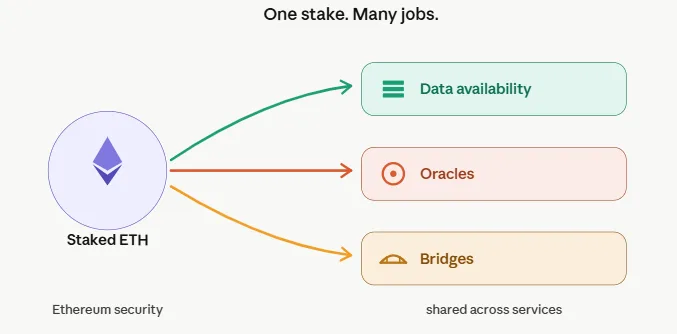
EigenLayer changed how shared security works across the modular stack through a concept called restaking.
Staked ETH normally secures only one network. EigenLayer lets that same staked ETH simultaneously secure other services – data availability layers, oracles, bridges. It’s comparable to a security team covering multiple locations at once, getting paid for each, without needing separate staff for every building.
It reached an all-time high of $19.7 billion in restaked value. Its data availability service, EigenDA, has reached 100MB/s throughput. New projects can now tap into Ethereum-grade validator security without building their own validator set from scratch, which used to be one of the most expensive parts of launching a credible new network.
6. zkSync
zkSync is a ZK rollup, meaning instead of assuming transactions are valid and checking later like Arbitrum and Optimism do, it generates cryptographic proofs that mathematically confirm every transaction is correct before it’s finalized. That difference matters a lot for institutions that can’t afford to wait out a dispute window.
Its 2026 focus is scaling Prividium deployments, which is a privacy-first institutional blockchain platform already live with clients, including Deutsche Bank, built on its ZK Stack. The idea is simple: banks and asset managers need the benefits of blockchain without exposing sensitive client data on a public ledger. Prividium solves that by letting institutions run their own private chains that still settle trustlessly on Ethereum.
Deutsche Bank’s fund management platform is already live on it, and zkSync has been working with over 30 major global institutions, including Citi, Mastercard, and two central banks. For a modular blockchain project, landing that kind of institutional adoption in 2026 is a meaningful signal that the ZK approach has found its real-world use case.
7. Base
Base is built on Optimism’s OP Stack and backed by Coinbase, making it one of the clearest examples of what modular infrastructure looks like when paired with serious distribution.
It holds 46.58% of Layer 2 DeFi total value locked, the largest share of any L2, and showed the strongest sustained organic growth across all major activity metrics throughout 2025. DEX volume, active wallets, and on-chain interactions all point in the same direction. Base and Arbitrum together represent over 75% of Layer 2 total value secured. That level of concentration shows where real usage has actually settled.
What separates the best modular blockchains from the rest
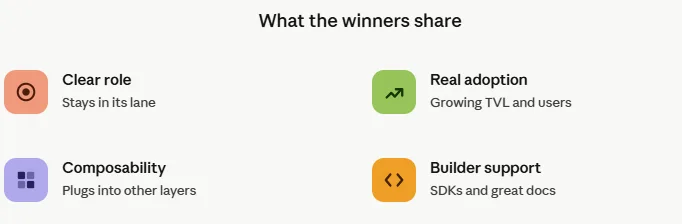
A few patterns show up consistently across the stronger projects:
- A clearly defined role: The best ones stay in their lane and do that one thing well
- Real adoption: Growing TVL, active rollups, and genuine developer communities behind them
- Composability: They plug into other layers cleanly rather than trying to own the full stack
- Builder support: Tooling, SDKs, and documentation that help teams ship without fighting the infrastructure
Challenges the modular space still hasn’t solved
Bridge security remains the most significant open problem. Moving assets between modular layers requires bridges, and bridges have historically been the most exploited surface in the entire space.
Most of these networks are also still relatively young under real adversarial conditions. They haven’t built up the battle-tested history that Ethereum or Bitcoin carries over many years. Ecosystem fragmentation, where different layers adopt incompatible standards, creates real friction for developers trying to build across multiple layers at once. These aren’t permanent roadblocks, but they’re honest ones worth knowing about.
Where this is all headed?
The shift toward modular blockchain projects has already happened at scale. In 2026, they’re processing the majority of Ethereum’s transaction volume, running DeFi protocols, and powering consumer-facing apps that most users never realize are running on layered infrastructure.
What’s worth watching now isn’t whether the model works. It clearly does. The more interesting question is which of these modular blockchain projects cement themselves as permanent infrastructure, and which ones get absorbed, replaced, or made redundant as the stack keeps evolving.