


Crypto derivatives trading has grown into one of the most active corners of the market, and perpetual futures are right at the center of it. Daily volumes have hit record peaks, and more traders than ever are looking to trade crypto perpetual futures or find the right platform to do it on.
Whether someone’s been in crypto for years or is just getting their footing, knowing which platforms lead the space in 2026 matters. CEXs and DEXs both have a strong presence, and they serve very different types of traders.
What is a perpetual futures contract?
A perpetual futures contract lets a trader speculate on whether the price of a cryptocurrency will go up or down, without ever owning the asset. It’s similar to placing a directional bet on Bitcoin’s price, but the coin never changes hands.
What makes it “perpetual” is that it doesn’t expire. Regular futures contracts in traditional finance settle on a fixed date. A perpetual contract can stay open as long as the trader wants, provided there’s enough margin in the account to keep the position alive.
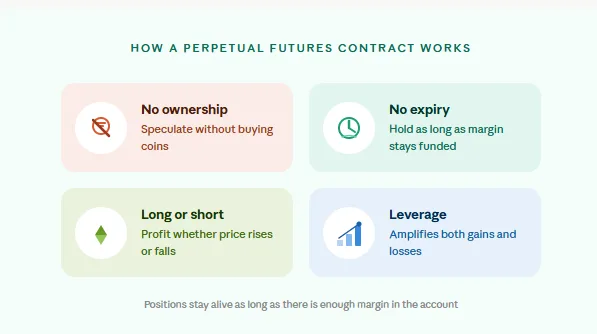
Leverage is a big part of the appeal. A trader can put up a fraction of the position’s value and control a much larger trade. That cuts both ways, since gains are amplified and so are losses.
There’s also a mechanism called a funding rate. It’s a small periodic payment exchanged between traders on opposite sides of the market. When the contract price drifts above the spot price, those on the long side pay those on the short side. It keeps prices anchored to the real market.
Best crypto perpetual futures platforms (centralized exchanges)
CEXs are what most people start with, and for good reason. The exchange holds the funds, handles the infrastructure, and the whole experience feels closer to a regular trading app than anything technical. Liquidity tends to be deeper too, which matters when getting in and out of positions quickly.
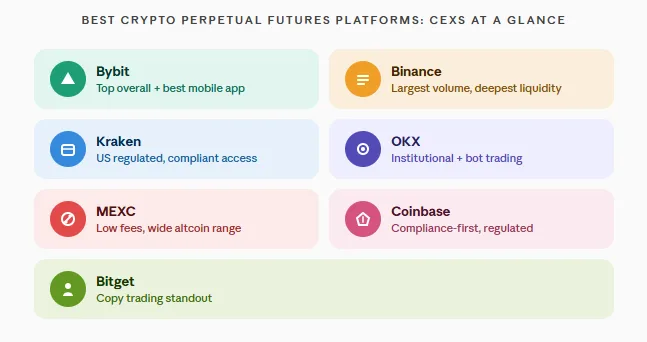
Bybit, top pick for everyday perpetual trading
Bybit keeps coming up as the top pick for a reason. Tens of millions of traders use it, there’s a wide range of perpetual and inverse contracts available, and the fees don’t eat into profits the way some platforms do. The mobile app gets a lot of praise specifically, since managing leveraged positions from a phone isn’t always smooth on other platforms, but Bybit handles it well.
Binance, largest volume and deepest liquidity
No other centralized exchange comes close to Binance on volume. It holds the largest share of Bitcoin futures open interest among CEXs, and the liquidity stays consistent even when markets get choppy. One thing worth knowing upfront: it’s not accessible to traders based in the US.
Kraken, regulated access for US and international traders
Kraken is one of the few major platforms that’s actually accessible to traders in the US, UK, and Canada, which already sets it apart from most of the list. The leverage ceiling is lower than what offshore platforms offer, but that’s partly the tradeoff for operating in a compliant, regulated space. It covers both perpetuals and traditional futures, and the security reputation has held up consistently over the years.
OKX, built for advanced and institutional traders
OKX is geared toward traders who want more than just a basic perp contract. The derivatives suite covers perpetuals, expiry futures, and options, and there’s a bot marketplace built in for anyone who wants to run automated strategies without needing to build anything from scratch.
MEXC, low fees with the widest altcoin selection
Fee-conscious traders tend to gravitate toward MEXC, and the altcoin selection is a big part of the draw too. Smaller tokens that aren’t listed elsewhere often show up here, and the trading costs stay lean across the board.
Coinbase, the fully regulated and compliance-first option
Coinbase Financial Markets offers perpetual-style futures on Bitcoin and Ethereum for traders who want to stay within a fully regulated setup. Contracts are USDC-margined, available around the clock, and capped at 10x leverage. It’s built around compliance first, which makes it a natural fit for those who prioritize that over raw features.
Bitget, best known for copy trading
Copy trading is where Bitget separates itself. The feature lets a trader pick someone with a solid track record and have their positions automatically mirrored in real time. It supports hundreds of derivative pairs and regularly runs promotions that reward active trading volume.
Best perpetual DEXs worth knowing in 2026
With a DEX, nobody’s holding the funds but the trader. Trades run through smart contracts, the wallet stays connected throughout, and there’s no account to create or identity check to pass on most platforms. It’s a fundamentally different setup from a CEX, and for a lot of traders, that control is the whole point.
Two main structures power the perp DEX space:
- Order book model: Buyers and sellers are matched directly, much like a CEX
- Liquidity pool model: Trades execute against pooled funds locked in smart contracts
Hyperliquid, the dominant on-chain perp exchange
Hyperliquid has pulled ahead of every other perpetual DEX in 2026 by a noticeable margin. It runs on a custom Layer 1 chain built from scratch for trading, not adapted from a general-purpose blockchain. The order book lives entirely on-chain, fees are low, and the range of available pairs is wider than most competitors. Volume and open interest have reached a level that puts it in the same conversation as mid-tier CEXs, which wasn’t something anyone expected from a DEX this quickly.
dYdX, the original perp DEX still going strong
dYdX has been around since 2019, which makes it one of the oldest perp DEXs still actively used. It moved to its own Cosmos-based blockchain and now supports well over 200 perpetual markets. Traders who care about order book precision and want a platform with years of protocol development behind it tend to land here.
GMX, a DeFi-native approach through liquidity pools
GMX takes a different route through its liquidity pool model. Traders execute against pooled assets, and DeFi users can earn yield by providing that liquidity. It runs on Arbitrum and Avalanche and is generally seen as the most approachable option in decentralized perp trading for those who want to keep things straightforward.
Jupiter Perps and Drift, the Solana-native choices
For anyone already active on Solana, Jupiter Perps and Drift Protocol are the natural starting points. Jupiter Perps stays focused on Bitcoin, Ethereum, and Solana. Drift is more feature-rich, with additional DeFi tools built alongside perpetual trading for users who want more depth within the same ecosystem.
How to trade crypto perpetual futures: What actually matters
There’s no single right approach when looking to trade crypto perpetual futures, and platform choice should come down to practical factors rather than hype.
Key things to compare:
- Fees: Both the headline trading rate and ongoing funding costs
- Liquidity: Tighter spreads mean better fills, especially on larger trades
- Leverage: Higher isn’t always smarter, and it raises liquidation risk sharply
- Asset selection: Not every platform lists the same tokens
- Access: Some platforms restrict certain regions
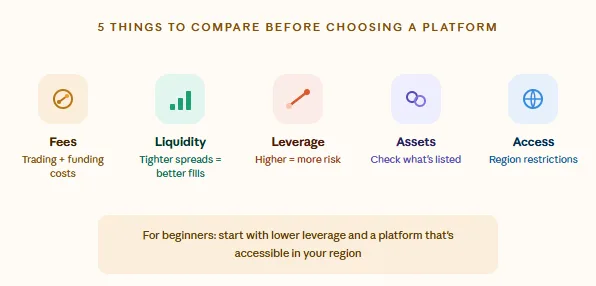
For anyone starting out, lower leverage is the safer entry point. A smaller position is far easier to manage and far less likely to get wiped out during a sudden market swing. Understanding margin requirements before going live is time well spent.
Perpetual DEXs have closed the gap on centralized platforms in a meaningful way. Hyperliquid, in particular, now matches or beats several CEXs on execution quality, which is one reason DEX volume keeps growing as a share of overall perp trading activity.
Final takeaway
Perpetual futures aren’t just for professional traders anymore. The best crypto perpetual futures platforms in 2026 have made access more practical, more transparent, and far more competitive across both centralized and decentralized options.
Whether the goal is a regulated CEX or the best perpetual DEXs available on-chain, the options are strong. The key is matching the platform to trading style, risk tolerance, and experience level, and going in with a clear understanding of how these contracts actually work.