


Staring at a red or green chart and making a call based on gut feeling is one of the fastest ways to lose money in crypto. Long-term investors who build real wealth do something different. They read the signals hiding underneath the price, and those signals have names.
Crypto indicators are what separate disciplined investors from emotional ones. They translate market chaos into readable patterns, and once an investor learns how to use the best crypto indicators correctly, the market starts making a whole lot more sense.
Understanding crypto indicators and what they show
A price chart shows what happened. Crypto indicators explain why, and what might come next.
They’re mathematical tools built on price, volume, and blockchain data. Some track momentum, some reveal trend direction, and some tap directly into the blockchain to show what large holders are doing with their coins in real time.
There are three types of indicators that you need to know about:
- Technical indicators: Built from price and volume history
- On-chain indicators: Pulled straight from blockchain data
- Macro and sentiment indicators: Reflecting the broader market environment
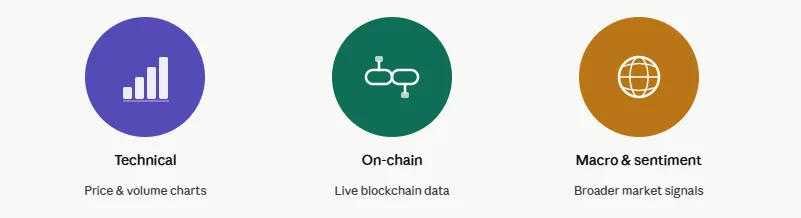
Used together, they build a complete picture. Each type answers a different question about the market, and using all three is where the real clarity comes from.
The best crypto indicators for tracking price charts and market trends
Technical indicators live on trading charts and they’ve proven their value across multiple market cycles. These are among the best crypto indicators for reading trend direction, momentum, and potential turning points.
RSI
RSI (Relative Strength Index) runs on a scale of 0 to 100. Cross above 70 and the asset is considered overbought. Drop below 30 and it’s oversold, and a bounce often follows.
For long-term investors, the weekly RSI is the one worth tracking. A deeply oversold reading on a weekly chart has historically lined up with some of the strongest buying windows in Bitcoin’s history.
Remember: Daily RSI is noise. Weekly RSI is signal.

Moving averages
Moving averages strip away short-term volatility to reveal the actual direction of a trend. The two-hundred-day moving average is the benchmark long-term investors rely on. When Bitcoin stays above it, the broader trend is healthy. When it slips below, caution is warranted.
A pattern called the Golden Cross forms when a short-term moving average rises above a long-term one, often signaling the early stages of a new uptrend. As of April 2026, Bitcoin has reclaimed its shorter moving averages but still sits below the one-hundred and two-hundred-day lines.
That’s a market rebuilding confidence, not one running hot.
MACD
MACD tracks momentum through two lines and a histogram. The key event is the bullish crossover, when the MACD line crosses above the signal line. That move has historically marked the start of a new trend rather than the middle of one, and on a weekly Bitcoin chart, it carries real weight.
Bollinger Bands
Bollinger Bands wrap around price and contract during calm periods, expanding when volatility increases. When that squeeze happens, a significant price move is building. When price tags the lower band during a broader uptrend, long-term investors often treat it as a quality entry zone.
Long-term crypto indicators that serious investors use beyond price charts
The blockchain is public. Every transaction is recorded, which means it’s possible to see what large wallets and long-term holders are doing in real time. On-chain data makes long-term crypto indicators fundamentally different from their technical counterparts.
MVRV Ratio
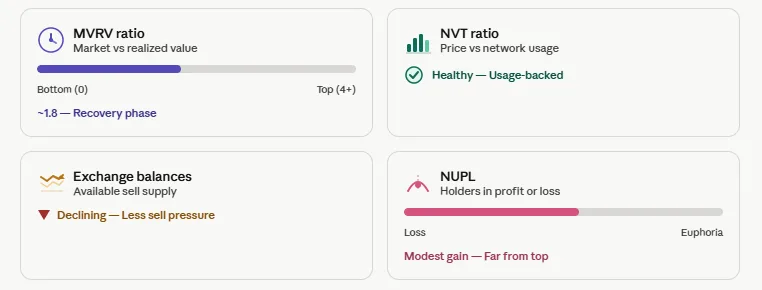
MVRV (market value to realized value) compares Bitcoin’s market cap to its realized cap, the average price at which every coin last changed hands. When MVRV sits above 1, holders are collectively in profit. When it drops below 1, they’re collectively at a loss.
Market tops have historically arrived when MVRV spikes into extreme positive territory. Recent readings have sat in recovery territory, a range analysts associate with healthy accumulation rather than speculative peaks.
NVT Ratio
NVT (network value to transactions) is Bitcoin’s version of a price-to-earnings ratio. It measures Bitcoin’s market cap against the actual dollar value of transactions flowing through its network.
A low reading is a healthy sign. The price has real usage backing it up. When the reading climbs high, the market cap has grown faster than the actual activity on the network, which usually means speculation has taken the wheel from fundamentals.
The NVT golden cross right now is pointing toward a market where valuations have transaction volume behind them. That’s the kind of foundation long-term investors want to see, price movement driven by real usage rather than hype.
Exchange balances
When Bitcoin moves off exchanges into cold wallets and long-term storage, it exits the available selling pool. Exchange reserves have been declining steadily, with a growing share of Bitcoin locked in ETFs, corporate treasuries, and long-term wallets.
As of early 2026, roughly 74% of Bitcoin’s supply is considered illiquid. Less supply available to sell means less downward pressure on price.
NUPL
NUPL (net unrealized profit/loss) tracks whether the market as a whole is sitting on gains or bleeding losses. When it crashes into deeply negative territory, it’s historically been one of the clearest signals that a bottom is forming. When it spikes to the other extreme, cycle tops haven’t been far behind.
Right now, NUPL is sitting in modest positive ground. Holders are in profit, but the kind of euphoria that shows up before a major correction? Nowhere close to that yet.
Macro crypto indicators that give long-term investors the full picture
Technical and on-chain data paint a strong picture, but neither exists in a vacuum. The broader environment, monetary policy, institutional behavior, and market sentiment sets the stage on which everything else plays out.
Bitcoin dominance
Bitcoin Dominance measures how much of the total crypto market cap BTC actually owns. When that number climbs, capital is consolidating into Bitcoin, which typically means investors are playing it safer within the space. When it drops, money starts spreading out into altcoins.
In April 2026, dominance sits above 58%, firmly in Bitcoin-first territory, with altcoins yet to find their moment.
Fear and Greed Index
This index scores market emotion from 0 (Extreme Fear) to 100 (Extreme Greed). The counterintuitive truth long-term investors know well: accumulating during fear has historically produced far stronger returns than buying into excitement. When the market is panicking, prices are usually better. When confidence peaks, the top is usually closer than it feels.
ETF flows and institutional demand
Spot Bitcoin ETFs shifted how the market is structured. Institutional capital now enters Bitcoin through regulated products, and that’s built a layer of consistent demand that previous cycles didn’t have. When ETF inflows hold steady, available supply tightens and the price floor lifts with it.
The Bitcoin halving cycle
Every four years, Bitcoin cuts its new supply creation in half. April 2024 was the most recent one. What follows historically is significant, with major price rallies developing within twelve to twenty-four months after each halving. That timeline places 2026 firmly in the window long-term investors have been watching.
How layering crypto indicators gives long-term investors a sharper edge
One indicator can mislead. Three indicators agreeing is where real conviction gets built. The approach that works: one for trend direction, one for momentum, and one for on-chain or sentiment health. When all three point the same way, the signal is far stronger than any single reading alone.
The best crypto indicators are tools, and like any tool, they work best when used with consistency and realistic expectations across full market cycles.
Why learning crypto indicators changes how long-term investors see the market
Learning to read long-term crypto indicators changes the entire experience of being in the market. Prices stop feeling random. The market doesn’t become predictable, but it does become navigable, and that shift in clarity is worth everything.
Start with RSI and moving averages to build the foundation, then layer in MVRV and exchange balances as understanding grows. The more fluent an investor becomes in these tools, the fewer emotional decisions they’ll make, and in crypto, avoiding emotional decisions is where the real edge lives.