



Crypto cards provide a way for crypto holders to use their digital assets to pay for goods and services. These cards enable the spending of cryptocurrencies such as stablecoins and others like Bitcoin or Ethereum, directly without you needing to manually convert the assets to fiat or use conventional banking systems.
Some act as debit cards that are connected to your wallet, while others operate like credit cards. These cards vary greatly, with some providing larger cashback and rewards.
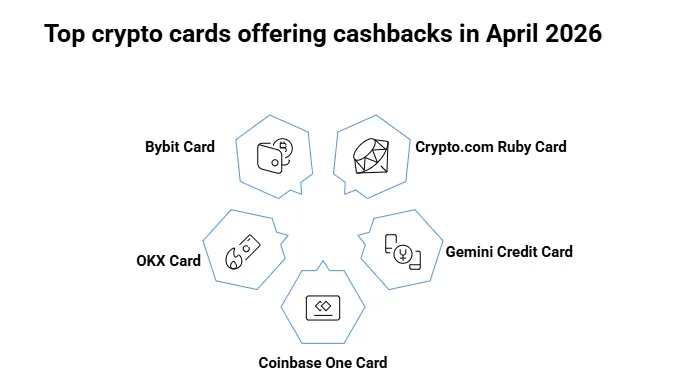
This article will review the best crypto cards offering substantial cashback in April 2026. Our selection goes beyond headline percentages to provide you with cards that actually save you money when spending crypto.
What is a crypto card?
A crypto card, whether debit or credit, serves as an ordinary payment card, except that the money spent does not come from a bank account, but your cryptocurrency account balance. When making payments via crypto cards, your assets are automatically converted to fiat by the card provider, allowing the seller to receive the local currency, whereas you spend Bitcoin, Ethereum, or stablecoins.
The fact that these cards support real-time conversion makes them convenient, unlike the manual way of converting digital assets into fiat to allow spending. Generally, using crypto cards feels just like spending with a normal Visa or Mastercard card.
The best crypto cards in April 2026
1. Crypto.com Ruby Card
The Crypto.com Ruby Card is designed to act as a credit card with 3.5% cashback. To obtain this cashback, you must subscribe via a monthly fee of $4.99 or stake out about $500 worth of your CRO for one year.
This card has an APR of 18.24% to 32.24%, and comes with a $200 sign-up bonus after meeting the spending requirement. Although the card is commonly offered throughout the U.S., it charges a 3% foreign transaction fee in addition to conventional credit card fees.
The Crypto.com Ruby Card also has additional benefits, such as a six-month Spotify rebate, which provides short-term value. In the long-run, though, its attractiveness drops due to consistency in expenditure and tolerance for token exposure.
Pros
- High cashback rate compared to other cards.
- Impressive sign-up bonus and additional benefits.
- Users can choose between staking and subscription.
Cons
- Monthly fee or necessary CRO lock-up.
- Cashback is paid in the form of a volatile token.
2. Gemini Credit Card
The Gemini credit card is a simple credit card that has neither an annual fee nor fees for foreign transactions. This card has an APR of 17.24% to 29.24% and offers as much as 4% rewards.
It allows users to decide on the cryptocurrency through which they wish to receive the rewards. However, this card offers no sign-up bonus.
The most unique thing about the Gemini credit card is its simplicity. Additionally, it does not require staking requirements, subscription fees, or obligatory exposure to a single token. It works as a typical rewards card, except with crypto payouts.
Pros
- No FX or annual charges.
- Flexible cryptocurrency rewards.
- Uncomplicated and straightforward design.
Cons
- Tiered incentives decrease efficient incomes.
- No sign-up bonus.
3. Coinbase One Card
Coinbase One Card is a credit card that is directly connected to the Coinbase ecosystem and provides up to 4% in Bitcoin rewards. It has an APR of 19.99% and needs an active Coinbase One subscription, which starts at $5 monthly.
This card does not charge annual or foreign transaction fees, and the card has standard American Express benefits. Rewards also depend on the size of assets in Coinbase, and bigger balances will obtain better rates.
Particularly, users who have less than 10,000 will receive approximately 2%, and those with much larger portfolios can receive the entire 4%. There are,e however, spending limits and increased rates that only pay a part of the transactions made monthly.
Pros
- High balance users get competitive rewards.
- No FX or annual fee.
- Other Amex perks and coverages.
Cons
- Requires a monthly subscription.
- Optimal rates reserved for large holdings.
4. OKX Card
The OKX Card is a debit card enabling easier crypto expenditure, particularly with stablecoins. It offers up to 5% cash back, but frequent users receive approximately 2% without any setup, transaction, or foreign exchange fees.
However, the card does not have any APR because it is a debit product, and it does not offer a sign-up bonus. It supports automatic conversion at the point of sale, with only a 0.1% spread charged. This makes it effective in the daily spending without undertaking any manual conversions.
Greater rewards mean increased balances or trading volume on the OKX platform. This renders the card much more valuable to active users who are already a part of the ecosystem.
Pros
- No transaction or FX fees charged.
- Uninterrupted spending for stablecoins.
- VIP user-competitive rewards.
Cons
- Low cashback for regular users.
- Bigger demands for high-end rewards.
5. Bybit Card
The Bybit Card is a debit card that has a rewards scheme that promotes cashback of up to 10%, although in practice, the cashback is significantly less. The card also has no APR, but is issued free of charge. However, local currency charges like FX charges and spreads on conversions may be charged.
The rewards program is progressive and depends on the level of spending, with the majority of users receiving 2-4%. The more advanced levels demand a large amount of monthly expenditure and have a limit, so even the promoted 10 per cent charge is limited to specific amounts of transactions.
Although the card is flexible, with the points system, and there are other advantages such as merchant rebates, it is complex. Users must track tiers, caps, and redemption options to comprehend what they are getting.
Pros
- Easy entry-level rewards
- Flexible redemption options
- Free card issuance
Cons
- Complex tier system
- Very high FX charges in certain areas
Are crypto cards worth it in 2026?
Crypto cards are no longer a new concept in the financial market. These cards have become a convenient means of spending digital assets without converting them manually. Using these cards makes local and cross-border payments easier and minimizes friction between crypto and fiat conversions.
They also enable users to get rewards as they spend, and in most cases. However, their overall importance is subject to understanding the trade-offs, such as fees, limits, and token volatility.