



It is September 2025. A brand-new political action committee storms into Washington with the kind of confidence usually reserved for billion-dollar startups and overfunded AI founders.
It promises $100 million, pledges total transparency, and drops a press release so confident it practically has its own theme music. Its name? The crypto fellowship PAC, as it would brand itself to the world. Its name? The crypto fellowship PAC. Its filings at the time? Practically zero.
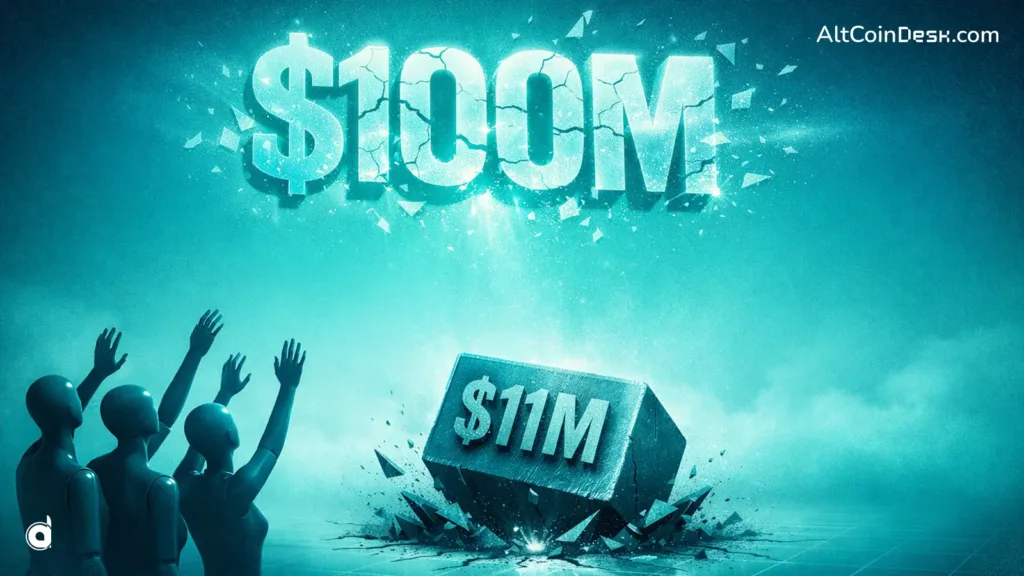
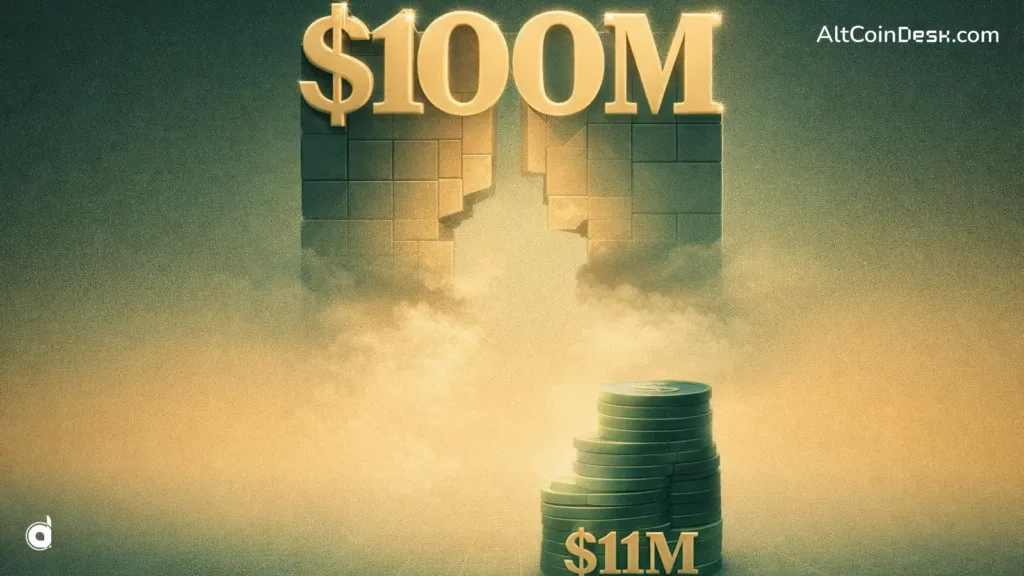
Fast forward to April 2026, and the curtain has finally been pulled back, just a little. What was hiding behind the velvet drape of crypto political ambition turned out to be $11 million, a stablecoin executive in the chairman’s seat, and a marketing firm co-founded by the CEO of Tether US. Welcome, friends, to the most entertaining political drama in digital asset history. The crypto fellowship PAC has arrived, fashionably late and significantly lighter than advertised.
Where did the other $89M go?
Let us start with the math, because math, unlike campaign finance reporting, does not lie. When the crypto fellowship PAC launched last September with a bold proclamation of over $100 million in pledged support, the crypto world sat up and took notice. Fairshake, the incumbent heavyweight of crypto political spending that deployed more than $130 million in the 2024 cycle, suddenly had a rival in town.
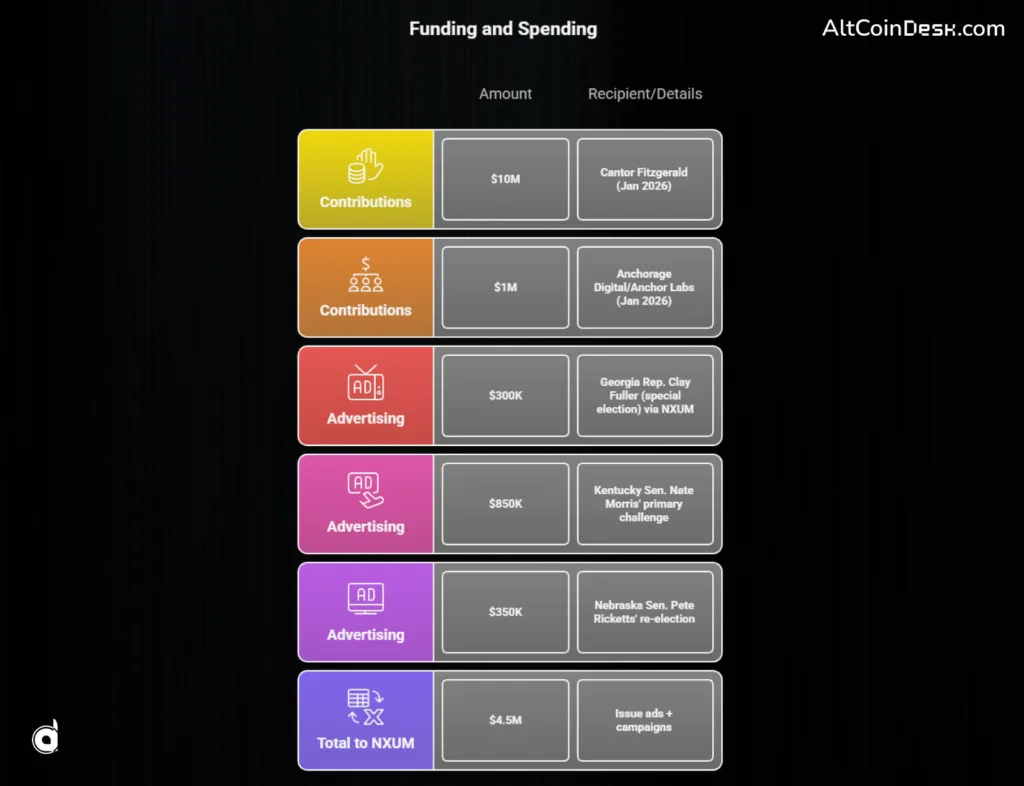
Then the FEC filings came in. Crickets. Month after month, the reports showed numbers so close to zero they could have been audited by a houseplant. It was not until January 2026 that real money finally moved, and the April 15 disclosures confirmed the totals. Cantor Fitzgerald contributed $10 million while Anchor Labs, the parent company of Anchorage Digital, added $1 million, bringing the reported 2026 funding to $11 million. That is a far cry from nine figures, but it is certainly enough to buy some political advertising and, apparently, some very interesting questions.
Meet the men running the show
Now here is where it gets genuinely delicious. The crypto fellowship PAC did not just hire any old political operative to run things. It installed Jesse Spiro, vice president of regulatory affairs for Tether US, as its chairman. Tether US, of course, is the domestic entity tied to Tether, the company behind USDT, the stablecoin with roughly $184 billion in circulation and a talent for generating headlines.
But wait, the story gets better. The PAC’s treasurer is Mitchell Nobel, a Cantor Fitzgerald executive. That is the same Cantor Fitzgerald that just wrote a $10 million check to the PAC. So the firm providing most of the money also controls the books. In corporate America, auditors tend to frown on that kind of arrangement. In super PAC land, it is just Tuesday.
And then there is Bo Hines. Hines, CEO of Tether US and formerly President Trump’s leading crypto adviser, co-founded Nxum Group alongside his father and a third partner. Nxum is the marketing company that received $3 million from the crypto fellowship PAC for advertising services, with the total expected to reach $4.5 million as more campaign spending is reported.
The PAC that says it is defined by transparency handed its first major advertising contract to a company run by the CEO of the organization, whose executive chairs the PAC itself. Individually, each piece is explainable. Together, they form a pattern, holding a sign that says “nothing to see here.”
Cantor, Tether, and a tidy loop
Here is a detail that deserves its own true-crime podcast episode. Cantor Fitzgerald, which provided the bulk of Fellowship’s $11 million, handles the reserve assets for Tether’s stablecoin operations. Howard Lutnick, the firm’s former chief, now serves as Trump’s Commerce Secretary, with his children having taken over the business.
Federal regulations prohibit foreign entities from participating directly in U.S. electoral financing activities, which is why questions persist about whether Tether itself could contribute to the crypto fellowship PAC directly. So the arrangement looks something like this: Tether, a non-U.S. entity, cannot write a check to the crypto fellowship PAC.
But Cantor Fitzgerald, which custodies Tether’s reserves and has deep financial ties to the stablecoin issuer, absolutely can. Whether any legal lines were crossed is a matter for regulators, but even the most charitable reading of this setup looks like a carefully structured workaround in a bespoke three-piece suit.
Tether’s official response to all of this? “Tether International has no affiliation or oversight of Fellowship.” Technically true. Practically speaking, the PAC is chaired by a Tether executive, funded primarily by Tether’s reserve custodian, and its advertising dollars flow to a firm run by Tether’s U.S. CEO. Other than that, completely unrelated.
Who is cashing in here?
Federal Election Commission records show the group reported a $300,000 ad buy through Nxum Group in support of Clay Fuller in Georgia’s 14th Congressional District, filed one day after Fuller won the special runoff to replace Marjorie Taylor Greene in Congress.
That timing is impeccable in a way that only someone who has never dealt with FEC reporting timelines would attempt to call suspicious. Fuller, notably, has no recorded stance on crypto and no grade from Stand With Crypto, the industry’s candidate-scoring advocacy group. He does, however, have Trump’s endorsement, and in 2026, that appears to be a sufficient credential for the crypto fellowship PAC’s support.
Beyond Fuller, the PAC has endorsed Alan Wilson for South Carolina governor, Mike Collins and Julia Letlow for Senate seats in Georgia and Louisiana, respectively, Pete Ricketts for Nebraska Senate reelection, Nate Morris in a Kentucky Senate primary challenge, and Blake Miguez for Louisiana’s House District 5. Total ad spending for the Kentucky and Nebraska races alone sits at $1.2 million, with Kentucky’s Nate Morris receiving the single largest allocation of $850,000.
Transparency is just a vibe
The crypto fellowship PAC launched with a mission statement explicitly contrasting itself with previous crypto political efforts. It promised to be “defined by transparency and trust,” supporting the broader ecosystem rather than, and this is a direct paraphrase of its own words, “narrow or individual interests.”
It then spent $3 million with a firm run by an insider, appointed an industry executive as chairman without disclosing his identity for months, filed financial reports showing zero funds despite claiming $100 million in commitments, and declined to respond to repeated media inquiries from multiple outlets. The PAC said it would support candidates who favor regulatory clarity for digital assets and open markets. Regulatory clarity for thee, but apparently not transparency for me.
What actually matters here
Beneath all the satirical gold is a genuinely important story about what the crypto fellowship PAC represents in the broader picture of digital assets and American democracy. The end goal of crypto PAC spending at this scale is to secure enough lawmakers to advance the CLARITY Act, the major market structure bill, which remains unresolved in the Senate after passing the House last year. The stakes are real, and the money, even if it came in at a fraction of the headline promise, is substantial.
The crypto fellowship PAC may not have delivered its $100 million, but it has delivered something arguably more valuable: a masterclass in how political money moves through the digital assets industry, who it connects, and what it is really trying to buy. Whether that is “transparency and trust” is, at this point, a question best left to the FEC, watchdog groups, and anyone who enjoys reading campaign finance filings at midnight.
Key takeaway
The fellowship is gathering. The donations are trickling in. And somewhere in Washington, the crypto fellowship PAC continues its remarkable run: a Tether executive chairs a PAC that Tether says it has nothing to do with, spending millions at a firm his own boss co-founded, funded by the bank that holds the stablecoin reserves. If that is what transparency looks like in crypto politics, one shudders to imagine what the opaque version would be.