


Regulators recently dubbed Polkadot (DOT) a non-security; even after this classification, the market has still not reacted favorably. The prices are numb as the traders are ignorant about how it will have an impact on the prices.
Earlier this month, the Commodity Futures Trading Commission (CFTC) and the US Securities and Exchange Commission (SEC) came together to discuss how the federal securities law would apply to crypto. To envision the treatment of crypto under federal law, the duo first laid the groundwork of defining ‘security.’
SEC segregates crypto assets to 5 categories
According to the SEC, crypto assets have been segregated into five categories. Digital commodities, digital collectibles, digital tools, and stablecoins were considered non-securities.
Meanwhile, the Commodity Futures Trading Commission (CFTC), which assisted in the interpretation, stated that some “non-security crypto assets” actually fit the definition of “commodity” under the Commodity Exchange Act.
As such, SEC’s guidance classifies Aptos (APT), Avalanche (AVAX), Bitcoin (BTC), Bitcoin Cash (BCH), Cardano (ADA), Chainlink (LINK), Dogecoin (DOGE), Ether (ETH), Hedera (HBAR), Litecoin (LTC), Polkadot (DOT), Shiba Inu (SHIB), Solana (SOL), Stellar (XLM), Tezos (XTZ), and XRP (XRP) as non-security digital commodities.
Polkadot (DOT), which was considered a non-security digital commodity, has not reacted despite falling under this category. For the uninitiated, the classification as a non-security comes with its perks.
Advantages of being categorized as non-securities
Reduced regulatory burden is a major benefit these asset classes get. A crypto asset that is considered a security is under the purview of regulatory bodies like the SEC.
And when the SEC regulates them, it comes with a cost in the form of registration, disclosure, and other requirements. But once the token has been categorized as a non-security, it bypasses all the aforementioned hurdles. This gives them more freedom and flexibility to innovate.
The second advantage lies in the exchange listings. When it comes to listing, exchanges are extremely cautious as securities because it increases the liability factor. But when it comes to non-security tokens – which fall more under the Commodity Futures Trading Commission’s umbrella – they face fewer hurdles.
Institutional participation thrives with commodities. Since holding securities demands meeting many criteria like legal compliance, qualified custody solution KYC, and AML compliance, many institutional investors don’t hold securities.
However, the game changes with commodities, and it becomes easier for hedge funds, asset managers, and other large players to gain exposure through regulated channels like futures, ETFs, or spot markets.
For projects, this classification supports decentralization narratives. A non-security often implies that no central entity is solely responsible for driving profits, which aligns with decentralized network models. This can improve credibility in the eyes of developers and users who prefer permissionless systems.
From a market perspective, non-security status can reduce legal uncertainty. Clear classification lowers the risk of sudden enforcement actions, which can otherwise create volatility. This clarity often encourages longer-term capital allocation rather than short-term speculation driven by regulatory fear.
Fewer restrictions on token economics, such as token distribution, incentives, and utility, teams get to experiment more freely with staking mechanisms, governance structures, and DeFi integrations without securities law issues.
In essence, if you are considered a non-security, you are looking at less red tape, greater accessibility, greater liquidity, and greater institutional support.
Despite all these advantages coming alongside being considered a commodity, DOT prices have still not reflected this positive sentiment.
To put the ignorance of the traders into context, Crypto Patel, a crypto analyst, stated that it was like ignoring Ethereum during a time when the smart contracts were considered useless. However, in today’s context, there are so many projects building on the Ethereum network.
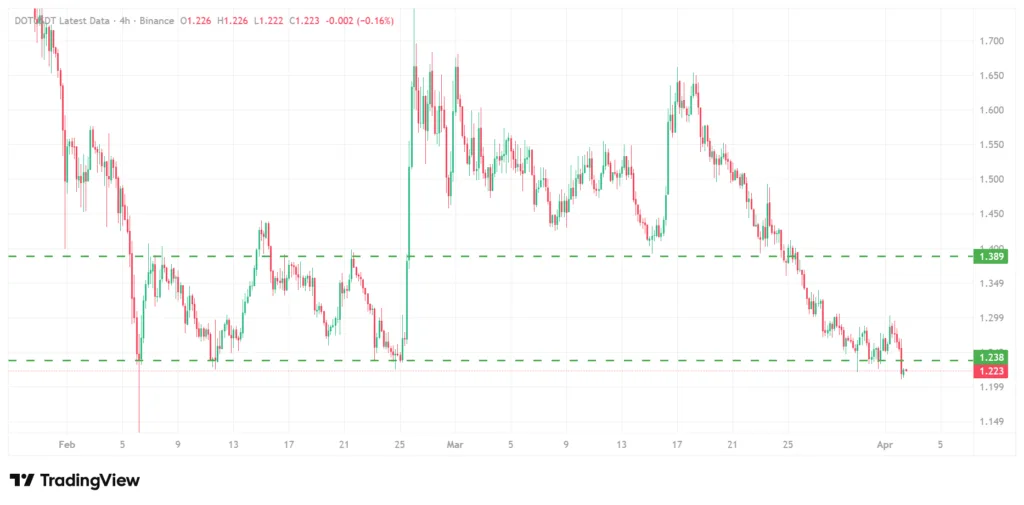
Priced at $1.23, DOT has continued its decline since February. The token hit values above $1.65 a month ago before the bears took control of the market, crashing the prices. Going by the relative strength index indicator, DOT is barely holding above the oversold region as it shows 36 on its scale.