



The Polygon network announced that it will launch the Giugliano hard fork upgrade tomorrow, April 8. The upgrade reportedly improves the network’s speed of finality. Despite Polygon posting this exciting announcement on their X handle, the POL prices are still below $0.1. It was only able to fake a breakout from the falling wedge.
The Polygon network informed its community about the Giugliano hard fork. The official X post read, “The Giugliano hardfork will be released on Polygon mainnet at block number 85,268,500, at approximately 2 PM UTC on April 8.
This upgrade: enables faster finality by letting producers announce blocks earlier, adds fee parameters directly in block headers, and introduces new RPC support for fee data.”
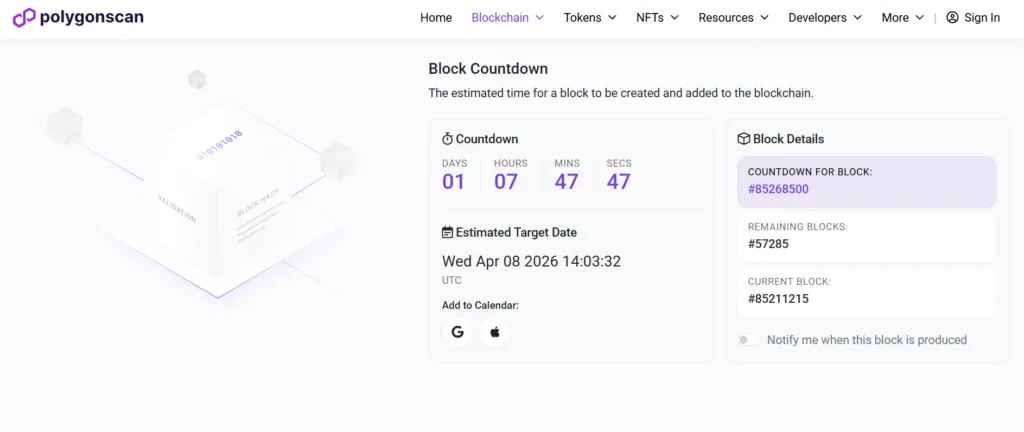
Countdown to the upgrade
What is Giugliano?
Giugliano is simply the name given to a specific network upgrade, inspired by Giugliano in Campania, following the common blockchain practice of naming upgrades after cities.
Just like the Ethereum network had the Shanghai upgrade and the London hard fork–2021, this is just named after the city.
What is the Giugliano Hard Fork?
The Giugliano hard fork is a protocol-level upgrade to Polygon’s Proof-of-Stake chain. A hardfork is different from a soft fork, and it means that after the network has been upgraded and the changes have been made, it requires all the validators and nodes to update their software to stay in the loop.
This upgrade is actually targeted at block production and communication between validators to reduce the latency. How? With the upgrade, validators will be able to announce and propagate block data earlier and will not have to wait for a block to be fully completed before sharing it with the network, allowing other nodes to begin verification sooner.
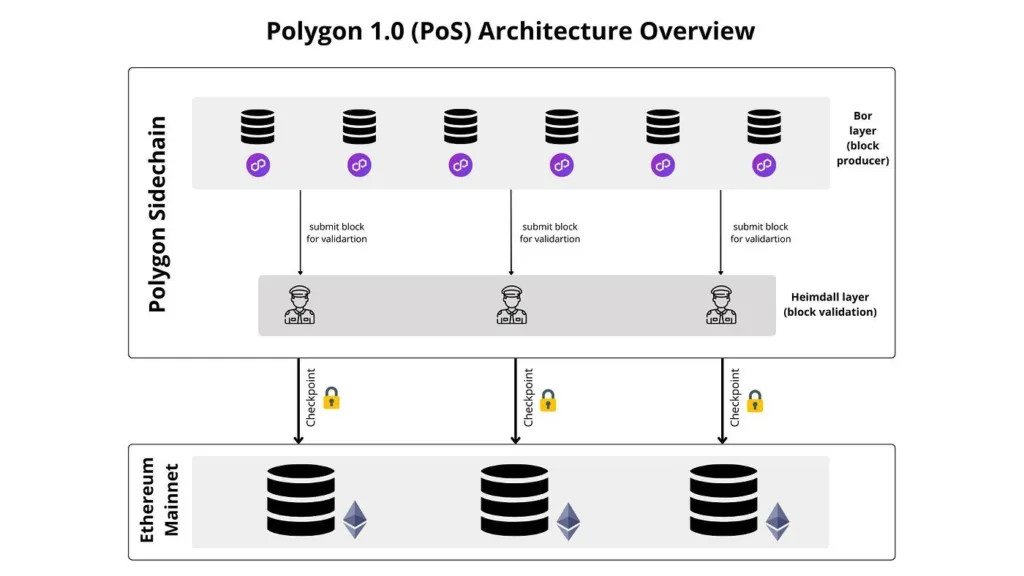
Before the upgrade, a validator would first need to collect transactions from the mempool, after which he would need to build a full block containing those transactions.
It was only when the block was fully constructed or there were enough transactions for one entire block that it would be broadcast to the network.
Following this, the validators would receive, verify, and agree on the block. So this latency of waiting for the block to be complete is the main issue that the upgrade focuses on.
Major shortcomings of the old protocol flow
- Latency is high because nodes had to wait before starting the verification procedure
- Block propagation speed was lower since whole blocks had to be sent around for verification
- Finality was delayed until the consensus reached its stage
- Inefficiency at peak load since network propagation was affected when transaction rates were high
How the Upgrade Positively Affects the Network
The improvement in the network protocol helps in reducing propagation and consensus delays through the introduction of early node communication.
The result:
- Finality is reached faster as transactions are approved faster
- The latency reduces as waiting periods in the network have gone done drastically
- Increased efficiency because of smoother validation processes
Despite these significant changes and upgrades to the network, POL prices continue to struggle below the $0.1 level. The POL prices have been trading inside a falling wedge since the last week of February. It has been making lower highs and lower lows as the range of motion inside the wedge drastically reduces.
POL fakes a breakout
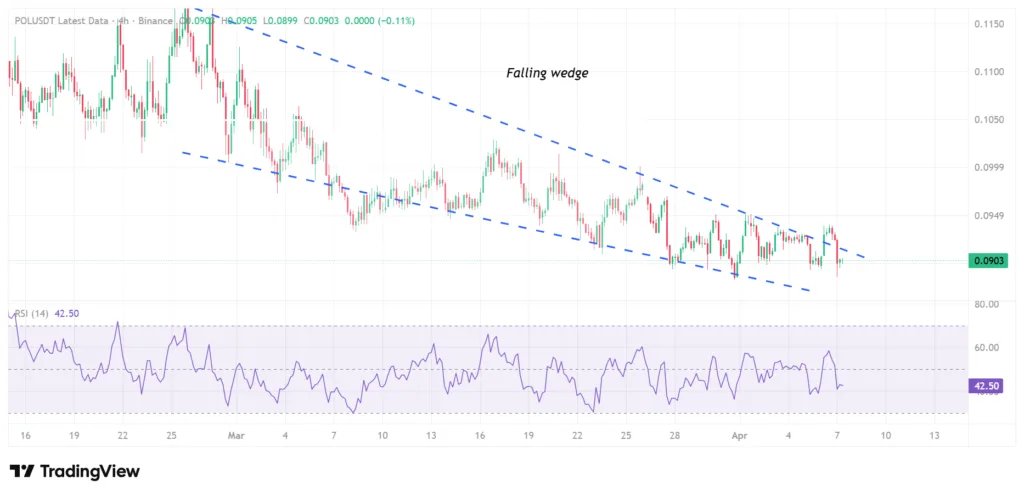
Although the price is trending downward inside the falling wedge, the pace at which the price falls is reducing. This is explained by both lower highs and lower lows still forming, but each swing becomes weaker than the previous one.
Through a trader’s lens, it is interpreted as a sign that bearish momentum is fading. Despite the sellers still having the upper hand in the short term, they no longer have the intensity to push prices down with the same strength as they did during the early stages of formation. This happens simultaneously while buyers gradually start stepping in at higher levels.
With the wedge tightening while forming the apex, volatility contracts and price compresses between the converging trendlines. Traders become cautious, and many wait for a confirmed breakout.
But with POL prices, there was a fake breakout, and this caught many buyers off guard. Now that POL is once again back inside the trendlines of the falling wedge, it may continue inside the wedge. This means that the POL will once again form a new lower low, which may be close to $0.08.