


Despite Canary Capital and Grayscale launching SUI ETFs just about a week ago, SUI has crashed to 2024 August levels. However, historically, this level has produced massive price reversals, and SUI may be on the route to end the 14-month-long downtrend.
SUI continues to struggle despite two asset management companies launching SUI spot ETFs. Canary Capital and Grayscale launched the SUI ETF about a week ago.
Canary and Grayscale launch SUI ETFs
Canary launched its ETF under the symbol SUIS on the Nasdaq exchange. According to Canary, the fund will track the spot price of SUI, and investors could also benefit from net staking rewards through SUI’s proof-of-stake mechanism.
Meanwhile, Grayscale also debuted its SUI fund, which will trade under the ticker symbol GSUI on NYSE Arca. Unlike Canary’s SUI ETF which is registered as an investment adviser under the Investment Advisers Act of 1940, GSUI is not registered under the Investment Company Act of 1940.
SUIS is structured as a fully registered ETF under the Investment Company Act of 1940, meaning it has the typical oversight, governance, liquidity, and disclosure requirements associated with traditional ETFs, which can attract more cautious institutional and retail capital while offering built‑in investor protections.
GSUI is riskier than SUIS
In contrast, GSUI, while also trading on a major exchange like the NYSE Arca and staking SUI for yield, is not registered under the 1940 Act, operating instead as an exchange‑traded product that doesn’t carry the same level of regulatory oversight and protections, potentially exposing investors to greater structural and liquidity risk.
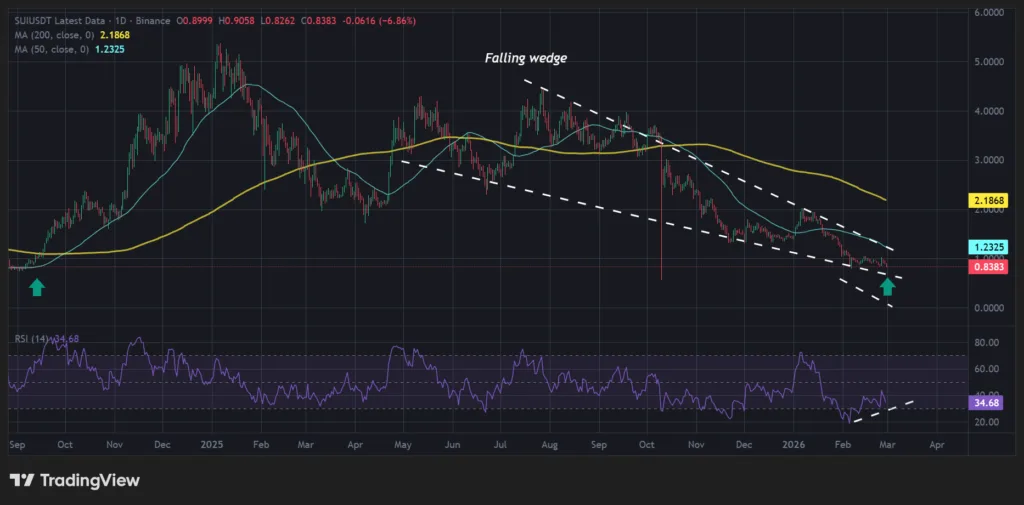
Despite two firms launching SUI ETF, the excitement has not been translated into the token, as it continues its downtrend that began 14 months ago. Now that the price has reached 2024 August levels, there is a slight belief that the token might recover, based on historic data.
Bullish momentum builds undercover
On the technical front, SUI is currently trading inside a falling wedge, which is nearing its completion. A falling wedge usually produces a breakout once it’s complete. As such, SUI might be bracing for a breakout. Looking at the technical indicator—Relative Strength Index—there is a bullish divergence occurring.
The RSI is moving in one direction while the SUI price is moving in another direction, unlike most of the time. When SUI is making lower lows, the RSI is making higher lows, suggesting that the SUI token is gaining momentum under the surface. Eventually, it will break out and reach above $1, a psychological level, and there will be an SUI reversal.