

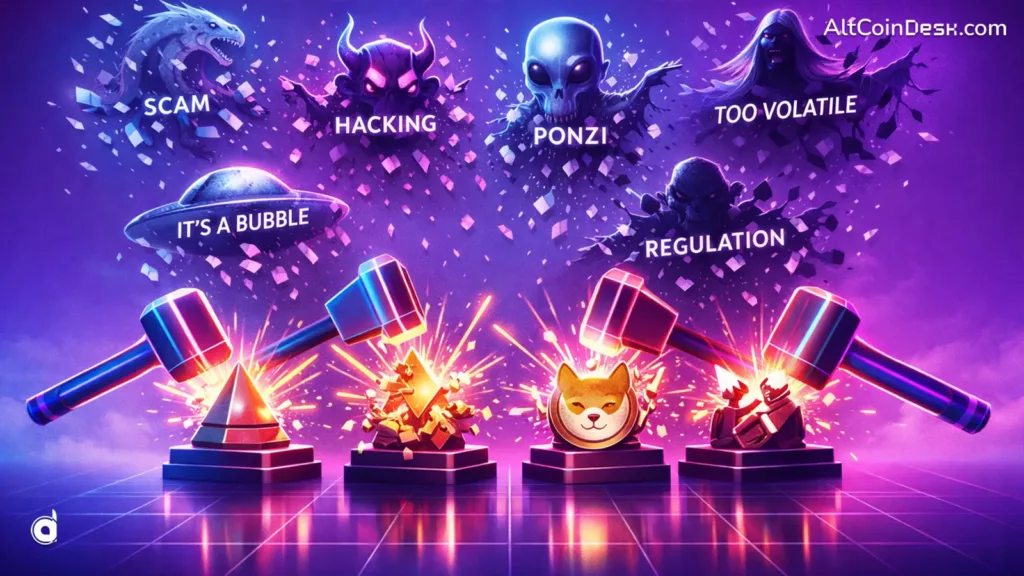

An unexpected bedtime story about money, fear, and the 10 biggest crypto myths we keep telling ourselves.
Welcome to a strange little town where rumors travel faster than facts, screenshots count as evidence, and everyone has a cousin who once got rich overnight. This town has a name. It is called Crypto. And at the center of it all sit the biggest crypto myths, dressed up as wisdom, shouted as warnings, and shared like family heirlooms.
This is not a lecture. This is a playful walk through the biggest crypto myths, told like a story, without charts, jargon, or anyone yelling at you to buy anything.
Pull up a chair!
The stranger who said crypto is only for criminals
The first myth walks into town wearing dark glasses and whispering scary things. Crypto is only for criminals, it says. Hackers. Drug dealers. Shadowy figures in hoodies.
Then the town looks around. Banks are using blockchains. Governments are tracking crypto transactions. Stablecoins move billions in plain sight every day. Cash, meanwhile, still disappears quietly in briefcases and envelopes.
This is the first of the biggest crypto myths. It survives because it sounds dramatic. Not because it is true.
The invisible man who was never invisible
Next comes the myth of total anonymity. “Bitcoin makes you invisible,” they say. No one can see you. Except everyone can.
Every transaction is public. Every move leaves a trail. Entire companies exist just to follow those trails. Courts use them. Investigators love them.
If crypto were truly invisible, half the headlines from the last decade would not exist. This myth remains one of the biggest crypto myths because it feels comforting. It promises secrecy in a world that watches everything.
The empty box that was supposedly backed by nothing
Another myth arrives holding an empty box. Crypto is backed by nothing, it declares proudly. The town opens the box and finds something familiar inside. Belief. Networks. Rules. Trust. That is what backs most money today. Paper notes work because we agree they do. Crypto works because code enforces rules without asking permission.
Calling it nothing is easy. Understanding it takes effort. That is why this myth keeps its seat among the biggest crypto myths.
The haunted chain that could be rewritten
Someone whispers that blockchains can be altered. Records can be erased. History can be rewritten. Then old hacks resurface. Old scandals reappear. Old wallets get traced years later. Blockchains remember. That is their entire personality. They are bad at forgetting. This myth survives because people confuse difficulty with impossibility.
It is still one of the biggest crypto myths because permanence feels scary until you realize it applies to everyone equally.
The carnival barker selling easy money
Now comes the loudest myth of all. Crypto is easy money. This myth has emptied more wallets than any crash. It promises shortcuts. It smiles before it disappears.
Crypto rewards patience. It punishes rushing. It teaches expensive lessons quickly. Anyone who tells you otherwise is either new, lucky, or lying. Yet this remains one of the biggest crypto myths because hope sells better than caution.
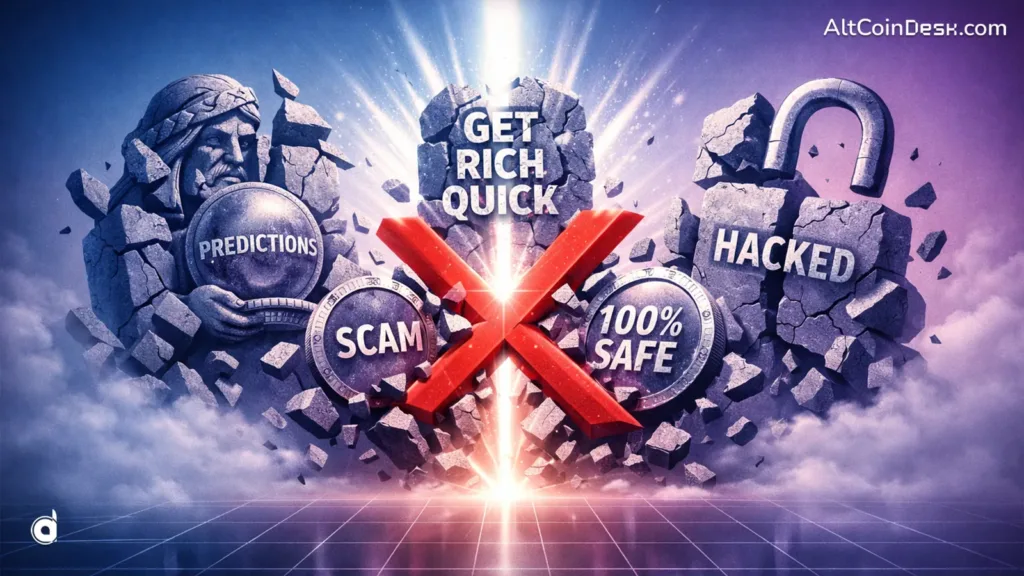
The funeral held every time prices fall
Prices drop, and the town gathers for another funeral. “The project is dead,” they say. But behind closed doors, developers keep building. Users keep using. Quiet progress continues while headlines move on.
Price measures mood, not life. This myth stays alive because numbers feel final even when they are not. It earns its place among the biggest crypto myths by confusing noise with reality.
The monster that eats the planet
“Crypto mining destroys the planet,” the myth roars. Energy use is real. So is nuance. Mining follows cheap energy. Often, that means renewables or wasted excess power. The picture is messy, not monstrous.
Simple villains are easier to understand than complex systems. That is why this myth keeps returning, insisting it belongs among the biggest crypto myths.
The regulator who was supposed to end everything
Each year, a regulation is announced as the final blow. Crypto is finished now, the myth says. Crypto survives bans, lawsuits, collapses, and crackdowns. Regulation changes behavior. It slows chaos. It rarely kills innovation.
Fear loves deadlines. Reality rarely meets them. This myth remains one of the biggest crypto myths because it promises closure in a story that keeps going.
The stablecoin that promised perfect safety
Stablecoins enter the story wearing suits and speaking calmly. Risk-free, they say. They are useful. They are powerful. They are not magical. Issuers fail. Rules change. Markets panic. Stablecoins are tools, not miracles. Forgetting that keeps this myth alive among the biggest crypto myths.
The last chance that was never the last
“You missed it,” the myth whispers. Too late. People heard this at $100. At $1,000. At $20,000. At every peak and every crash. Every cycle creates new stories. New builders. New mistakes. The idea that opportunity expires forever is comforting because it excuses inaction. That is why it remains one of the biggest crypto myths.
Final chapter: Why the biggest crypto myths refuse to leave
The biggest crypto myths survive because they are emotional. They sound like advice. They spread faster than facts. They protect people from uncertainty by offering simple answers. Crypto is not magic. It is not evil. It is not finished. It is not easy. It is not pointless. It is a messy, human experiment playing out in real time.
Once you see the biggest crypto myths for what they are, stories we tell ourselves when new ideas feel uncomfortable, the noise fades. What remains is choice. Learn slowly. Ask better questions. Ignore anyone promising certainty. That is how you survive the town called Crypto.