


When newcomers encounter crypto, their main concern usually centers on volatility. And, honestly, it’s justified: Bitcoin can swing 10% up or down within hours, Ethereum’s price graph is practically a rollercoaster, and altcoins? They’re a digital dice throw. That sort of price whiplash makes crypto as a daily currency pretty challenging. This is the gap stablecoins aim to fill.
Why stablecoins exist
Stablecoins solve a key problem: how to move money around the crypto ecosystem without worrying about massive price swings. Imagine you’re a trader who just made a profit on Bitcoin. If you sell into U.S. dollars through a bank, you’ll face slow transactions, high fees, and sometimes restrictions. But if you sell into a stablecoin like USDC or USDT, you can lock in your gains instantly and still keep your funds inside the crypto economy.
For everyday users, stablecoins make crypto payments more realistic. No one wants to pay $20 for coffee today only to realize the same coins would’ve been worth $30 tomorrow. By holding stable value, stablecoins make spending, sending, and saving in crypto much more predictable.
What are the different types of stablecoins?
Not all stablecoins work the same way. Here are the main categories:
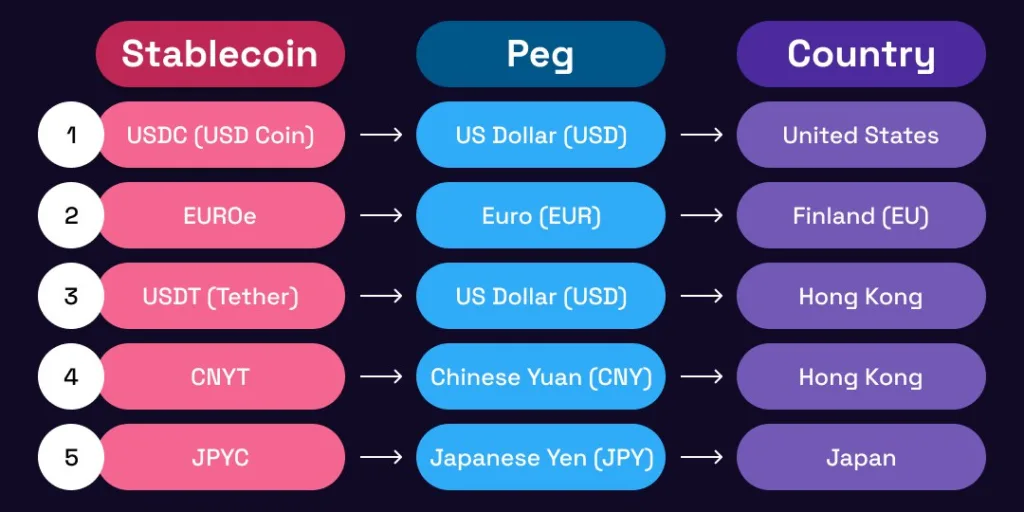
- Fiat-backed stablecoins: These are the most common. Each token is backed by reserves of fiat currency or equivalent assets. For example, Tether (USDT) and USD Coin (USDC) claim to hold U.S. dollars or dollar-denominated assets in reserve for every token issued. The only issue is that they rely heavily on trust in the issuing company.
- Crypto-backed stablecoins: Instead of holding fiat, these stablecoins are backed by other cryptocurrencies locked in smart contracts. DAI, for example, is pegged to the dollar but backed by collateral like Ethereum. Since crypto prices are volatile, these systems are often over-collateralized — meaning you might need to lock up $150 worth of ETH to mint $100 worth of DAI.
- Algorithmic stablecoins: These attempt to maintain their peg using algorithms and supply-demand mechanics, rather than collateral. When the price rises, more tokens are minted; when it falls, tokens are burned. While innovative, this model is fragile — the infamous collapse of TerraUSD (UST) in 2022 wiped out billions, showing the risks of purely algorithmic designs.
- Commodity-backed stablecoins: Some stablecoins are tied to assets like gold. For example, PAX Gold (PAXG) represents ownership of physical gold stored in vaults.
Why should you use stablecoins?
Stablecoins are more than just “digital dollars.” Their applications are wide-ranging:
- Trading and investing: Traders use stablecoins to move in and out of positions faster than using fiat.
- Cross-border payments: Sending stablecoins across borders is cheaper and faster than traditional remittance services.
- Make purchases: Pay for goods and services with a growing number of online retailers and physical merchants who accept stablecoins as a form of payment.
- Hedge against volatility: In unstable economies, people sometimes prefer holding stablecoins over local currencies that are prone to inflation.
- Micropayments: Because stablecoins can be split into tiny units and transferred cheaply, they work well for small online transactions.
- Hold a stable asset: Use them as a digital safe haven to temporarily park your assets and protect your portfolio’s value during periods of high market volatility.
Converting fiat to stablecoin
- Choose a platform: Select a reputable cryptocurrency exchange like Coinbase or Kraken, or a broker that operates in your region.
- Create and verify an account: Sign up for an account and complete the Know Your Customer (KYC) verification process, which typically requires providing identification to comply with financial regulations.
- Deposit fiat currency: Link your bank account, debit card, or other approved payment method to deposit your local currency into your account on the platform.
- Navigate to the trading section: Locate the platform’s “Buy,” “Trade,” or “Markets” section.
- Select your stablecoin pair: Choose the stablecoin you wish to purchase and the fiat currency pair you are using.
- Execute the trade: Enter the amount of fiat you want to convert and confirm the purchase. The platform will execute the trade at the current market rate, often for a small fee.
- Secure your stablecoins: For long-term holding, withdraw your newly purchased stablecoins from the exchange to your own personal cryptocurrency wallet for enhanced security.
The risks of stablecoins
Stable doesn’t mean risk-free. Here are the main concerns:
- Reserve transparency: Do fiat-backed stablecoins really hold enough cash to cover all their tokens? Regulators have questioned whether some issuers are fully backed.
- Regulation: Governments are watching closely. Since stablecoins blur the line between crypto and traditional money, they could face stricter rules or even bans in some countries.
- Smart contract risk: Crypto-backed and algorithmic stablecoins depend on code. Bugs, hacks, or flawed designs (like UST) can destroy their value.
- Centralization: While crypto is meant to be decentralized, many stablecoins are controlled by companies. They can freeze accounts or blacklist addresses if required by law.
Expert opinions
Stablecoins remain in the spotlight, pitched as the key link between traditional finance and the evolving digital asset landscape. But honestly, the experts aren’t just popping champagne yet. The Bank for International Settlements (BIS) has flagged major concerns: stablecoins come up short on core monetary functions like reliability, flexibility, and integrity, mainly because they lack central bank backing. There’s also the risk of misuse—these things have a knack for slipping past regulators.
Scott Bessent, Treasury Secretary, isn’t sounding any alarm bells over crypto—stablecoins in particular. In his view, these digital assets aren’t a threat to the dollar; if anything, they can strengthen its global standing. “Stablecoins can reinforce dollar supremacy,” he said, making it clear he sees them as an asset, not a liability.
Stablecoins vs. CBDCs
You may have heard of CBDCs (Central Bank Digital Currencies)—government-issued digital money. On the surface, they look like stablecoins, but they’re very different. CBDCs are controlled entirely by central banks, while stablecoins are private projects built on blockchain. Some see CBDCs as competitors that could replace or heavily regulate stablecoins in the future.
The future of stablecoins
Stablecoins are most certainly here to stay. Their role keeps growing, especially now that governments are actively developing their own central bank digital currencies—and private companies are leaning on stablecoins to make international payments faster and more cost-effective. The regulatory landscape is also shifting: authorities now expect much greater transparency and solid reserve documentation from stablecoin issuers.
For users, it comes down to due diligence. Not all stablecoins are created equal. Before making a business decision, dig into the fundamentals: what assets are backing the stablecoin? Is the issuer reputable and regulated? Are reserve reports and audits made available regularly? The bottom line—don’t assume stability just because “stable” is in the name.