


More than 50% of the stablecoin supply is lying on the Ethereum network, while a good portion of the remainder is on the Tron blockchain. Meanwhile, Ethereum has crossed a major obstacle on its price charts with highly speculative market betting on it, but price sustenance above this level is questionable.
$170 billion stablecoin lie on the Ethereum network
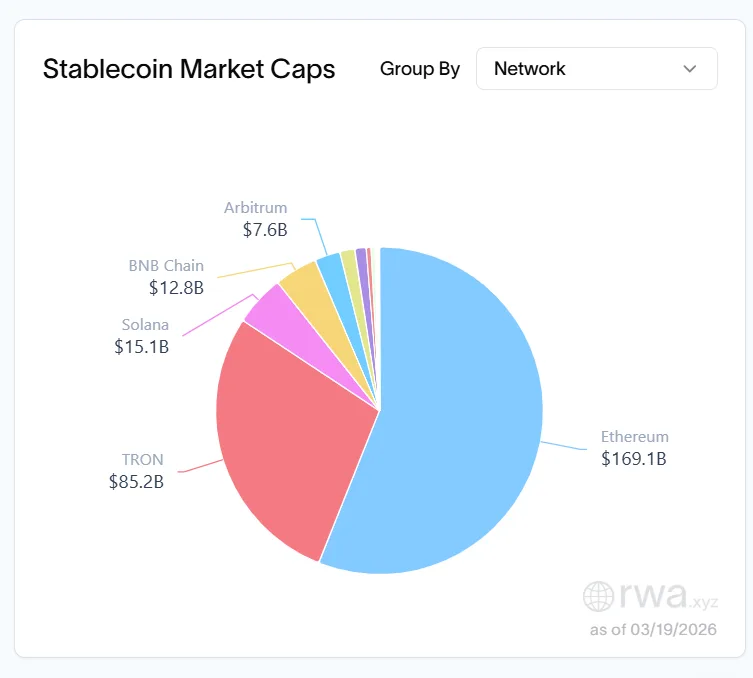
The Ethereum network dominates when it comes to the largest supply of stablecoins on a blockchain network. With about 54% of the market share, there are about $170 billion in stablecoins on the network. Tron, which is the second-largest network by stablecoin market cap, has an $85 billion stablecoin, which is almost half of that on Ethereum.
The rest of the market share is fragmented to Solana, BNB Chain, and Arbitrum. In addition, the stablecoin transfer volume on the Ethereum network was $82 billion within the last 30 days alone.
Stablecoins represent buying power. or even dry powder, which could be utilized when the need arises. A large supply of Ethereum means that there’s capital readily awaiting to be deployed into ETH or other layer-2s. This also increases the chance of quick rallies if sentiment flips bullish.
With the crypto market holding strong despite the war in the Middle East, the ETH traders seemed to have gained a lot of confidence. According to CryptoQuant, an analytical platform, ETH traders are taking on higher risk with increased leveraged exposure.
This shows that the market is overconfident, and with extreme confidence comes the risk of forced deleveraging. With 75% of the ETH on Binance being leveraged, which is borrowed money to to enlarge the position, there is a huge risk. Minor news or price changes can trigger significant fluctuations, leading to market instability and reactivity.
ETH breaks above 50-day MA but it may not sustain
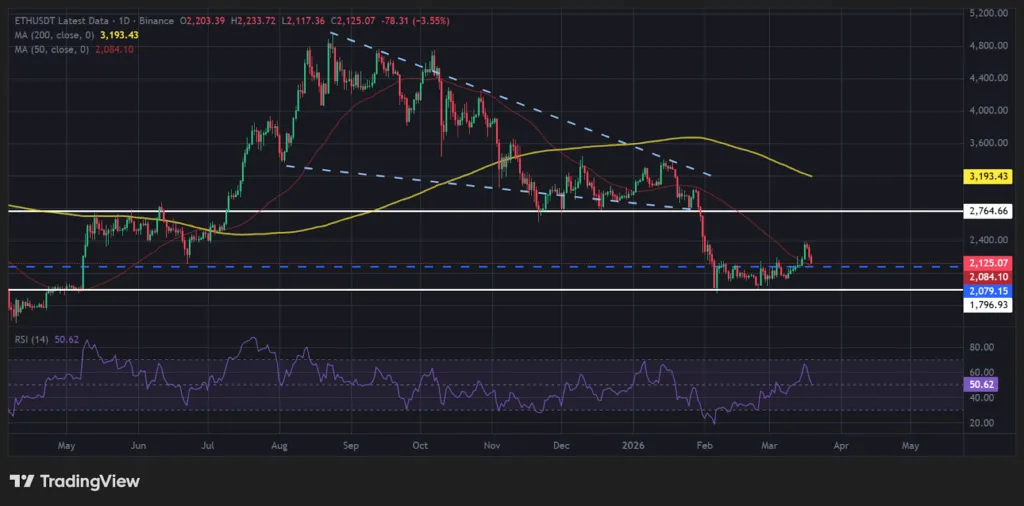
In such a backdrop, ETH has risen above the 50-day moving average, a short-term indicator. When a coin rises above the 50-day moving average, which is the average price of the coin for the past 50 days, traders consider it a short-term bullish signal. Although the ETH price rose above this, the sustenance of the price above this level is quite a question, as the market is highly speculative and volatile.