

Amid the rising geopolitical tensions in the Middle East, the crypto market is behaving with caution. Leading altcoins like Ether and Solana had minor pullbacks over the past 24 hours. Meanwhile, ETH reserves on Binance have fallen to 2020 lows.
Ethereum reserves on Binance fall to 2020 lows
Latest exchange data from Binance shows that ETH reserves on the crypto trading platform have declined to 2020 lows. Specifically, ETH holdings have dropped to 3.46 million ETH, suggesting important implications for the wider crypto market.
Typically, a severe fall in a specific digital asset’s reserves on a leading exchange like Binance suggests that investors are choosing to pull their holdings to cold wallets or long-term custody solutions.
Such behavior indicates that investors have a clear preference for holding ETH rather than selling. When the available supply of a digital asset decreases on an exchange, the volume ready for immediate trading also falls.
As a result, the likelihood of a sharp sell-off caused by excessive liquidity also drastically goes down. All this points toward the possibility of ETH already having reached a potential local bottom in price terms.
The following chart shows that ETH reserves during previous market cycles have typically peaked at more than 5 million. However, the indicator has since been on a gradual downtrend, interrupted by short rebounds.
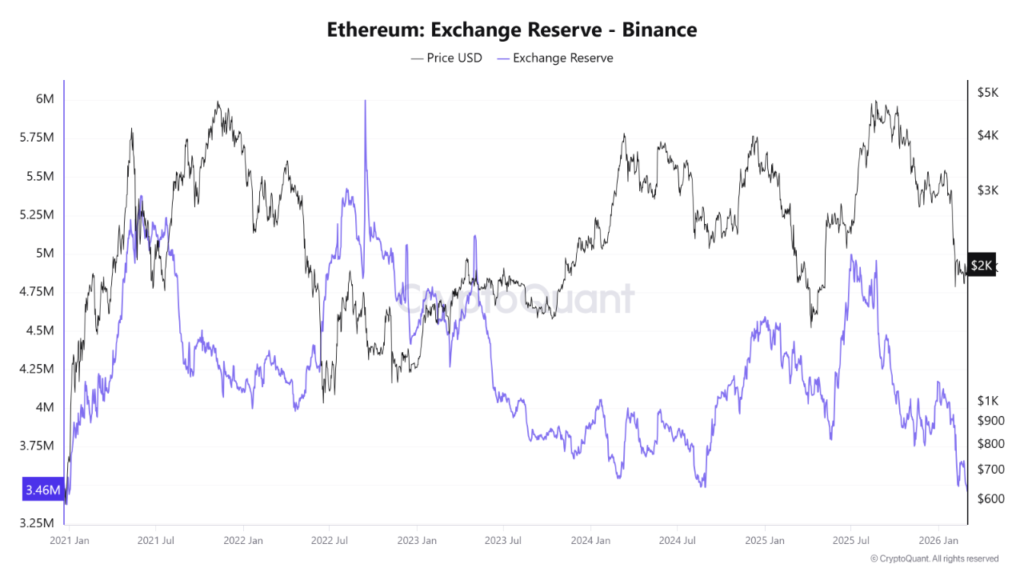
However, the trend remains to the downside, as confirmed by the successive lower highs. The exchange reserves indicator has reached its lowest level in almost six months, pointing toward the adoption of self-custody solutions.
Ethereum developments continue
While the Ethereum price may be showing signs of stagnation – recording a slump of 19.2% over the past month – on the development front, the smart contract protocol continues to advance.
In February, the Ethereum Foundation launched a DeFi-focused initiative to support its DeFi ecosystem. Similarly, Ethereum co-founder Vitalik Buterin shared a new draft roadmap for the project called ‘Strawmap,’ focusing on privacy, quantum resistance, and Layer-2 scaling.