



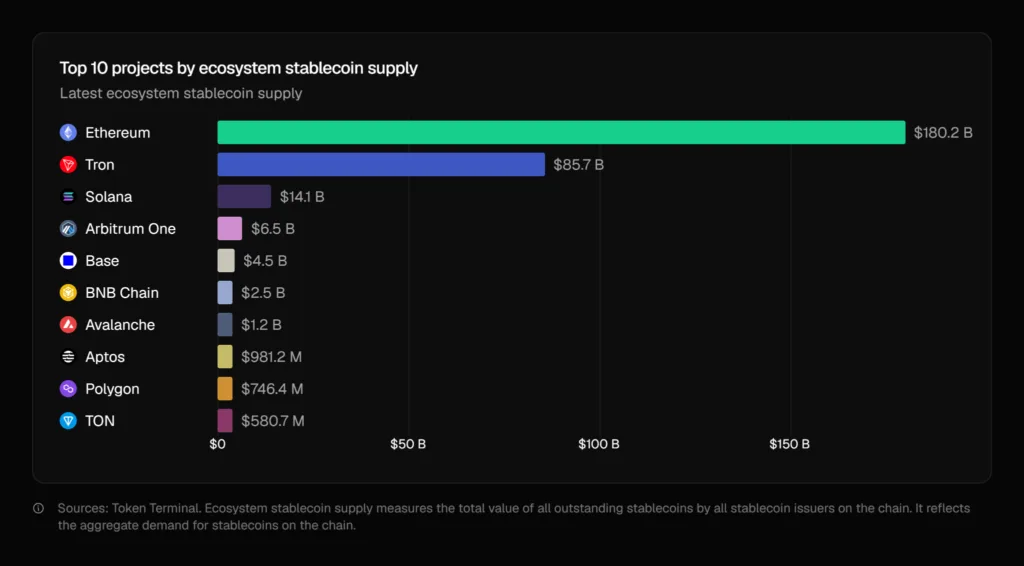
The stablecoins deployed on the Ethereum network hit a new all-time high of $180 billion, which is over a 150% increment since the last three years. Standard Chartered Bank predicted back in 2025 that about $1 trillion would exit banks and enter stablecoins. With these positive predictions, the hype, and the ceasefire, ETH has crossed above a psychological resistance level of $2.1K.
A fundamental crypto metric tool, Token Terminal, displayed that the on-chain value of stablecoins on Ethereum has reached an all-time high of $180 billion. This parameter gives Ethereum the top hand and crowns it as the best network for stablecoin activity, accounting for roughly 60% of the total supply. The number of stablecoins on the network grew by 150% over the past three years.
$1.7 trillion expected to move onchain in 4 years
Looking ahead, Token Terminal predicts that within the next four years, around $1.7 trillion would be moved across all blockchain networks.
And in particular, if Ethereum manages to hold its current position and scales alongside this growth, Token Terminal predicts it could attract up to $850 billion in new inflows by 2030, which accumulates to a potential expansion of around 470% over that period.
It’s not just Token Terminal expecting growth, but even traditional financial institutions like Standard Chartered projected that more than $1 trillion move out of traditional banking systems into stablecoins by 2028.
When the data is put into context, it shows that a gradual but notable transition of capital toward on-chain financial infrastructure will happen, with Ethereum currently positioned as a primary destination for these flows.
While Ethereum leads the way with the most number of stablecoins on its network, Tron is second with less than half ($86 billion) of the value of stablecoins available on Ethereum. The Solana network takes the third spot with $14 billion.
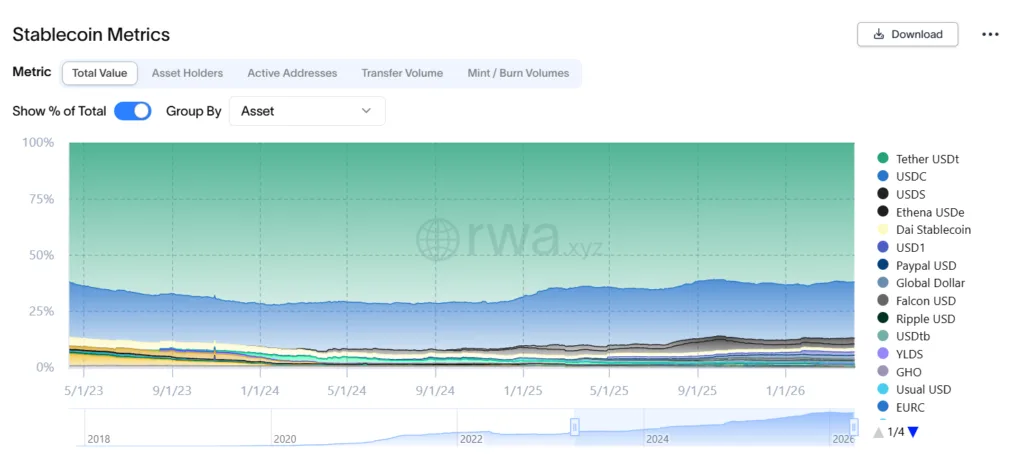
Tether claims 60% of the stablecoin market share
Among all stablecoins, Tether claims the largest market share, with over 60%, while Circle’s USDC holds over 25% of the market share. Meanwhile, the transfer volume of stablecoins has been gradually increasing since February 2025.
From recording values of $650 billion an year ago, the stablecoin transfer now shows $2.75 trillion, showing an increase of over 285% over the year.
Ethereum prices crossed a major obstacle, and it now has more potential to appreciate further. For quite some time, Ethereum prices were struggling under the $2.1K psychological support level. Despite testing and even breaking out from this level a few times, it was never able to sustain and hold on to the grounds it gained.
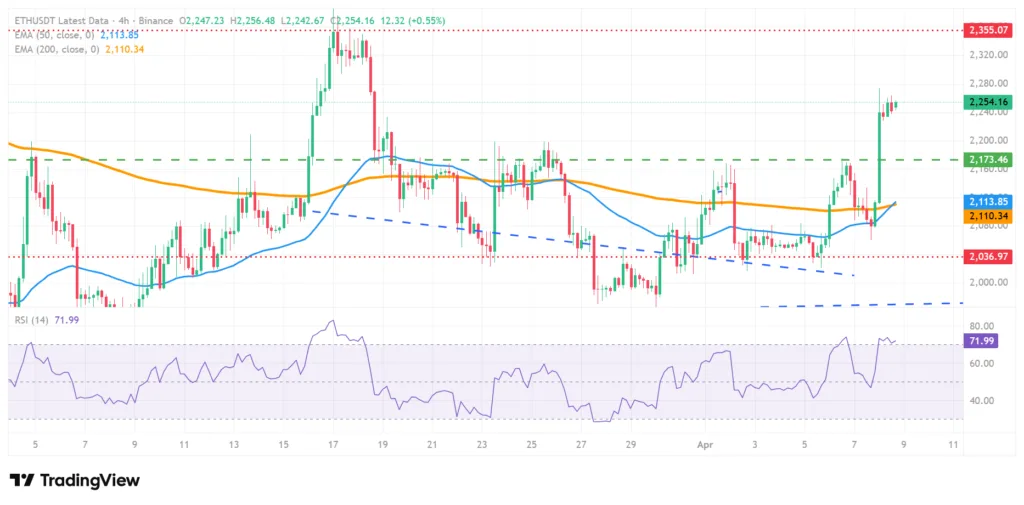
However, with the announcement of the ceasefire in the U.S. and Iran war, ETH prices once again appreciated and reached $2.25K. Not only did it break above the resistance level, but it also crashed over the 50-day and 200-day moving averages.
These indicators are considered the short-term and long-term moving averages. Traders usually use these indicators as entry and exit points depending on their position.
Meanwhile, the ETH chart shows that a golden cross occurred. A golden cross happens when a short-term moving average (commonly the 50-day) crosses above a long-term moving average (such as the 200-day). This signals a potential shift from bearish or sideways conditions into a bullish trend.
Traders generally interpret and use this sign to adjudicate the market. It means that the momentum is improving and that buyers are starting to gain control. But the signal is lagging, and this could mean that part of the upward move may already have happened by the time the crossover is visible.
Usually the price may initially push higher on the news of the crossover, and thereafter it could be followed by a short pullback or retest of the moving averages when the market consolidates. However, if the broader structure remains intact – forming higher lows and higher highs – the trend can continue upward with strengthening momentum. This means that the geopolitical conditions should be neutral for prices to continue rising.
On the other hand, the golden cross may be a trap. Given that price fails to hold above key support levels and falls back below the moving averages, the golden cross can act as a false alarm or bull trap, leading to renewed downside.