


The interest of the crypto community in Pi Network (PI) has drastically increased after a moderator hinted that a second token migration would occur in 2025. With this unofficial statement from a moderator, the hopes of Pi holders were renewed, as many were unable to access their mined tokens for a prolonged period.
According to the source, the team behind PI is said to resolve the ongoing issues related to delayed referral bonuses and untransferred balances during this migration.
What is a migration in blockchain, and why does it happen?
Before launching, projects usually run on a testnet (a sandbox environment where developers can try things out without real value at risk).
Migration to mainnet signals that the blockchain or protocol is ready for real-world use with real assets. Many projects initially issue ERC-20 tokens (on Ethereum, for example) as a placeholder. Once the mainnet is live, those ERC-20 tokens are swapped for the project’s native tokens that operate on the mainnet.
Why is a second migration needed?
If the original chain has limitations (scalability, security flaws, or regulatory issues), projects may migrate to an upgraded chain or even an entirely new L1/L2. This second migration lets them adopt better consensus, token standards, or governance.
So why is Pi network migrating?
According to Pi network’s X post, “Second mainnet migration involves migrating previously unmigrated $Pi tokens, particularly those earned through referrals and those associated with users who have recently completed KYC verification. This phase focuses on including referral mining bonuses for users who have passed the KYC process.”
Pi price targets $0.4, can the bulls push through?
Pi price today stands at $0.3538, after shedding about 7% during the past week. On the 4-hour chart, Pi is trading inside a bullish falling wedge. The RSI and the MACD line show very gloomy conditions, which are dominated by the bulls. Since the indicators are very bearish, Pi will continue fluctuating inside the falling wedge pattern. Inside the wedge, the price makes lower highs and lower lows, but the top trendline (connecting the highs) descends faster than the bottom trendline (connecting the lows), creating a narrowing downward channel. As the wedge forms, momentum weakens because sellers are losing strength, and trading volume typically declines, reflecting reduced participation.
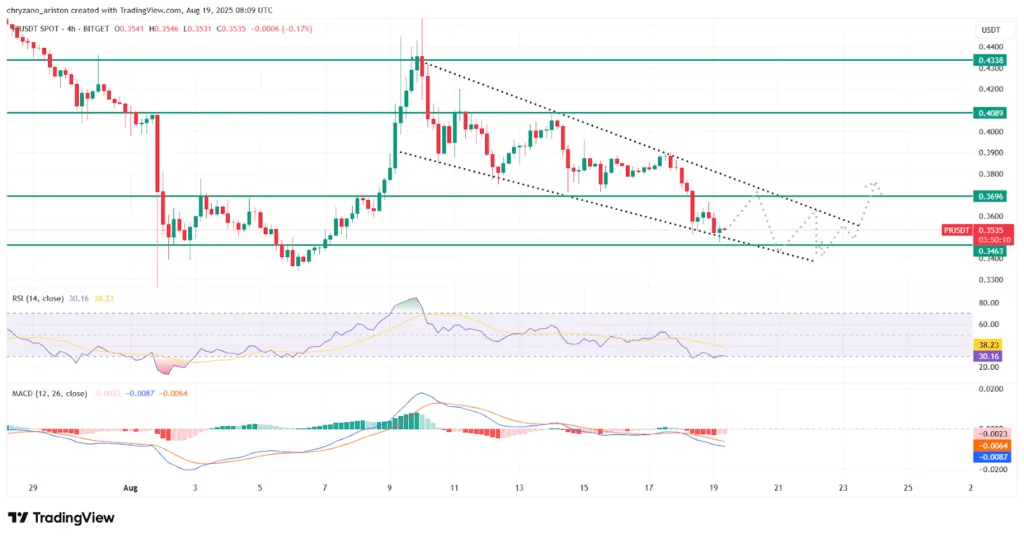
Buyers keep accumulating quietly while the price continues bouncing between the converging support and resistance lines, and at some point, they overtake the sellers, and the prices break out. When Pi breaks out of the wedge, it will reach above $0.40.