


XRP is going through a consolidation phase, and mid-level investors are seizing the opportunity to accumulate the coin. During the past month, there were several days that recorded more than 4,000 outflow transactions on exchanges, and some days peaked at 6,000.
Ripple’s coin XRP is currently trading just above the $1.35 price level. Since February, the coin has been fluctuating between a tight range of $1.30 and $1.50.
This consolidation phase comes after XRP ended its downtrend, which started back in August 2025. During this 7-month-long downtrend, XRP prices slid from as high as $3.60 to their current price of $1.35.
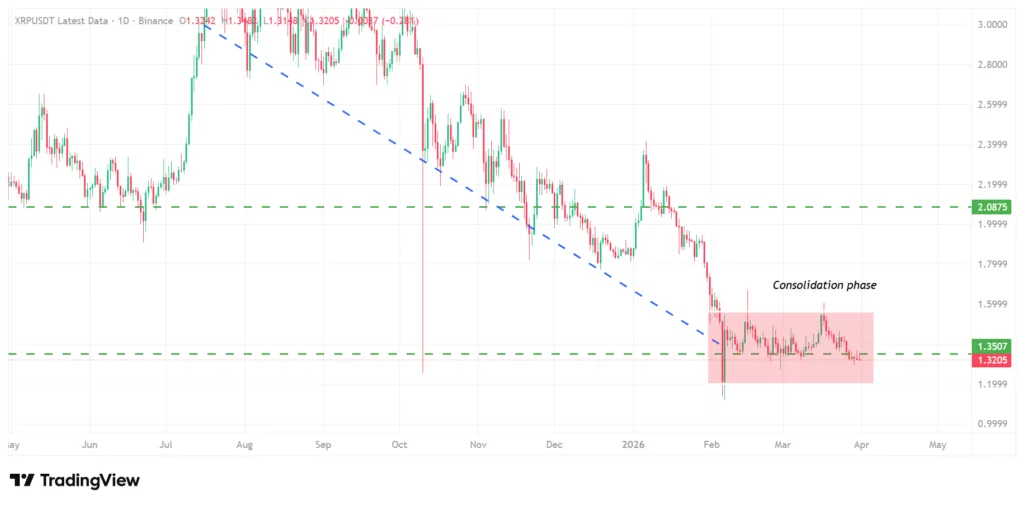
As XRP kept printing lower lows, the trend was clearly still down – nothing bullish about the structure. But what stood out was how quick buyers were to step in on those dips. Not because they believed in a reversal, but because they were playing the range, grabbing cheap entries and flipping them at the next lower high.
XRP bounces back fast only to get sold faster
It turns into this cycle where every drop gets bought, but every bounce gets sold even faster. You’ve got trapped buyers from higher levels just waiting to exit, plus short-term traders taking profit the moment the price shows any strength.
So even when XRP pushes up, it lacks conviction – no real follow-through, just weak relief rallies that fade into the trend.
At that point, it’s not a market driven by strong hands trying to build positions. It’s mostly short-term players farming volatility. And until the price actually breaks a key lower high with strength, all these dip buys are basically just setting up liquidity for the next leg down.
XRP market resets after 7-month long downtrend
But now that XRP has ended its downtrend and is going through a consolidation phase. After a downtrend, consolidation is basically the market catching its breath—but more importantly, it’s where control quietly shifts.
Price stops making aggressive lower lows and starts moving sideways, usually in a tight range. On the surface, it looks like nothing is happening, but underneath, there’s a lot going on. Sellers who drove the trend down begin to lose momentum, while buyers slowly step in and absorb the remaining supply. It’s less emotional, more calculated.
You’ll often see volatility drop, volume dry up, and price just chop around—this is where most retail traders get frustrated or chopped out. Meanwhile, stronger players are either accumulating positions or waiting for confirmation before the next move.
The key thing is consolidation after a downtrend can go both ways. If buyers manage to absorb all that selling pressure, it can lead to a reversal. But if the range breaks down, it usually means the trend isn’t done yet and another leg lower is coming.
So it’s not just a “sideways price”—it’s a transition phase where the market decides whether it’s done going down or just pausing before the next move. To find out what’s going through the market, it is important to zoom in on the consolidation phase.
Investors buy XRP as it slides out of the triangle
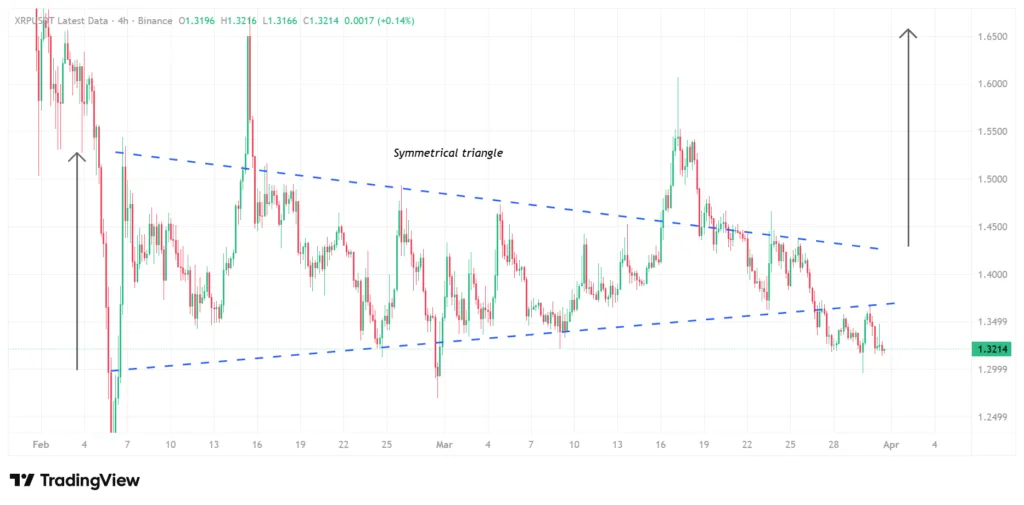
As shown in the 4-hour chart above, XRP has been consolidating within the symmetrical triangle since February. But the prices have slid out of the lower trendline of the triangle, and the traders saw this as an excellent opportunity to enter the market.
As XRP slid below the lower trendline, the buyers settled in and started accumulating. According to Cryptoquant, an analytical platform, mid-sized investors holding 1,000-100,000 XRP started to gulp up XRP in huge quantities.
The symmetrical triangle breakout occurs when the price breaks out of the tightening range formed by lower highs and higher lows that converge at the triangle’s apex.
The level of volatility is constantly shrinking during this period of consolidation because buyers and sellers are meeting halfway and are unable to gain a dominant position.
Eventually, the price will breakout of either the upper or lower end of the trend line due to increasing levels of liquidity on either side of the triangle. A breakout above the resistance level is a bullish sign of increasing momentum, whereas a breakdown below the support level is a sign of a continuation of a bearish trend.
The sign that a breakout is genuine is usually accompanied by an impulse and increasing volume levels. Often, the price may even retrace and return to the breakout level before continuing in the breakout direction.
XRP could reach $1.65 if it breaks upwards
If XRP breaks upwards out of the triangle, it will normally take the coin above the $1.65 level, which is the level of the wedge and the largest distance from the wedge. This is a basic breakout level based on the past compression of the price action, where volatility increases before exploding in a new direction following the breakout.
But in reality, the price does not always move in a straight line to the breakout level. Once a breakout occurs from a triangle pattern, there could be a number of movements that take place before the price continues moving in a new direction.
A retest of the broken trend line may take place shortly after a breakout, or some pullbacks may happen before the price continues moving.
However, if a breakout is strong and genuine, a high volume will accompany the breakout and propel the price past the breakout level over time. On the other hand, if a breakout is weak and fake, the price will not be able to hold up and will fall back into the triangle.