
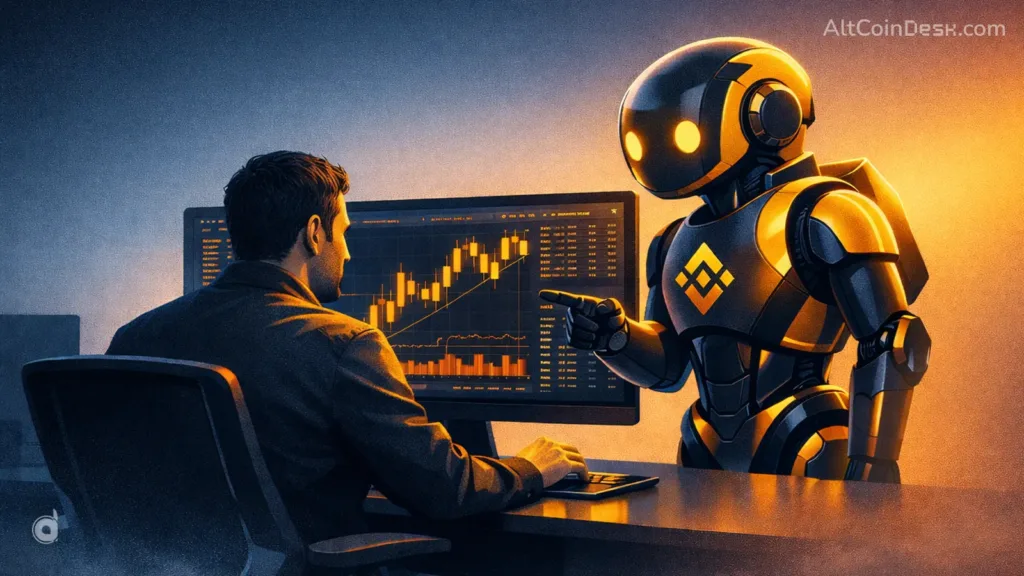

Binance’s new tools push autonomous crypto trading from idea to infrastructure by introducing a new set of tools that could change how people and software trade crypto. On March 3, 2026, the exchange said it launched its first batch of seven “AI Agent Skills,” designed to give AI agents direct access to Binance market data, trading execution features, and basic security and risk checks through one unified interface across Binance Wallet and Binance Spot.
In plain terms, Binance is trying to turn the messy flood of crypto signals, like wallet moves, token launches, and price swings, into clean building blocks that automated systems can understand and act on. That is why the launch is drawing attention. It is not just an analytics upgrade. It is another step toward autonomous crypto trading being something regular traders will see in real products, not just in hedge fund codes.
What Binance launched: The seven pillars of the robot trader
Binance says these skills are “modular capability packages” that let AI agents tap structured data and trading infrastructure. In practice, each skill is like a dedicated function. One might fetch token details. Another might rank what is trending. Another can help place an order.
Binance Academy, in an explainer published right after the launch, lists the first seven skills and describes them as packaged toolkits that make agents perform real tasks more reliably.
They rolled out seven specific tools, think of them as superpowers, that any AI agent (like Claude or OpenClaw) can now plug into. Here is what the bots can suddenly do:
- Binance Spot Skill: The bot can check prices and, scariest of all, actually execute trades. It can place simple orders or complex conditional strategies like OCO (One-Cancels-the-Other) without a human clicking the mouse.
- Query Address Info: The AI can analyze a public wallet address and estimate holdings and activity, depending on chain coverage. It can see what the “whales” (big players) are holding, how much their bags are worth, and if they are dumping.
- Query Token Info: In seconds, the bot can pull up a token’s price, liquidity, and how many holders it has. It is like a background check on a coin.
- Crypto Market Rank: Instead of endless scrolling, the AI gets a prioritized list of what is trending, what is being searched, and what the top traders are making money on.
- Meme Rush: This is pure genius. It tracks the life cycle of meme coins from the moment they are launched, through migration, to the end. It organizes the chaos of meme mania into a structured feed.
- Trading Signal: This taps into “smart money.” It shows the bot where sophisticated investors are moving funds, complete with entry rates and potential profit targets.
- Query Token Audit: Before the bot buys, it checks the contract for red flags. Can the creator mint infinite coins? Can they freeze your assets? The AI skips the scams.
From “research” to “robot execution”
Here is why this is a bigger deal than any typical exchange update. In the old days, you would see a coin pumping on Twitter, you would rush to a scanner like DexScreener, check the contract on a tool like Honeypot, panic about the gas fees, and by the time you bought, the smart money had already left. That delay is gone.
Now, an AI agent can do all of that in milliseconds. It can monitor the “Meme Rush” skill, see a new token gaining traction, instantly audit the contract with the “Query Token Audit” skill, check if the “smart money” is buying via the “Trading Signal” skill, and place a buy order using the “Spot Skill.” It is a straight line from data chaos to trade execution, with no human slowing it down.
Binance confirmed this shift in their announcement, stating these skills give AI agents access to “structured data and trading infrastructure… transforming fragmented crypto signals into actionable intelligence.”
The big question: Are we just spectators now?
This naturally leads to an uncomfortable question. If AI agents start dominating the market, what happens to the rest of us?
We are already seeing the rise of autonomous crypto trading, where machines talk to machines. They will likely front-run the slow retail trader every single time. When a meme coin launches, the bots will see it, audit it, and buy it before a human even finishes typing the contract address into a search bar.
We might be entering an era of “post-human” trading. The volatility might get worse, or maybe the bots will bring efficiency. But one thing is certain: Binance is no longer just a place to store your coins. It is becoming the digital brain for an army of AI traders.
The safety brake
To be fair, Binance isn’t just unleashing chaos. They built in guardrails. The “Query Token Audit” skill is specifically designed to stop bots from buying obvious scams. They are trying to teach the machines to be safe.
But for the average person reading this, the takeaway is simple. The landscape just shifted. If you want to survive in the next crypto cycle, you might need to stop competing with the traders next door and start figuring out how to work with the bots.
Because the era of autonomous crypto trading isn’t coming. As of March 3, 2026, it is already here.