
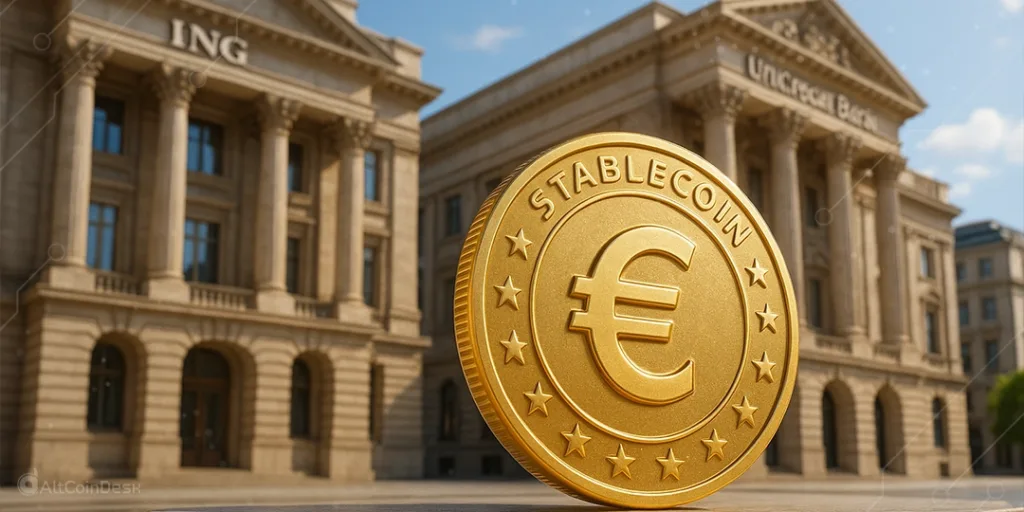

A consortium of nine European banks, including ING and UniCredit, announced Thursday that they are forming a new company to issue a euro-denominated stablecoin.
The new company will be based in the Netherlands and is seeking oversight and licensing from the Dutch central bank. The stablecoin will be regulated under the European Union’s Markets in Crypto Assets (MiCA) framework.
The group includes ING, UniCredit, Banca Sella, KBC, Danske Bank, DekaBank, SEB, CaixaBank, and Raiffeisen Bank International. The consortium said other banks could join, and a CEO will be appointed soon.
Stablecoins
Stablecoins are digital tokens designed to maintain a constant value and are typically backed by traditional currencies like the U.S. dollar or euro. The planned euro stablecoin is expected to be issued in the second half of 2026.
According to the banks, the project aims to provide a trusted and regulated solution for on-chain payments and settlement. The stablecoin will enable near-instant, low-cost transactions, 24/7 access to cross-border payments, programmable features, and improvements in digital asset settlements and supply chain management.
“We are contributing to fill the need for a trusted, regulated solution for on-chain payments and settlement, paving the way for a new standard in the digital asset space that will support Europe’s growth and financial sovereignty,” said Fiona Melrose, UniCredit’s head of strategy.
Floris Lugt, digital assets lead at ING, added that digital payments are key to building new euro-denominated financial infrastructure. “We believe this development requires an industry-wide approach, and it’s imperative that banks adopt the same standards,” he said.
e-money institution
The consortium plans to operate as an e-money institution once licensed by the Dutch central bank, with individual banks able to provide services such as wallets and custody.
The initiative is positioned as a European alternative to the U.S.-dominated stablecoin market, aiming to strengthen Europe’s strategic autonomy in digital payments.