
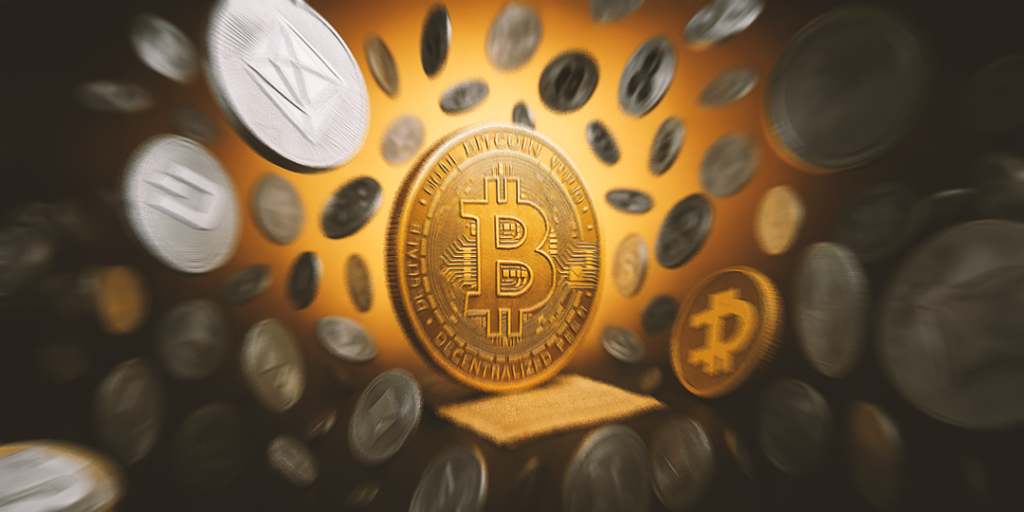

As crypto barrels into 2025 with its usual mix of hype and hope, an old argument is back on center stage: Bitcoin versus altcoins. And yes, it’s getting loud again. This time, Samson Mow, CEO of JAN3 and one of Bitcoin’s most unapologetic defenders, is stirring the pot by calling out what he labels “altcoin bias.”
In plain terms, he is warning that many newcomers are falling for a familiar trap, assuming that a cheap token must be an undiscovered bargain, when in reality, price tags in crypto rarely tell the full story.
“Newcomers see a $0.10 altcoin and think it’s ‘cheaper’ than Bitcoin at $100,000. That’s like choosing a dollar-store flashlight over a lighthouse,” Mow argued in a fiery X (formerly Twitter) thread this week. His warning underscores a critical blind spot: price ≠ value.
Chasing cheap coins over real value: Bitcoin vs altcoins
The allure is understandable. Give a new investor $500 and watch what happens. They can walk away with millions of DogeXYZ tokens, or a painfully tiny 0.005 Bitcoin. Most will pick the option that looks bigger. It feels like progress. It feels like upside down. Cue the altseason memes, the 100x daydreams, and the comforting illusion that more tokens mean more opportunity.
But as Mow keeps reminding people, that instinct has very little to do with fundamentals and everything to do with psychology.
Bitcoin’s massive $2.1 trillion market cap completely overshadows the entire altcoin space. Even though altcoins together are worth around $800 billion, that value is spread out over thousands of risky bets—literally over 20,000 different coins and tokens. But here’s the real twist. Bitcoin’s edge is not just that it is big. It is that it was built to last. With a hard cap of 21 million coins, scarcity is baked in, not promised. Add to that the fact that 8 Fortune 100 companies now hold Bitcoin on their balance sheets, and you start to see why it has real gravity. This is not hype. It is institutional muscle. Most altcoins, by contrast, are still chasing relevance, often without Bitcoin’s proven utility or its decade-plus of stress-tested security.
That gap becomes even clearer when volatility enters the conversation. Bitcoin in 2025 looks almost grown-up, with 30-day volatility around 35%, a far cry from the wild 80% swings of 2021. Altcoins, on the other hand, remain an emotional workout. Tokens like the hypothetical SolanaX can jump or crash by 120% in a single week, turning calm investors into nervous day traders. As Samson Mow joked on a recent podcast, altcoins are not really investments at all. They are more like lottery tickets, fun to hold, thrilling to watch, and very easy to lose sleep over. “Altcoins aren’t investments; they’re lottery tickets,” Mow quipped during a recent podcast. His critique follows April’s “memecoin massacre,” where PEPE3.0 and ShibaMars collapsed 70% overnight after Elon Musk tweeted a single “?” emoji.
Altcoins: Innovation labs or obituary lists?
But aren’t altcoins innovation labs? Sure. Ethereum’s shift to quantum-resistant zk-rollups and Ripple’s CBDC partnerships show promise. Yet, for every breakthrough, a dozen “Ethereum killers” fade into obscurity. Since 2021, over 75% of the top 100 altcoins have vanished, per CoinGecko data. Bitcoin, meanwhile, has weathered 14 years of FUD, emerging as digital gold with 90% of institutional crypto allocations.
Mow’s message isn’t anti-altcoin but pro-education. “Do your homework. If you can’t explain the token’s utility beyond ‘number go up,’ stick to Bitcoin.” As regulators clamp down on speculative ICOs post-2024’s MiCA laws in Europe, the Bitcoin vs altcoins narrative tilts further toward caution.
Final Thought: Bitcoin outshines altcoins
So, what’s the takeaway? Bitcoin offers a battle-tested safe harbor; altcoins, a high-stakes casino. New investors, dazzled by decimal points, often miss the forest for the trees. As Mow puts it, “you wouldn’t trade a diamond for a truckload of glitter. Don’t do it with your portfolio either.” In crypto’s wild west, sometimes the oldest sheriff in town remains the smartest bet.