
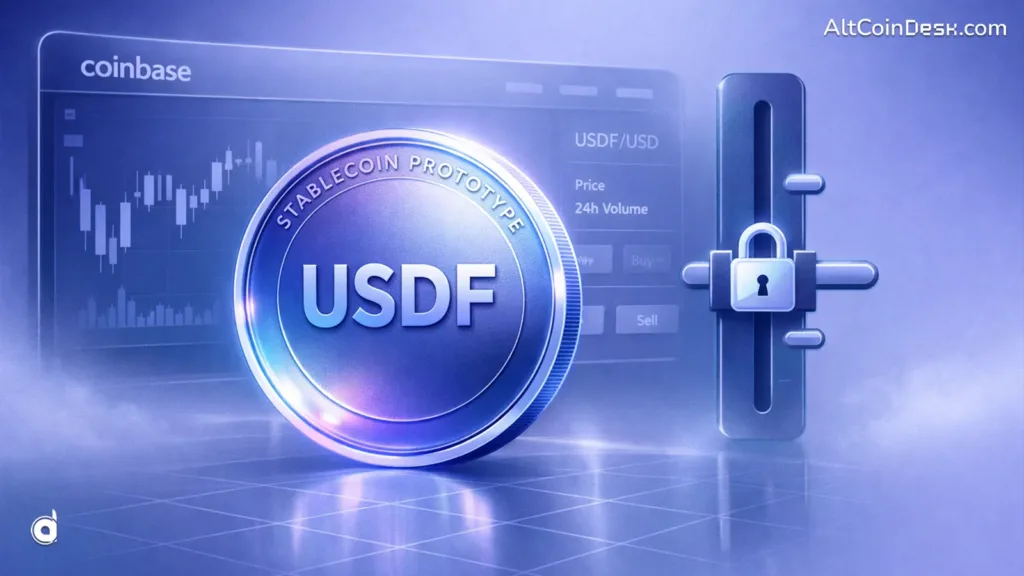

Stablecoin integrations into mainstream finance have been rising exponentially, and against this backdrop, crypto exchange Coinbase has taken a step forward by building ‘Coinbase Custom Stablecoins’, a stablecoin project introduced in December 2025. The crypto platform chose Flipcash’s USDF as the first real-world test case for the custom stablecoin move.
Flipcash is a mobile payments app built on Solana that uses the USDC stablecoin for transactions. However, the app has an in-development stablecoin — USDF— that is currently being built by them. Coinbase is testing this new stablecoin on its backend as part of the ‘custom stablecoins.’
Worth noting, Coinbase is optimizing the USDF stablecoin into the Flipcash mobile app.
What is ‘Coinbase Custom Satablecoin’?
Essentially, the latest news is about Coinbase testing the USDF stablecoin on its platform. “This is a backend test phase only,” announced Coinbase executives. However, trading, deposits, withdrawals, and other operations have not yet started.
For Coinbase, USDF is a pilot project for its stablecoin strategy. With the new stablecoin initiative, Coinbase allows companies to issue their own branded stablecoins, helping them issue the coins, custody of assets backing the stablecoins, connect stablecoins to exchanges/blockchains, and enhance compliance.
In brief, Coinbase has an ambitious goal to support more stablecoins rather than narrowing its focus to Circle’s USDC stablecoin. By testing Flipcash’s USDF stablecoin, the crypto firm:
- supports different companies in issuing their native stablecoins on Coinbase.
- does not self-promote itself to users, instead pushes external firms interested in launching stablecoins.
- runs an invisible infrastructure and earns money for providing the services to stablecoin issuers.
Why did Coinbase choose Flipcash?
Coinbase did not simply opt for Flipcash as the first test for its custom stablecoin strategy. Flipcash, as mentioned, is a crypto-native mobile payments app, which makes it easy for Coinbase to support the app.
Moreover, the app is built on Solana, a faster and cheaper blockchain, allowing Coinbase to support USDF both economically and technically, as the crypto platform already backs the blockchain significantly. To note, the Solana blockchain is explicitly built for payments.
Coinbase’ move syncs with market growth
In 2025, stablecoin witnessed 50% growth in market cap when compared to the previous year. This hike resulted in $305 billion in market cap, driven by increased stablecoin launches, adoption, and integrations. As is well evident, stablecoin issuer Tether is the major contributor to this growth, with over $186 billion in value flowing into its USDT stablecoin.
According to Zalk Folkman, co-founder of Trump-linked World Liberty Financial, the real stablecoin revolution lies in payments, and everyone knows this. However, the interesting part of stablecoins is about “how fast the infrastructure is maturing and how many real-world problems are getting solved right now.”