
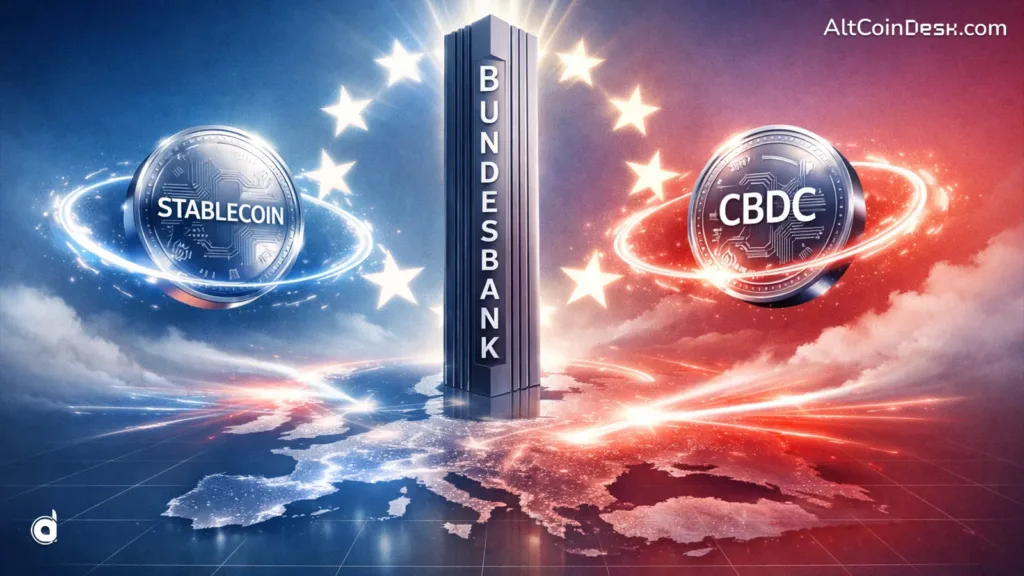

Germany’s central bank president, Joachim Nagel of the Bundesbank, acknowledged that stablecoins have benefits. At the same time, he reaffirmed strong support for a central bank digital currency, commonly called a CBDC. You think this is confusion? Oh no, it is strategy. Nagel wasn’t endorsing your USDT trading strategy. He was announcing a hostile takeover.
Europe is protecting its monetary power while modernizing payments, which is way bigger than crypto. Under the EU Stablecoin Regulation and the planned Digital Euro 2026 roadmap, the old debate of CBDC vs. stablecoin is no longer a fight. It is a two-track system. There’s more!
The sovereignty play they’re not shouting about
In recent speeches in London and through official Bundesbank communications, Nagel described stablecoins as useful but risky. He pointed to their strengths, including programmable payments and faster cross-border transactions. He also warned that foreign currency stablecoins, especially those tied to the US dollar, could create financial stability concerns inside the euro area. That balance is important.
Under the EU Stablecoin Regulation, Europe is building rules that allow euro-denominated stablecoins to operate legally and safely. At the same time, the European Central Bank continues preparing for Digital Euro 2026, with pilot phases expected before full issuance later in the decade.
Why nine banks just formed a stablecoin consortium
Nine major European banks, including ING, UniCredit, Banca Sella, KBC, Danske Bank, DekaBank, SEB, CaixaBank, and Raiffeisen Bank International, have officially joined forces to launch a MiCA-compliant euro-denominated stablecoin. According to statements from ING and UniCredit, the group has established a Netherlands-based entity to seek regulatory approval, targeting issuance in the second half of 2026.
Read that again. This is traditional banks building a stablecoin together.
This is more about institutional settlement, programmable payments, and frankly, keeping the payment volumes inside the regulated banking system rather than watching them flow to offshore dollar-stablecoin issuers. The euro stablecoin market today is tiny, under €350 million combined capitalization, compared to hundreds of billions in dollar tokens. That gap is what keeps European officials awake.
Why Europe wants regulated stablecoins
Stablecoins move money quickly across borders. They are programmable. They settle transactions without relying on slow banking hours. That efficiency appeals to businesses, financial institutions, and even governments.
EU Stablecoin Regulation under MiCA sets clear rules for issuers. It requires transparency, reserves, and consumer protection. In simple terms, Europe wants stablecoins, but it wants them supervised.
The fear is deposit flight. If citizens move money from banks into large foreign stablecoins, traditional banks could lose funding. That is why the European Central Bank has raised concerns in past reports. But here is the nuance. Europe does not want to ban stablecoins. It wants euro-based alternatives that compete with US dollar tokens.

What is the importance of the digital euro 2026?
The Digital Euro 2026 project is Europe’s answer to maintaining central bank control in a digital age. Unlike private stablecoins, a CBDC is issued directly by the central bank.
The goal is simple. Provide a safe digital version of cash that works across the euro area, both online and offline. The European Parliament recently signaled strong backing for this direction.
A stablecoin depends on a private company managing reserves. A CBDC depends on the central bank itself. Europe wants citizens to have both options, but it wants the core payment infrastructure anchored in public money. That is why Digital Euro 2026 is moving forward even while the EU Stablecoin Regulation expands.
EU stablecoin regulation: This is about sovereignty, not hype
Look at the global landscape. Most major stablecoins are tied to the US dollar. They hold large amounts of US Treasury bills. That strengthens the dollar’s international role. Europe sees that clearly.
If Euro area residents increasingly use dollar stablecoins, monetary influence slowly shifts outward. That risk explains why Nagel’s remarks matter. His acknowledgment of stablecoin benefits does not weaken the digital euro case. It strengthens the need for a European alternative.
The quiet endorsement that changes tone
For years, many central bankers spoke about crypto mainly through the lens of risk. Fraud, volatility, and speculation dominated the narrative.
Nagel’s language reflects evolution. He recognized innovation while highlighting safeguards. That balance signals maturity in EU Stablecoin Regulation and confidence in the Digital Euro 2026 roadmap. It also tells markets that Europe does not view all stablecoins as threats. Some are tools if properly supervised. That nuance is new.
What happens next?
Expect three developments:
- First, euro-denominated stablecoin issuers will grow under the EU Stablecoin Regulation as MiCA enforcement tightens.
- Second, the Digital Euro 2026 pilots will clarify how retail CBDC wallets function in daily life.
- Third, the CBDC vs. stablecoin comparison will become less dramatic and more technical. Institutions may use wholesale CBDC for large settlements. Retail users may hold digital euros. Businesses may issue compliant stablecoins.
This layered system reduces systemic risk while allowing innovation.