



When Alessio Marinelli founded CREDI, he had a simple question: why should only large
corporations have access to fast, fair credit? After spending more than 15 years in private
credit and earning a PhD focused on machine learning credit risk modeling, Marinelli saw
how small and medium-sized businesses were still left out.
“Traditional tools to assess a business were developed during the 60s and 70s based on
very large corporations,” he said. “When it comes to small and medium enterprises, their
accounts are generally 18 months old, not audited, and not reliable.”
That gap inspired the creation of CREDI, a company that blends blockchain technology and
AI-powered credit modeling to open new funding routes for smaller businesses while giving
investors a transparent, fixed-income-like product.
Bringing private credit on-chain
At the heart of CREDI’s model is what Marinelli calls the credit token: a stablecoin pegged
to USDC that allows both institutional and private investors to access liquidity pools backed
by real-world private credit portfolios.
“The credit token is nothing more than a stablecoin, which is pegged on USDCs and enables
institutionals and private liquidity providers to access liquidity pools that are supported by
private credit portfolios of high-quality assets,” Marinelli explained. “In doing so, it enables
liquidity providers to earn 12% to 18% on their underlying credit assets,, similar to a fixed income product.”
Investors can mint these tokens using USDC and stake them across various pools with
different risk-reward profiles, all governed by smart contracts that eliminate manual
intervention and enhance transparency.
Using machine learning for fairer lending
Behind the scenes, CREDI’s AI models analyze bank transaction data to rebuild a
company’s true profit and loss statement. “We developed new predictors and credit
assessment models based on bank transaction data that aim to reconstruct the true P&L
(profit and loss) of a company,” Marinelli said. This allows CREDI to make credit decisions
faster, often within days rather than weeks. Their use of Web3 and blockchain enables both
privacy and transparency in their vision and goal.
The road ahead
Marinelli envisions a future where blockchain quietly powers global finance. While The
UK’s progress is still cautious; he sees regions like the UAE have issued full regulatory approval for RWA tokenization under VARA (2025).
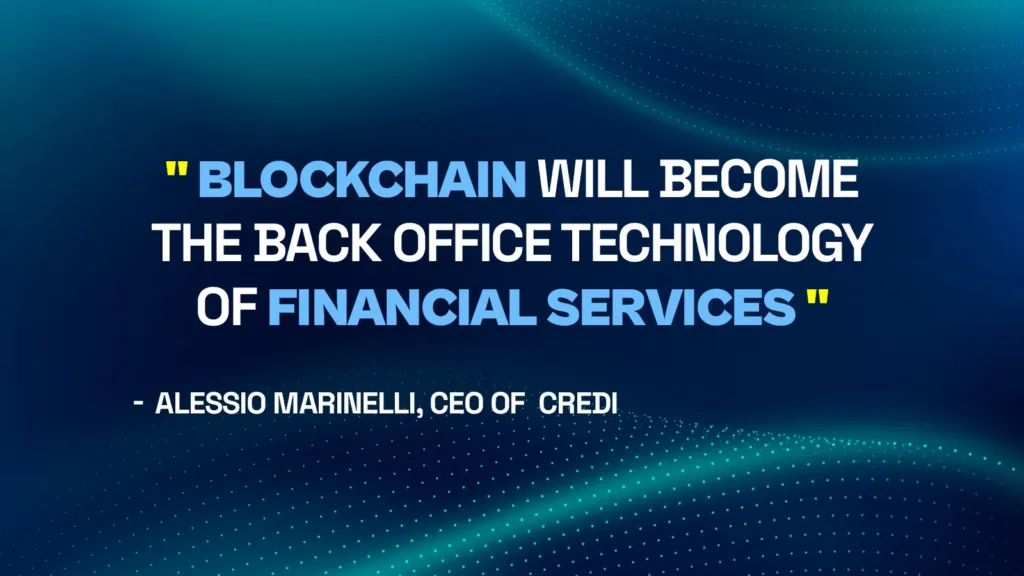
For Marinelli, the mission goes beyond profit; it’s about reshaping how capital flows. By
merging regulated credit structures with Web3 efficiency, CREDI aims to build a bridge
between traditional lenders and the next generation of decentralized finance.
As the technology matures, Marinelli believes platforms like CREDI could redefine trust in
financial markets, not by replacing banks, but by making them smarter, faster, and more
inclusive.