
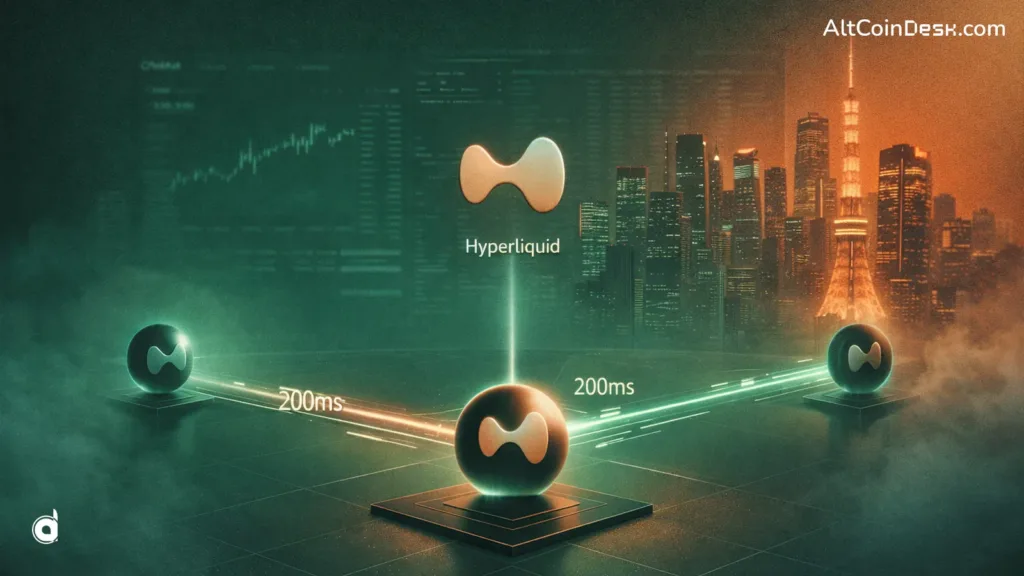

Hyperliquid traders in Tokyo have the added advantage of geography, with a 200 millisecond edge despite being ‘decentralized’ according to Glassnode research.
Decentralized Hyperliquid may not be equal for all
Crypto stood out for its decentralization, where all the users are promised equal access, with no centralized control and transparency. Hyperliquid is also built on similar principles, but the new data suggests that traders may not be competing on equal grounds.
Research from blockchain analytics firm Glassnode shows that traders operating in or near Tokyo enjoy a latency advantage of roughly 200 milliseconds over traders in the U.S. or Europe. According to research, this is a proximity advantage of being closer to its infrastructure.
Trading edge of proximity
According to reports, the difference is due to the company’s 24 validators clustered in AWS’s Tokyo region across several availability zones, while its API layers are globally distributed through Amazon CloudFront and content delivery network (CDN).
A mere 2-3 millisecond raw network latency from Tokyo can significantly impact execution and profit-and-loss differences for an exchange that handles over $4 billion in daily perpetual volume. This time difference, though small, compounds into real-world variations.
Simply put, the geographical advantage gives the local traders the opportunity to be in the front of the queue, with tighter spreads between bid-ask spread while enjoying the benefits of priority in both execution and better rates.
In case of High Frequency Trading, when the local traders are ahead of others, they can see a large incoming order and place their own trade ahead of it to guarantee a profit from the resulting price movement.
Hyperliquid is not alone; industry giants like Binance, BitMEX, and KuCoin have also established key infrastructure within the AWS ap-northeast-1 region, effectively turning the Japanese capital into a crucial center that the ecosystem needs.
Tokyo’s role in the crypto landscape
Tokyo is essentially a central hub for crypto, with its most advanced crypto regulatory regimes. Japan has had a revised Payment Services Act (PSA) for crypto exchange licensing since 2017. Regulations designed to protect users were in place for stablecoin regulatory frameworks by 2023.
In 2025, the government proposed new licenses for crypto asset intermediaries under the PSA, aiming to treat these assets like securities in the future. With stronger frameworks in place, Hyperliquid benefits from the favorable location by building its core infrastructure in the AWS Tokyo region.