


Malta’s government-run Malta Community Chest Fund (MCCF) declined a cryptocurrency gift that had grown from roughly $200,000 in 2018 to approximately $33 million today. Finance Minister Clyde Caruana backed the refusal; Prime Minister Robert Abela urged a rethink. At the center is the $33 million Binance donation, along with a dispute over how and to whom the money should be distributed.
Back in 2018, Binance Charity and its users pledged 30,644 BNB to MCCF to support cancer patients. As prices climbed, the gift swelled into the $33 million Binance donation. But the transfer never completed. Binance Charity requires direct disbursement to end beneficiaries, meaning documented patient details and wallet addresses. MCCF refused to share that data, citing reputational and procedural concerns. Result: stalemate.
Why will a government charity reject a $33 million Binance donation? Find out how a five-year standoff over transparency and patient privacy became a political storm.
Why Malta said “no”
MCCF, backed publicly by Malta’s president Myriam Spiteri Debono and now by the finance minister, argues that accepting the funds on Binance’s terms could compromise standards and set a precedent it can’t audit.
The president even labeled the offer a “bogus donation,” not because the money isn’t real, but because the conditional structure, patient data for direct payout, conflicts with how the charity operates. In plain English: the state wants control of vetting and distribution; it doesn’t want a corporate donor setting the rails.
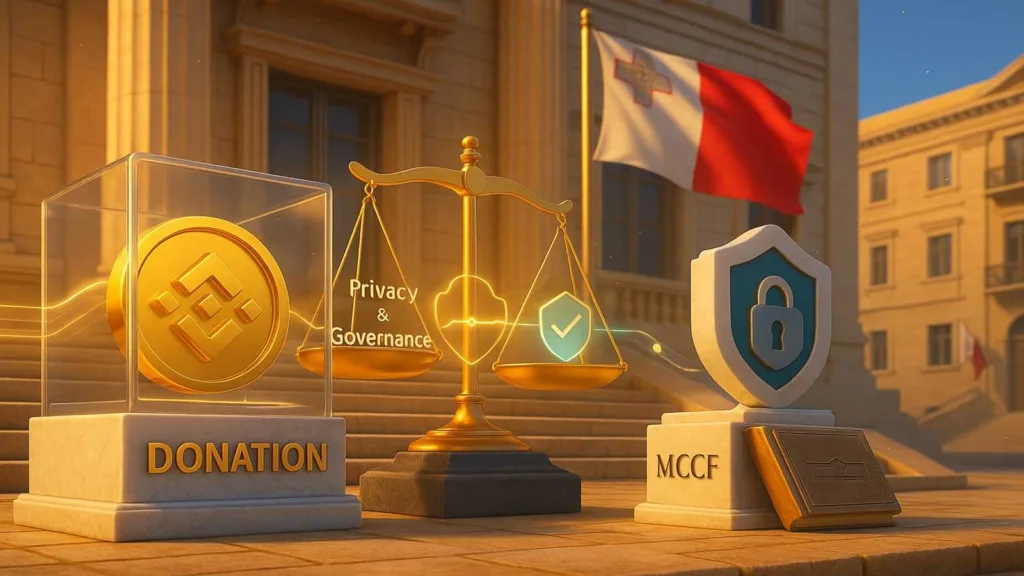
Why Binance insists on direct payouts
Binance Charity’s model aims to minimize middlemen and show on-chain transparency from donor to recipient. To U.S. readers, think of it like insisting on itemized receipts and traceable ACH, not a blank check.
But there’s a catch: sharing identifiable patient information can collide with privacy expectations (in the U.S., you’d think HIPAA-style sensitivities). MCCF says that line can’t be crossed; Binance says direct, verifiable aid is non-negotiable.
Politics enters the chat
The $33 million Binance donation has split Malta’s political class. The prime minister asked MCCF to reconsider, worried that life-changing funds might “be lost.” Other MPs echoed him. The finance minister, however, sided with MCCF’s refusal, arguing that charity should be simple: either give without strings or don’t give at all. The debate has since morphed from a fundraising question into a test of governance, reputation, and who sets standards in public-interest crypto philanthropy.
For the U.S. audience, the lesson is straightforward: crypto-native charity models work best when compliance, privacy, and transparency frameworks are aligned from day one. If a donor requires on-chain direct payouts, recipient organizations must confirm early whether they can legally share beneficiary data and maintain dignity and safety for patients. Otherwise, you get exactly what we see here: a well-intentioned, headline-grabbing $33 million Binance donation that never reaches the people it was meant to help.
The bottom line
Both sides can claim principle. Binance wants traceable impact; Malta’s charity wants control, compliance, and reputational safety. Until they agree on a privacy-preserving way to prove funds reached patients, think audited intermediaries, zero-knowledge attestations, or regulator-approved escrow, the $33 million Binance donation will sit in limbo as a case study in good intentions colliding with governance.
Conclusion: The $33 million Binance donation is a reminder that philanthropy in crypto isn’t just wallets and blockchains, it’s law, trust, and people. Align those, and the money flows. Fail, and even millions can’t move an inch.