
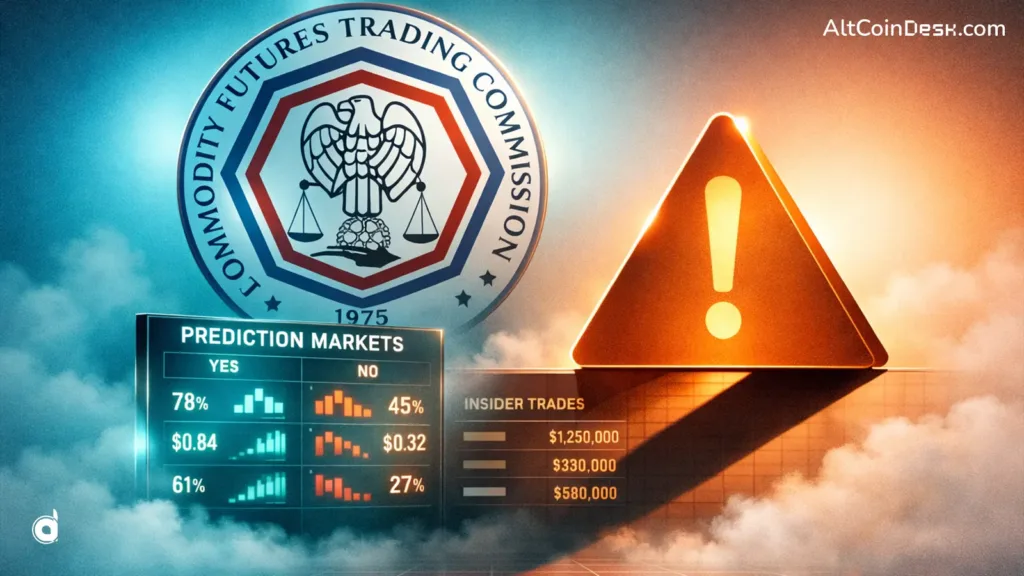
The U.S. Commodity Futures Trading Commission (CFTC) has stepped in with a massive warning for insiders and fraud in prediction markets, stating that it is a one-way ticket to federal trouble. This is followed by sanctions on two traders on Kalshi.
The CFTC’s Enforcement Division issued an official advisory, warning traders and prediction markets that any sort of insider activity or fraud will be subject to federal regulations.
This follows the public disclosure of two major enforcement cases by Kalshi, where the agency reminded traders that it retains full authority to prosecute anyone attempting to trade with insider data.
Sanctions that triggered the warning
The warning follows two trader sanctions, which revealed how some users tried to trade using insider data, which is unavailable to the public. In the first case, a political candidate, identified as Kyle Langford, was caught betting about $200 on his own election campaign outcome for California governor.
He even posted videos on social media of himself placing the bets. Kalshi’s systems flagged the trade immediately, leading to a $2,246 penalty and a five-year ban from the platform.
The second case involved Artem Kaptur, a video editor for a massive YouTube channel, who traded using his insider data about an upcoming video to place bets totaling $4,000.
Investigators found his near-perfect success statistically impossible without access to confidential data. He was given a $20,397 fine and a two-year ban. In both cases, Kalshi stopped the traders before they could withdraw a single cent and reported the violations to the federal government.
The battle for control: Feds vs. States
This isn’t just about two traders. Several U.S. states, including Massachusetts and Nevada, have tried to block prediction markets, calling them illegal gambling. However, CFTC Chair Michael Selig is fighting back, asserting that these platforms are federally regulated commodity derivatives under the Commodity Exchange Act.
Selig has been a strong defender of the agency’s exclusive federal jurisdiction, recently telling state challengers in a video, saying that “We will see you in court.”
Since 2025, the CFTC has shifted toward a pro-innovation stance, even forming an Innovation Advisory Committee with leaders from both crypto and traditional finance.