



The Delaware stablecoin regulation promises new ideas, but the details show a bigger move toward bank-style control and federal alignment.
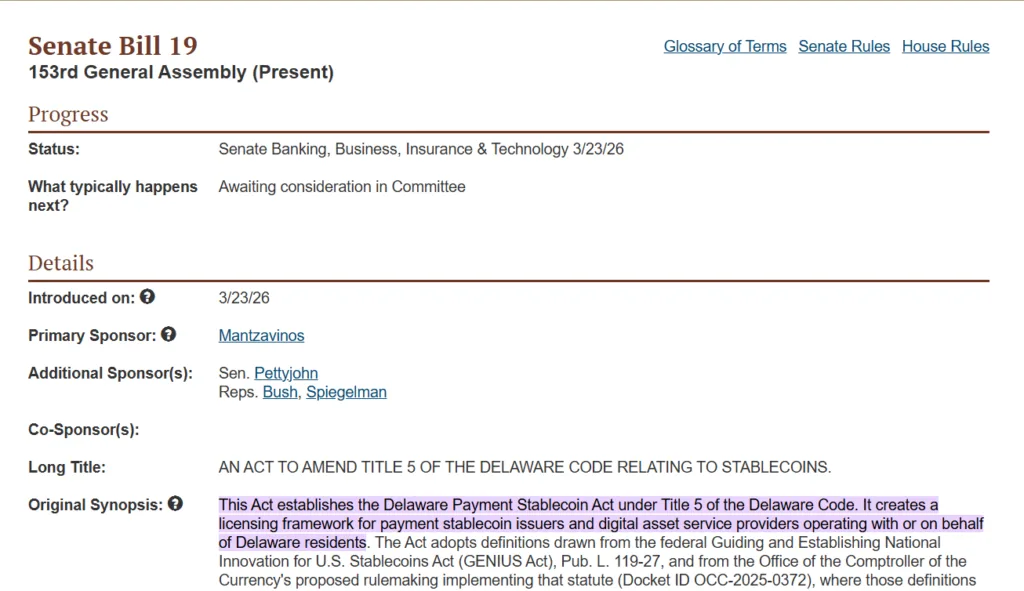
Delaware stablecoin regulation is making headlines as lawmakers move to bring stablecoins under a formal banking framework. On March 23, 2026, the state introduced two major bills that could reshape how digital dollars operate in the United States. At first glance, it looks like progress for crypto. Look closer, and a different story begins to unfold.
A simple idea that changes everything
Delaware stablecoin regulation starts with a simple promise. Make digital money safer and easier to use.
Lawmakers introduced Senate Bill 19, known as the Delaware Payment Stablecoins Act, alongside Senate Bill 16, a broader banking update. Together, they aim to modernize financial laws for a digital age.
The core idea is straightforward. Stablecoin issuers would need a license, clear rules, and strict oversight. Think of it like turning stablecoin companies into something closer to banks. But here is where things get interesting. This is not just about making crypto safer. It is about reshaping it.
When stablecoins start looking like banks
Under Delaware stablecoin regulation, issuers must hold full reserves for every token they create. If reserves fall short, they must fix it immediately or stop issuing new coins.
Users must be able to redeem their tokens within two business days under normal conditions. During heavy demand, that window can stretch to seven days.
There are also strict rules for identity checks, anti-money laundering controls, and reporting requirements. Companies must even build systems that allow authorities to freeze or block transactions when required. At this point, stablecoins start to look less like crypto and more like traditional bank deposits. This is the quiet shift most people are missing.

A strategic play hidden in plain sight
Delaware stablecoin regulation is not happening in isolation. It is carefully designed to match federal plans, especially the GENIUS Act. That matters more than it sounds.
The federal framework allows state-regulated issuers to operate, but only if they follow similar rules. Once an issuer grows beyond a certain size, around 10 billion dollars, it must move under federal supervision or scale down. This creates a clear pathway. Start in Delaware. Grow under state rules. Then transition to federal oversight.
In simple terms, Delaware is trying to become the starting point for stablecoin companies. Not the final destination. It is a smart play. Delaware used a similar strategy decades ago to become the credit card capital of the United States. Now it wants to do the same for digital money.
The risk most people are ignoring
Delaware stablecoin regulation is being sold as safety. And in many ways, it is. But there is a tradeoff. Redemption limits could slow withdrawals during market stress. If too many people try to cash out at once, delays may happen.
The requirement to freeze or block transactions introduces central control into systems that were designed to be open. And the shift from state to federal oversight adds another layer of uncertainty for growing companies. In trying to reduce risk, the system may be introducing new kinds of risk.
A bigger plan years in the making
This move did not come out of nowhere. Delaware has been exploring blockchain since 2017, when it allowed companies to use distributed ledgers for corporate records.
Today, financial services make up about nine percent of the state’s workforce, nearly double the national average. With this new push, Delaware is not just updating its laws. It is extending its long-standing strategy into the digital era. The message is clear. Delaware sees where finance is going, and it wants to be at the center of it.